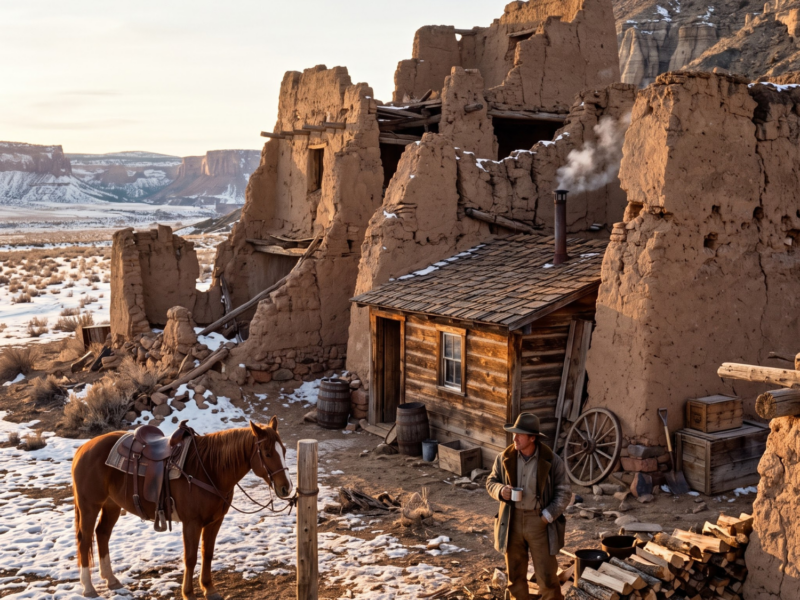
Neighbors Laughed When He Built a Cabin Inside Ancient Ruins — Until It Stayed 20 Degrees Warmer
Spring on the High Country
The transformation of Sable Creek did not happen overnight, but the urgency of survival is a powerful motivator.
By late February, the sounds of hammers ringing across the mesa had fundamentally changed. It was no longer the frantic, slapdash construction of the autumn. It was the measured, deliberate work of adaptation.
Silas Miller was the first to implement the changes. He and his sons built a sturdy vestibule onto the front of their home, sealing it tight. He spent three agonizing days packing mud-lime chinking into every seam of his walls from the inside, whitewashing over it to reflect the light.
Sarah, the widow, enlisted the help of the blacksmith to haul mesa stone, erecting a beautiful, curved thermal wall along the southern exposure of her shack.
The results were immediate and undeniable. When the final blizzard of the season swept through in early March, the town did not cower in terror. The average firewood consumption across the settlement dropped from a projected ten cords down to six. Families slept through the night without waking to tend desperately failing fires. Children stopped coughing.
Abigail Thorne recorded it all in her ledger, documenting a sharp decrease in school absences and a marked improvement in the overall health of the settlement. She titled her final winter entry: The Anatomy of Warmth: Lessons from the Ruins.
Spring finally broke over the high country in April. The snow retreated, leaving the buffalo grass damp and ready for the explosive, brief green of the alpine summer.
Elias Thorvald was no longer the outcast of the mesa. He was no longer the “ruin squatter” or the superstitious fool. When he walked down to the settlement to buy supplies, men tipped their hats to him. Silas Miller refused to let him pay for his coffee or his nails, keeping a running credit line that he swore he would never call in.
Elias had become the community’s informal architect, advising on the placement of new barns, the orientation of livestock sheds, and the compounding of natural plasters.
But Elias’s favorite place remained the quiet hillside.
One evening in late May, as the sun dipped below the jagged horizon, painting the sky in violent shades of crimson and bruised purple, Elias sat on his porch. The air was mild, carrying the scent of warming pine needles and damp earth.
He looked at the ancient Pueblo wall standing silently behind his cabin. The stones were warm to the touch, still radiating the heat of the afternoon sun.
The people who had built that wall were gone. Their names were lost to the wind, their language swallowed by time. But their wisdom had remained, encoded in the mud and the rock, waiting patiently for someone willing to read it.
Elias raised his coffee cup in a silent toast to the empty air, honoring the forgotten architects of the mesa. They had taught him that survival on the frontier was not about dominating the land with speed and iron. It was about listening to it. It was about understanding that true shelter doesn’t fight the elements; it dances with them.
And as the first stars pricked through the deepening twilight over the Territory of New Mexico, Elias Thorvald went inside his cabin, passed through his vestibule, and closed the door on a home that was built not just to exist, but to endure.









