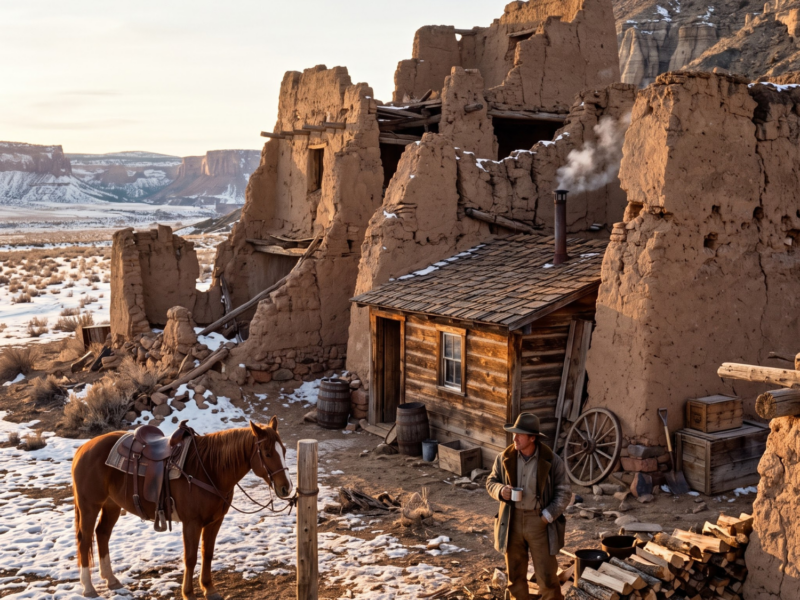
Neighbors Laughed When He Built a Cabin Inside Ancient Ruins — Until It Stayed 20 Degrees Warmer
The Architecture of Survival
For weeks, Elias became a fixture on the hillside, a solitary figure engaged in a slow, meticulous dance with the earth.
His first task was the foundation. He dug a rubble trench, twelve to sixteen inches wide and a foot deep, tracing a fourteen-by-eighteen-foot perimeter. He filled the trench with washed river stone hauled from the draw below. This was not merely a base; it was a drainage system. Moisture was the quiet assassin of frontier buildings, rotting sill plates from the bottom up. To ensure the water stayed away, he cut a swale into the upslope perimeter, an eight-inch depression with a precise two-percent fall, designed to channel snowmelt and summer monsoons away from his home.
His frame defied every convention of the settlement below. Where Silas and the others used thin lumber at sixteen-inch centers, Elias used thick two-by-four studs spaced twenty-four inches on center. The wider spacing reduced thermal bridging—the invisible pathway that allowed heat to conduct straight through the wooden skeleton of a house to the freezing air outside.
For his base, he used massive six-by-six juniper sills. They had been cut from dead-standing trees, seasoned for two years by the high-altitude sun, ensuring they would never warp or shrink. He laid them over flat rock piers, supporting a floor deck of thick planks.
When he began framing the roof, a 5/12 pitch to shed the coming snow, Abigail Thorne, the territorial schoolteacher, came walking up the hill. She carried a leather-bound notebook, a sharp contrast to the rough frontier around her.
“Mr. Thorvald,” she called out over the sound of his hammer. “May I inquire about your design? It is… unorthodox.”
Elias paused, resting his hammer against his leg. Miss Thorne was one of the few in the settlement who watched rather than judged. “It’s built for the wind, Miss Thorne. Look at the eave.”
He pointed to the leeward side of the roof, where the shingles extended eighteen inches past the wall. “It keeps the wind-driven moisture off the siding. But on the windward side, the eave is short. A long eave facing the gale acts like a sail. The wind will try to lift the roof right off the walls.”
Abigail made a quick note in her ledger. “And the structure on the front? It seems you are building a small room just for your door.”
Elias smiled. It was the feature that had drawn the loudest guffaws at Silas Miller’s store. “A vestibule,” he explained. “Three by five feet. It has two doors. An outer door facing east, and an inner door facing west.”
“To what end?”
“To keep the heat where it belongs. When you open a door in winter, the cold rushes in like water through a broken dam. In a single-room cabin, the temperature drops six to eight degrees every time you fetch wood. With a vestibule, I open the outer door, step in, and close it. Only then do I open the inner door. The house never meets the storm.”
Abigail’s eyes widened with genuine fascination. “A windlock.”
“Exactly.”
Before she left, she watched him mix his chinking. It wasn’t the haphazard mud the others slapped against their boards. Elias was mixing a specific recipe he had learned from a master mason on the Pecos River: two parts clay-rich soil, one part clean sand, a handful of chopped straw, and slaked lime. He worked the mud-lime putty meticulously into every gap between the frame members. It would cure hard, yet remain flexible enough to breathe, sealing out the wind while preventing the rot of trapped moisture.
“They call you a fool down there, you know,” Abigail said softly, adjusting her shawl.
“I know,” Elias said, packing the gray putty between the boards. “But a fool who sleeps warm is better than a wise man who freezes.”









