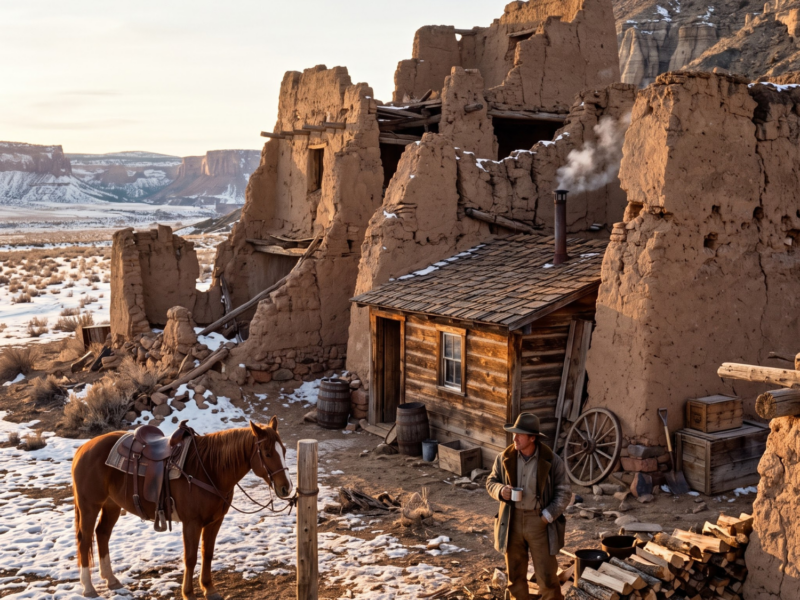
Neighbors Laughed When He Built a Cabin Inside Ancient Ruins — Until It Stayed 20 Degrees Warmer
The Fools of Autumn
By late October, the settlement was a chorus of smoking chimneys.
The homesteaders sat in their swiftly built shacks, burning their first fires, congratulating themselves on their efficiency. They had conquered the frontier in three weeks flat. They had invested their money in factory-milled boards and iron nails, rejecting the heavy, laborious earth as something belonging to the past. Speed was their god; convenience was their religion.
Down in the valley, Silas Miller had stockpiled ten cords of wood behind his cabin. He had hired men to chop whatever they could find—green pine, wet cottonwood, twisted brush. To Silas, wood was wood. It burned, didn’t it?
Elias, meanwhile, was applying the interior plaster to his cabin. It was an arduous, filthy process. He mixed clay, sand, straw, and fresh cow dung—the ancient Pueblo binder that provided plasticity and immense fiber strength. He applied a thick scratch coat over the interior walls, combing it with a wooden trowel to give it tooth, followed by a smooth finish coat that he painted with blinding white limewash.
The result was stunning. The interior of the cabin glowed, the white walls reflecting the light from his single, carefully positioned south-facing window. He had cut no windows on the north face at all; a north window in this country was just a hole where the warmth bled out to die.
He had gathered his firewood back in the summer. Five and a half cords of pure piñon and juniper, split into wrist-thick billets, two to three inches across. He had let them season for months. They would burn clean, hot, and smokeless. He needed far less wood than his neighbors because his house was designed to hold the fire’s gift, rather than let it escape through the walls.
In total, Elias had spent twenty-eight dollars on materials, and endless hours of sweat. His neighbors had spent the same money, but minimal labor.
As November swept in, carrying the first hard frosts that dusted the buffalo grass with diamond-hard ice, the mockery from the town continued. They pointed at the strange, mud-plastered cabin hiding behind the ancient ruins, lacking the grand east-facing windows and the towering profiles of their own homes.
But Elias felt the deep, resonant quiet inside his walls. When the autumn winds howled, rattling the tar paper on the shacks below, Elias’s cabin was silent. The massive 24-inch-thick ancient adobe wall standing just three inches from his siding absorbed the brunt of the kinetic energy of the wind.
The board was set. The pieces were in place. Now, the sky would make its move.









