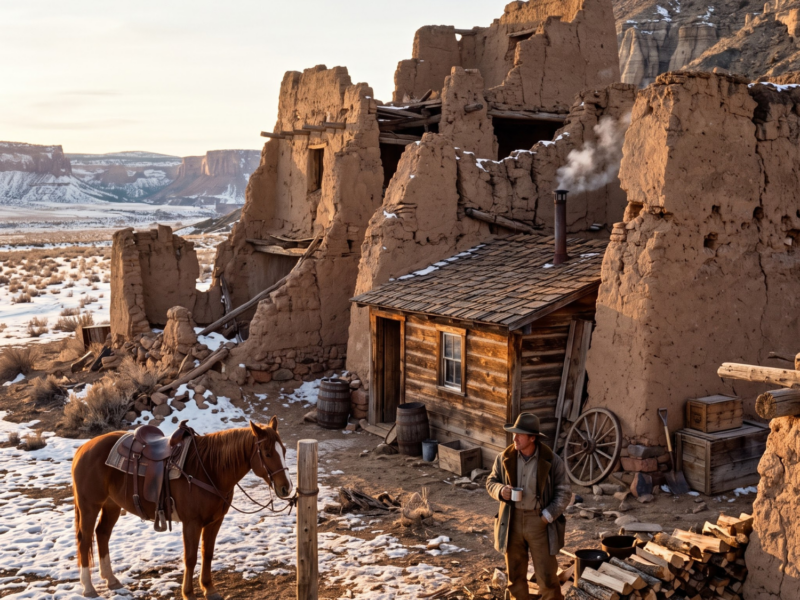
Neighbors Laughed When He Built a Cabin Inside Ancient Ruins — Until It Stayed 20 Degrees Warmer
The Freezing Dark
The dark hours of the early morning are when the body’s defenses are at their lowest, and when the cold is at its most predatory.
Inside the Miller household, the fight for warmth had been lost. Silas was exhausted, his face smeared with soot, his eyes red and tearing from the green wood smoke backing up into the room. The wind across his chimney was creating violent back-pressure, stalling the draft and puffing smoke back into the living space. They were suffocating to stay warm.
The interior temperature of the shack had dropped to twenty-six degrees.
Silas walked to the wash basin to splash water on his stinging eyes. He struck the surface of the water with his knuckles. It was frozen solid. An inch of hard ice covered the water they kept inside their home.
He looked at the walls. Frost—thick, white, and crystalline—was forming on the interior wood, creeping up the studs a mere three feet away from the roaring, red-hot cast-iron stove. The air infiltration was running at ten full air changes per hour. They were burning a cord of wood a week just to freeze slightly slower than the outdoors.
His youngest son coughed, a deep, rattling sound that tore at Silas’s chest. His wife’s fingers, clutching the quilts, were stark white at the tips—the first, undeniable signs of frostnip.
Panic, cold and absolute, gripped the storekeeper. He had built for speed. He had trusted the inventory of his store to save him. He had laughed at the mud.
At that exact moment, Elias Thorvald woke up, stretched, and walked across his cabin in his stocking feet.
The indoor temperature was forty-six degrees. Cool, certainly, but highly survivable. His breath did not fog in the air.
He opened the inner door of his vestibule, stepped into the airlock, and closed the door behind him. He opened the outer door. The wind shrieked, trying to claw its way inside, but it hit the closed inner door and died. Elias grabbed an armful of wood from the dry stack he kept in the vestibule, stepped back, closed the outer door, and only then re-entered his home.
He had lost perhaps two degrees of ambient heat.
He fed three sticks of dry piñon into the stove. The flames caught immediately, burning clean, hot, and blue. The mud-lime chinking in his walls held firm, flexing imperceptibly with the pressure but refusing to let the wind pass.
Elias sat back down, pouring water from a liquid pitcher into an iron kettle, and set it on the stove to boil. He listened to the storm rage against the ancient stones outside, feeling a deep, profound respect for the ghosts of the Pueblo builders who were, even now, shielding him from the wrath of the sky.









