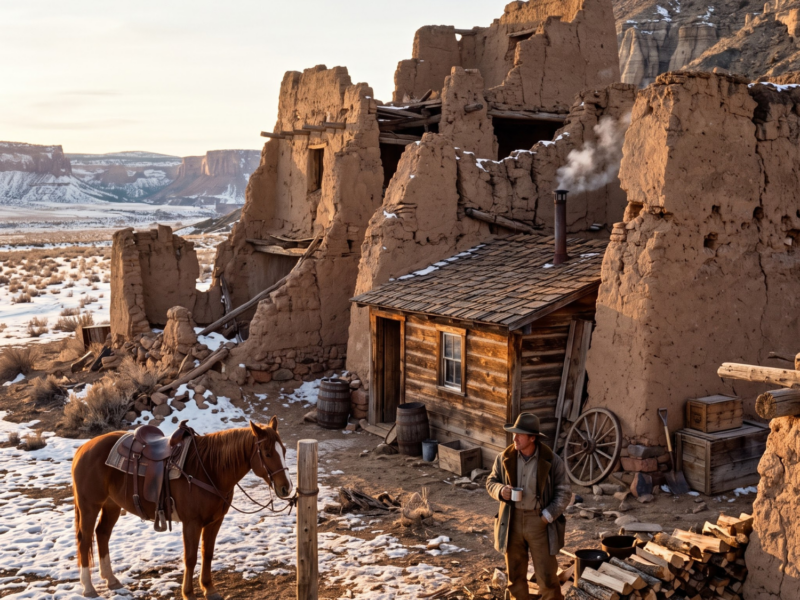
Neighbors Laughed When He Built a Cabin Inside Ancient Ruins — Until It Stayed 20 Degrees Warmer
The Deception of January
The morning of January 15, 1889, was a liar.
It dawned clear, bright, and deceptively warm. By noon, the mercury thermometer nailed to Elias’s covered porch read forty-two degrees in the shade. The ancient ruin wall, basking in the unobstructed southern exposure, was drinking in the solar radiation like a massive, thirsty sponge. If a man placed his hand against the centuries-old sandstone, he would feel a surface temperature pushing seventy degrees. It was a monumental thermal battery, charging itself for the darkness to come.
Down in the settlement, doors were flung open. Men walked in their shirtsleeves. Children chased a rag ball through the muddy ruts of the main street. Inside the thin board-and-tar-paper shacks, temperatures flirted with the low fifties. It felt like an early, unearned spring.
But in the small schoolhouse, Abigail Thorne was looking at her barometer.
As the county superintendent required, she maintained a meticulous daily weather log. When she tapped the glass dial at two o’clock in the afternoon, she frowned. The needle was dropping. It wasn’t a slow, creeping decline; it was plummeting, sliding down the dial as if the atmosphere itself were collapsing.
She walked to the window and looked west. Old-timers who had weathered decades on the high plains knew the signs. There was a particular, sickly yellow quality to the light on the horizon. The livestock in the valley had stopped grazing; they were bunching tightly together, turning their hindquarters toward the northwest, seeking the meager shelter of shallow ravines.
An uneasy, suffocating stillness fell over the mesa. The birds vanished.
By four o’clock, the sky tore open.
The first wisps of high cirrus clouds streamed in from the northwest like skeletal fingers reaching across the blue. And then, the temperature began its terrifying freefall.
Within two hours, the mercury dropped thirty degrees. The false spring was violently assassinated by the howling vanguard of a “Blue Norther.”
A Blue Norther was the apex predator of the high plains weather system. It was a massive, fast-moving cold front capable of driving temperatures down fifty degrees in a matter of hours, backed by cyclonic winds that turned every snowflake and grain of ice into a projectile. It was a storm that separated the survivors from the casualties.
Up by the ruins, Elias was splitting kindling when the first gust hit. It didn’t feel like wind; it felt like a physical blow from a heavy wooden plank. He didn’t panic. He calmly gathered his tools, carried a basket of his seasoned piñon billets inside, and initiated his protocol.
He closed his heavy wooden shutter over the south window, locking it tight. He unrolled the oiled muslin over the interior glass. He stepped through his vestibule, ensuring the outer door was firmly latched before opening the inner one.
Inside, the cabin was a fortress of tranquility. His stovepipe damper was set for a clean, slow burn. The firebox crackled with the dry, resinous heat of the juniper. The whitewashed mud walls glowed a warm gold in the lantern light. The thermometer on his interior wall read a steady fifty-eight degrees.
He poured himself a cup of coffee, sat in his rocking chair, and listened to the distant roar of the wind breaking itself against the ancient Pueblo wall outside.
Down in the valley, however, the nightmare was just beginning.









