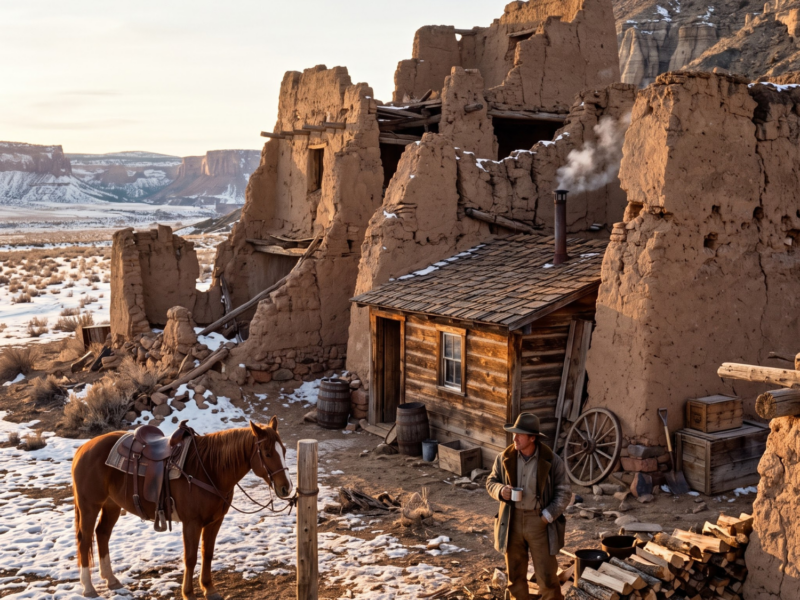
Neighbors Laughed When He Built a Cabin Inside Ancient Ruins — Until It Stayed 20 Degrees Warmer
The Physics of Fire and Earth
Saturday afternoon brought a weak but clear sun to the high mesa.
Gathered in the snow near the ancient ruins were seven families. The blacksmith was there, his leather apron wrapped tight against the cold. The widowed rancher, Sarah, stood with her two children. Abigail Thorne stood at the front, her ledger open, pencil poised. And Silas Miller stood beside his wife, watching Elias intently.
Elias had set up a simple demonstration on a wooden table.
He had constructed two small wooden boxes. One was built like the town’s shacks—boards nailed together with slight gaps between them. The other box was built tightly, its seams meticulously packed with the gray mud-lime chinking he had used on his cabin.
“The problem isn’t your stoves,” Elias began, his voice carrying clearly over the crisp air. “Your stoves are fine. The problem is your walls. You are trying to heat the wind.”
He placed a lit candle inside the first, gapped box. He then used a hand-bellows to blow air toward it. The candle flame danced wildly, flattened out, and nearly extinguished.
“In your homes, the wind strikes the windward wall, creating pressure. It forces cold air through every gap, nail hole, and seam. At the same time, it sucks the warm air out the other side. During the norther, your homes were exchanging their entire volume of air ten times an hour. You were heating the outside.”
He moved the candle to the sealed box and blew the bellows with the same force. The flame inside barely flickered, burning tall, steady, and bright.
“Mud-lime chinking,” Elias said, tapping the sealed box. “Two parts clay, one part sand, straw, and slaked lime. It seals the air leaks but lets the timber breathe so it doesn’t rot. It reduces your air changes to one or two per hour. It keeps the heat you bleed for inside the room.”
A murmur of realization rippled through the gathered crowd. It was so simple, yet so profoundly ignored in their rush to build.
Elias then picked up a dark adobe brick from the table. He had left it sitting in the direct sunlight for the last three hours. He walked over to Silas and placed it in the storekeeper’s bare hands.
Silas gasped softly. “It’s warm.”
“It’s thermal mass,” Elias explained to the crowd. “Wood is an insulator, but it has no mass. It cannot store heat. Earth and stone can.”
He pointed to the towering ruins behind his cabin. “Those builders generations ago knew that twenty-four inches of adobe facing south will soak up the sun’s radiation all day long. When the sun goes down and the air turns freezing, that wall slowly releases the heat it collected. It acts like a giant, invisible stove.”
He turned to the widowed rancher, Sarah. “Your shack is freezing because it has no mass. Gather stone from the mesa. Build a free-standing half-wall, two feet thick, along the south side of your home. Leave a two-inch gap so it doesn’t trap moisture against your wood. Let the sun hit it. It will cut your firewood needs by a third.”
The blacksmith raised his hand. “And the doors, Elias? You built a whole extra room just for your door.”
“A vestibule,” Elias nodded. “A windlock. Every time you open your front door to the storm, you lose eight degrees of heat instantly. A vestibule means the wind never touches your living space. Build one. It takes a few boards and an extra day, but it will save you a cord of wood a month.”
For the next two hours, Elias stood in the snow and answered every question. He gave them the exact recipe for the mud-lime mortar. He showed them how to tighten their nail spacing from eight inches down to six to prevent wind-lift on the siding. He explained why large east-facing windows were a liability, and why a small south-facing window with an oiled muslin cover was a necessity.
He didn’t speak to them as a superior. He spoke to them as a man translating the ancient, silent language of the stones behind him.









