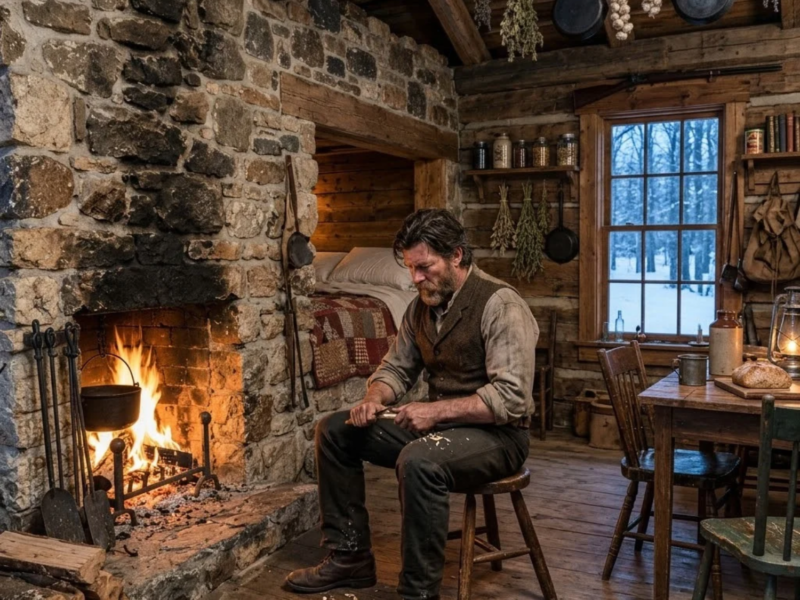
Neighbors Mocked His Frontier Cabin With No Bedroom — Until They Found His Bed Inside the Stove Wall
The Laughter of Cottonwood Draw
For the next week, Silas changed his design three times. He built small, crude test channels from scrap brick out in the dirt behind the cabin, burning handfuls of cottonwood twigs inside them to study the draw. He held a frayed strip of wool cloth near each exit opening, watching how the smoke pulled or stalled. When a sharp bend choked the draft, he knocked the bricks apart with a mallet. When another configuration drew cleanly, he measured the width with a notched cedar rule and copied it onto his master plank.
Nothing about the process looked impressive to passersby. It looked like a grown man kneeling in the dirt beside smoking little brick boxes while his actual house stood half-finished and roofless behind him.
That was when the local jokes began.
Harvey Cole rode over with two neighbors one crisp Tuesday morning to help lift the heavy oak roof timbers into place. Harvey entered the half-built cabin, carrying one end of a hand-hewn beam, and stopped dead beneath the rafters, his eyes scanning the open floor plan.
“Where’s the back room, Silas?” Harvey asked, grinning.
Silas pointed his chin toward the towering stone mass on the north side. Harvey looked where he pointed. “I see the stove.”
“That’s where we’re going to sleep.”
Harvey lowered his end of the timber with a heavy thud. One of the other men coughed into his fist to hide a snicker. Harvey walked closer to the stone wall, running a calloused hand over the rough mortar. “What, are you putting beds in the chimney now?”
Silas hoisted his end of the beam again, his shoulder muscles bunching under his shirt. “Something like that.”
The laughter followed them out into the bright yard.
By suppertime, half the valley had heard the rumor that Silas Mercer was building a cabin where his family would sleep inside the stove. The description mutated and improved each time it traveled. By Sunday, a man at the dry-goods store claimed Silas intended to suspend little Caleb directly over the firebox like a ham in a smokehouse. By Monday, a woman swore that Ruth had packed her bags and threatened to leave before the first snow fell.
Neither rumor was true. Ruth stayed, but she began inspecting the stone wall every single evening with the thoroughness of a bank examiner.
She ran her fingertips along the fresh, damp mortar joints, hunting for hairline gaps. She watched for places where floating sparks might collect. She asked how the deep interior soot would ever be cleaned out once the stones were locked in place. She asked what would happen if a heavy winter wind choked the chimney draft during a dead calm.
Silas answered whatever questions he had solutions for. When he didn’t know, he simply said so—and then immediately set about changing his design.
He incorporated two heavy, removable flat stones into the upper masonry so the inner passages could be accessed and brushed clean of soot. He placed the designated wooden sleeping platform three feet farther from the firebox than his original sketch dictated. He lined the hottest combustion zone with high-heat firebrick instead of porous fieldstone, and beneath the flagstones of the sleeping bench, he packed several inches of dry, sifted mineral sand to disperse the heat evenly across a wider surface area.
Caleb watched every step of the construction. One bitterly cold morning, when the wind whistled through the open door frames, the boy pressed his small hand against the unfinished stone bench.
“It’s just rock for now,” Silas murmured, pausing with his trowel.
Caleb looked from the cold stone toward the small iron firebox. “Will it get hot? Warm? How warm?”
Silas paused, the mortar dripping from his tool. “Enough, I hope.”
That small, fragile answer followed Silas for the rest of the day: Enough. Enough heat. Enough draft. Enough stone, and enough time before the winter roads closed for good.
On October 6th, a sharp frost whitened the grass before sunrise. On October 9th, thin sheets of ice formed in the livestock watering trough. And on October 12th, Warren Pike rode by again. This time, the rancher dismounted, tying his gelding to the wagon wheel.
The cabin now had a shingled roof, and the front door hung straight on its iron strap hinges. A thin ribbon of blue smoke rose from a temporary sheet-metal stovepipe Silas had rigged while finishing the permanent masonry system.
Warren stepped inside without removing his leather gloves, his gray eyes sweeping the spare, orderly interior. “One room,” Warren noted, stating the obvious.
Silas nodded, working a file across a saw blade.
Warren pointed a gloved finger toward the massive stone structure dominating the north wall. “That thing cost you enough floor space for another room.”
“It did.”
“Could’ve built a proper bedroom with a wood stove.”
“Could have.”
Warren stepped closer, tapping the broad stone bench that now extended three feet out from the masonry. It was long enough for a growing boy and two adults to lie side by side. Warren knocked his knuckles against the flags. “So this is it?”
“This is it.”
Warren bent down, studying the small iron firebox and the clean joints. “You sleep over them, not in them. The heat travels through the wall first.”
“That’s the theory.”
Warren straightened up, watching the temporary pipe smoke drift out into the gray sky. “Theory is a fine thing, Silas. But warm stone won’t matter a damn if that chimney quits pulling when a nor’wester hits.”
He turned on his heel and left without another word.
That evening, Silas didn’t touch his plate of salt pork and beans. He carried his tin plate outside, sitting silently on a chopping stump while the October darkness filled the low swale around the cabin. The ridge disappeared first, swallowed by the purple twilight, then the yellow grass, then the woodpile.
Ruth came out quietly, carrying his wool coat. She draped it across his narrow shoulders without speaking a word.
Silas stared up into the deepening gloom toward the hidden chimney top. “I need another draft path,” he muttered into the dark.
Ruth leaned against the rough door frame, her silhouette sharp against the warm lamplight within. “You already have one.”
“I need one that doesn’t depend entirely on the long channel. If the main route chokes, we’ll suffocate in our sleep.”
He went back inside. Before midnight, a brand-new, frantic sketch covered the pine table. The normal route still carried the hot gases winding through the stone labyrinth, but Silas added an emergency secondary route controlled by a small iron damper. If the long, torturous masonry passage ever clogged with soot or suffered a reverse draft, he could flip the damper and send the smoke almost directly up into the chimney stack.
It would waste the precious heat, certainly. But it could also clear a smoking room in seconds.
For three frantic days, Silas tore down and rebuilt the upper section of the stone wall. The autumn cold deepened noticeably while he worked; his fingers split and bled at the knuckles, the lime mortar stiffening in the wooden bucket before noon.
Caleb carried warm water from the cookstove in a tin pail to help keep the mix workable, while Ruth carefully warmed the bricks over an open fire before Silas set them in place with the mallet.
Nobody in Cottonwood Draw joked inside the cabin anymore. But outside, the whisper campaign continued. Harvey Cole passed on horseback one afternoon, calling toward the open door: “Mercer, you find your bedroom yet?”
Silas never looked up from his trowel. He simply pressed another brick into the mortar, sealing his silence against the wind.









