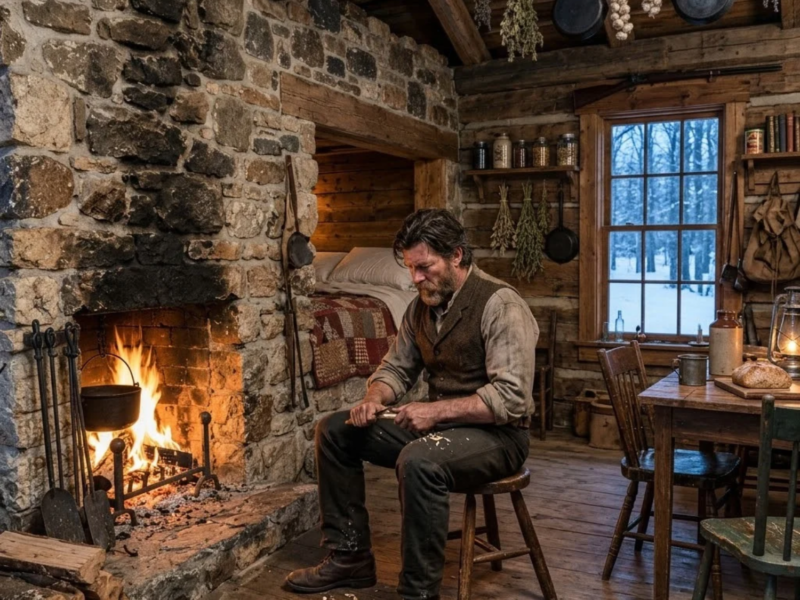
Neighbors Mocked His Frontier Cabin With No Bedroom — Until They Found His Bed Inside the Stove Wall
The Anatomy of a Flaw
At first light, Ruth found Silas already kneeling beside the stone bench with a tallow candle. He held the flickering flame close to the mortar joint where the smoke had forced its way out hours before.
The flame leaned toward the wall, dancing erratically. Silas moved the candle slowly along the seam until, at one specific spot, the flame flickered violently and leaned sideways. He marked the spot with a piece of charcoal. Then he checked another inch to the left, marking a second spot.
Ruth watched from the pine table, her arms wrapped around her waist. “You’re testing it again?”
Silas did not turn around. “I’m finding out where it failed.”
“It failed right where our boy was sleeping.”
His hand stopped. The candle flame shook once in the draft. Then he set the tin holder down on the flags. “I know.”
Ruth crossed the room, her boots clicking softly on the pine boards. Her voice stayed low, devoid of anger. “Then don’t fix it just because the men in town laughed at you.”
Silas looked up, his eyes bloodshot. “I’m fixing it because I can’t let it kill my son.”
“Fix it only if you can make it safe,” she said, holding his gaze until he slowly nodded.
That morning, the sleeping bench came apart. Silas removed the quilts first, then the heavy oak frame supporting the bed, and finally the flat flagstones themselves. By noon, half of the interior masonry wall lay in numbered, chalk-marked piles scattered across the cabin floor.
Caleb sat quietly at the table with a blanket draped over his shoulders, watching his father dismantle weeks of agonizing labor. The boy didn’t ask many questions, which somehow made Silas work even more slowly and deliberately.
The leak was not where Silas originally suspected. The outer mortar joint had indeed cracked under thermal stress, but the deeper, more dangerous problem sat several inches behind the face.
One heavy interior stone within the primary smoke channel had shifted and rotated during the expansion cycles of the first big burn. It hadn’t moved much—less than the width of a man’s finger—but that microscopic movement had pried open a hidden fracture corridor leading straight toward the sleeping side of the wall.
Silas stared into the dark gap, turning the problem over in his mind. The answer was glaringly obvious in hindsight: He had built the inner stones too tightly together. When the masonry absorbed the intense heat of the fire, the rocks expanded massively, pushing against one another with immense geological force. Something had to give, and an unyielding stone wall will always find the weakest seam to crack.
Ruth crouched beside him in the rubble. “Can you stop it from happening again?”
Silas picked up the offending stone, turning its sharp edges over in his calloused palm. “Not by putting it back the same way.”
That afternoon, Warren Pike happened to ride past the cabin. Seeing stones scattered across the floor through the open doorway, the rancher dismounted without being invited and walked inside. Silas braced himself for another round of grim warnings, but Warren offered none.
The older man removed his heavy leather gloves, knelt in the debris beside the open channel, and whistled softly. “Show me.”
Silas pointed to the shifted stone. Warren leaned closer, squinting through the gloom. “Heated up and walked right on you, didn’t it?”
“A little.”
“A little is all it takes,” Warren grunted, sitting back on his heels. “My father used to build stone bake ovens back in Ohio. He always left a little breathing room around any iron or timber that crossed the masonry.”
Silas looked at him, his brow furrowed. “Breathing room?”
“So the stone can move without breaking its neighbor. So the heat doesn’t push against something that refuses to yield.”
The idea was almost insultingly simple. Silas picked up the inner stone again, turning it over. Instead of rebuilding the internal flue as one rigid, locked mass of rock and mortar, he needed to leave calculated, microscopic expansion spaces where the hottest masonry met the cooler outer shell—not open gaps, but controlled, engineered buffers packed with a compressible material that could absorb the violent thermal expansion of the stone.
He had wool scraps, fine sand, and dense river clay.
For the next two days, the cabin became a chaotic laboratory. Silas constructed small, experimental test sections beside the operating stove. One section used packed sand as a buffer; another used a loose clay-and-fiber mix; a third utilized a narrow, deliberate gap filled with dry mineral grit harvested from the creek bank.
He heated each test section with a blowtorch-like bundle of twigs, let it cool completely, and then heated it again, watching for stress fractures.
Ruth marked the results on a flat cedar board with chalk: Sand shifts too easily under load. Clay mix barks too hard when fired. Creek grit stays firm, but yields slightly when the stone expands.
Silas rebuilt the critical section surrounding the first channel bend using that narrow, grit-packed buffer. Furthermore, he re-engineered the interior geometry: he made the first major turn inside the wall wider—not enough to ruin the thermal draw, but just enough to reduce the choking pressure at the precise corner where the smoke had stalled and backed up during the windshift.
On the second afternoon of the redesign, Warren returned, bringing Otto Weiss with him.
Otto was seventy-two years old, walking with one shoulder permanently lower than the other from a lifetime of setting stone foundations, well walls, bakery ovens, and massive commercial chimneys across the frontier. The old stonemason stepped inside the Mercer cabin, removed his flat cap, and stood silently before the open, half-rebuilt stove wall.
His faded blue eyes swept over the stones, pausing at the numbered chalk marks Silas had scrawled. “You took it apart carefully,” Otto observed, his voice like grinding gravel.
“I wanted to know what moved,” Silas replied.
“That’s better than breaking it in anger,” Otto grunted, crouching slowly with a groan of old joints. His knuckly fingers traced the inside of the new channel. “You made this from memory?”
“Yes.”
“Whose?”
“My mother’s uncle. Back east.”
Otto looked over his shoulder, his eyes sharp. “And where did he learn it?”
“Germany, I expect.”
Otto turned back toward the wall. For the first time, a toothless, genuine smile cracked his weather-beaten face. “Then somebody in your family carried a warm house a very long way across the water.”
The smile vanished instantly when his fingers reached the tricky middle bend. He tapped the inner stone twice with a small iron chisel. “Here is your trouble.”
Silas pointed proudly to his newly engineered expansion space. “I changed it. Added a buffer.”
Otto examined the repair closely, squinting through the dim light. “Better. Not good. Not safe. Only better.”
Silas bristled slightly at the word choice.
Otto sat down on the edge of the bare wooden floor, warming his stiff hands near the temporary iron stove. “These old stove walls were never built to just one rigid design,” the old mason explained, gesturing with a tobacco-stained thumb. “Men changed them from village to village, valley to valley. Different stone, different wood, different chimney heights.”
Silas listened intently.
Otto nodded toward the frozen window. “And a different wind. Cottonwood Draw doesn’t behave like Pennsylvania, Mercer. The wind here strikes harder. It changes direction faster. It drops over that north ridge and pushes straight down against your chimney mouth with the weight of a freight train. A chimney that draws like a dream on a calm October afternoon will choke and die at midnight when a blizzard hits.”
Otto stood up with another grunt. “Show me your chimney outside.”
The men stepped out into the freezing bite of the yard. Otto walked slowly in a circle around the cabin, tipping his head back to study the roofline. The metal stovepipe rose a few feet above the shingles, but terminated just below the crest of the nearby grass ridge.
Otto narrowed his eyes. “Too short.”
Silas followed his gaze. “It draws fine today.”
Otto pointed an accusing finger toward the north ridge. “When the winter wind comes down from there, it rolls right over your roof like a wave. Some of that crushing air pressure pushes straight down into your chimney mouth, fighting your fire.”
Warren Pike looked sideways at Silas. “Looks like the wall may not be your only problem, Mercer.”
Silas said nothing, his mind racing. He didn’t argue. Instead, he was already calculating precisely how many firebricks and lengths of pipe he had left in the lean-to.
By sunset, the cabin’s exterior chimney stood a full two feet taller, reinforced with a sturdy masonry collar. Silas added a simple, vented stone cap designed to deflect the downward-plunging air currents without choking the internal draft.
Then he lit a small, cautious fire in the firebox. The smoke rose cleanly, vanishing into the gray dusk without a single stutter.









