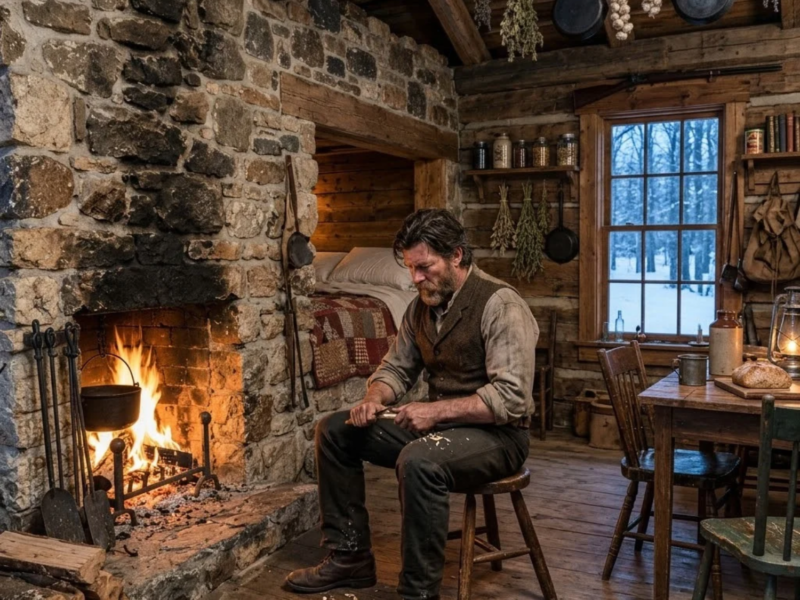
Neighbors Mocked His Frontier Cabin With No Bedroom — Until They Found His Bed Inside the Stove Wall
The Blizzard of '88
For the next six days, Silas tested the system with obsessive, relentless paranoia.
Nobody slept on the stone bench. Silas tested the wall during a dead calm, during an unexpected eastern blow, and during a hard, freezing west wind. He tested it with a tiny, smoldering fire, then loaded the firebox with pitchy pine to force maximum thermal stress.
He let the stones heat for hours, cool completely to ambient room temperature, and then heated them again. Every single morning, he checked the mortar joints inch by inch with a flickering candle flame. Every single evening, Ruth sniffed the air near the wall before tucking Caleb into bed.
No smoke appeared. The expansion buffers absorbed the thermal shift; the wider bend handled the pressure; the taller chimney mocked the ridge drafts. Still, Ruth kept their spare bedding piled on the wooden floor on the opposite side of the room. Silas didn’t ask her to move it back.
On the seventh night, the temperature plummeted below fifteen degrees. The cabin floor turned painfully, bitterly cold after sunset, the uninsulated pine boards acting like blocks of ice.
Caleb sat in a wooden chair with both stockinged feet tucked securely beneath him, watching the warm stone bench from across the room with wide, wistful eyes. “Can I sleep there again tonight, Papa?”
Ruth stopped folding a blanket, her hands freezing over the fabric. Silas looked toward the masonry wall. It had held through nearly a week of punishing tests. The chimney drew with a steady, musical hum. The repaired section showed no microscopic shifting whatsoever. Yet he hesitated, remembering the choking gray thread of smoke from a week prior.
He pulled a chair up beside Caleb, his voice gentle. “Not tonight, son.”
The boy nodded obediently. He didn’t complain. But then he was seized by a sudden, violent fit of coughing, barking twice sharply into his sleeve.
Silas looked toward Ruth. She had heard it too, and her jaw tightened in silent agony.
The very next night was colder still. By midnight, thick, opaque ice covered the lower half of the cabin window. The temporary sleeping pallet near the wooden wall held little heat now that the evening fire had burned down to embers, and Caleb curled tighter and tighter beneath his quilts, shivering.
Silas lay awake beside him on the cold floorboards, staring across the room. The stone bench was still warm from the evening burn; he could see its faint, dark outline radiating a soft, gentle aura in the weak orange glow of the dying coals.
Warmth sitting entirely unused, just three steps away.
Near dawn, Caleb began coughing again—not from smoke this time, but from the creeping, skeletal fingers of cold air leaking in around the door sill. Ruth sat up instantly, rubbing the boy’s bony back in frantic circles until the coughing spasms finally eased.
Then she looked across the room at the warm stone bench. Silas followed her eyes.
Neither spoke a word.
The next evening, without asking permission, Ruth moved Caleb’s pillow herself. She placed it squarely on the center of the stone bench. Silas stood near the table, his hands clenched. “Are you sure?”
Ruth pressed her bare palm flat against the masonry. Then she systematically checked the inspection opening, the bypass damper, and tested the chimney draft with a fluttering strip of paper.
Only after completing her ritual inspection did she spread the thick patchwork quilt over the stone. “No,” she said softly, looking up into Silas’s worried eyes. “I’m not sure of anything. But the cold has already proved precisely what it can do to our boy.”
Caleb climbed onto the bench, sinking gratefully into the warmth. Silas kept the fire smaller and safer than usual that night, checking the wall twice before midnight.
At one o’clock, the stone stayed perfectly warm. At three, the outer room had cooled down significantly, but the sleeping surface still held a deep, comforting reservoir of heat. Caleb hadn’t coughed once.
Before sunrise, Ruth woke and placed her palm gently against the boy’s back. His breathing stayed calm and even beneath the heavy quilt. She left her hand resting there for several long seconds. Silas watched from the other end of the bench.
Nobody celebrated. They simply repeated the quiet risk the next night, and the night after that. A week passed. Then two.
By early December, the miracle they had prayed for manifested: Caleb stopped waking before dawn with his chest rattling. His cheeks carried a healthy, natural color at breakfast. He even began running outside after a fresh snowfall without Ruth shouting for him to come back inside within minutes.
The stone wall officially transitioned from a dangerous experiment into the beating heart of the family’s daily routine. A strong evening fire charged the masonry with thermal energy; the fire burned down to ash; and the stone gave that heat back steadily through the long, freezing hours of the night.
The neighbors, however, began noticing something else entirely.
The Mercers were burning drastically less wood.
Harvey Cole noticed it first. The local farmer came over one sub-zero morning to borrow a heavy hickory axe handle. Silas opened the door, and Harvey stepped inside, stopping mid-stride as his eyes widened.
The room was warm. Not stiflingly hot, not choked with smoke—just comfortably, evenly warm. Yet the iron firebox held only a scattering of dead gray coals.
Harvey looked suspiciously toward the wood basket by the door; it was nearly full, untouched since yesterday. Then his eyes drifted to Caleb, who sat barefoot on the stone bench eating a thick slice of buttered bread.
Harvey stared at the bench, comprehension dawning on his weathered face. “So… that’s the bedroom.”
Caleb looked up, chewing. “Part of it.”
Harvey stepped closer, holding one palm suspended a few inches above the stone, then pressing it flat against the surface. His heavy eyebrows shot straight up toward his hairline. “How long has it been since you fed the fire?”
Silas glanced casually toward the frost-covered window. “About five hours.”
Harvey kept his hand flat on the stone, absorbing the lingering heat. The old, cynical jokes had nowhere left to go. Without another word, he picked up the borrowed axe handle from the table and walked out of the cabin, forgetting to say goodbye.
Three days later, two more curious neighbors visited. Then Warren Pike stopped by. Then a weary woman from a farm south of the creek whose youngest daughter had been coughing through every sub-zero night.
Nobody called the cabin foolish anymore.
Yet Silas steadfastly refused to tell anyone the wall was fully proven. He showed every visitor the emergency bypass damper. He showed them the removable inspection stones. He showed them precisely where the first internal channel had failed. He even kept the jagged, cracked piece of mortar resting on a shelf above the table like a trophy of failure.
When Harvey Cole asked why on earth he saved a piece of trash, Silas handed it to him without hesitation. “That’s the part worth remembering.”
Outside, the winter continued to build its frozen empire. Snow covered the low fields in blinding white dunes; the creek froze solid from bank to bank; and by Christmas, woodpiles all across Cottonwood Draw were shrinking at an alarming rate, consumed by inefficient, roaring stoves.
Then, during the first week of January, Warren Pike rode up to the Mercer cabin just before dark.
Thick icicles hung from his gray beard; his horse’s flanks were sheeted in white frost. Silas threw the door open, and Warren stumbled inside, tearing off one stiff leather glove. He skipped the pleasantries entirely, walking straight to the pine table.
“Storm coming,” Warren announced, his chest heaving.
Silas looked toward the small window. The sky had been a clear, deceptive blue all afternoon. “From the west?”
Warren shook his head grimly, pointing a thick finger toward the north. “Northwest.”
Silas’s eyes snapped toward the stone wall. That was the exact wind direction that had forced smoke past the mortar joints during their first near-disaster.
Warren saw him look. “Temperature is supposed to fall off a cliff after midnight.”
“How cold?”
Warren rubbed his stiffened fingers together, his face grim. “Cold enough that nobody’s going to want a door open if a chimney starts smoking.”
Behind them, Caleb climbed up onto the warm stone bench, pulling a thick woolen quilt over his legs.
Outside, the very first vanguard of the gale struck the north wall of the cabin hard enough to make the window glass rattle in its frame. Caleb stopped pulling the quilt over his knees, his eyes widening in the dim light.
Silas crossed the room in two strides, pressing his open palm flat against the north masonry. The stone felt reassuringly steady and warm, and the firebox gave off a low, comforting orange glow.
Warren stayed near the table, his ears tuned to the sound of the metal flue. A deep, steady pull murmured through the iron.
Then a second gust struck—longer, harder, and meaner than the first. The faint flame inside the firebox bent sharply sideways. Silas instantly dropped to his knees, opening the inspection stone nearest the first channel bend. No smoke billowed out. He slammed it shut again.
Ruth quietly lifted the heavy water kettle from the table, moving it closer to the stove to stabilize the thermal mass. “How long before it gets worse?” she asked quietly.
Warren looked toward the frozen window, listening to the rising shriek of the wind. “Could be an hour. Could be ten minutes.” He pulled his heavy glove back over his hand. “I need to get home before the trail blows shut.”
Silas stepped toward the door. “I’ll help you saddle your gelding.”
Warren caught his forearm in a tight grip. “You stay here, Silas.”
The next gust answered for both men. Thick, dry snow suddenly hissed and scratched against the windowpane like handfuls of gravel thrown by an angry hand. Warren wrenched the door open; a wall of freezing air rushed into the cabin, making Caleb gasp and pull his quilt tight.
Warren vaulted into the saddle, his horse turning its tail blindly away from the stinging gale. Before riding off into the white blur, the rancher leaned down from the saddle. “If that chimney starts acting wrong, Mercer… do not wait.”
Silas nodded once, slammed the heavy wooden door shut, and threw the iron drop-latch.
The cabin instantly became terrifyingly quiet—not truly quiet, for the timber walls groaned under the pressure and the chimney hummed like a struck wire, but isolated. Inside, the stone bench held its heat like an old friend. Silas checked the firebox, verified the draft, and fed two short, dry split logs into the iron belly.
Ruth watched him closely. “Small fire?”
“I know,” Silas said, refusing to add another stick.
By nine that evening, the storm had completely enveloped the homestead. The separate woodshed stood less than thirty feet from the front door, but it had entirely faded into a ghostly, pale hump behind a mountain of wind-driven snow.
Silas opened the door once, stepping outside with a stout hemp rope tied securely around his waist. Ruth held the other end wrapped twice around the heavy table leg inside, bracing her boots against the floorboards.
Silas groped blindly through the whiteout, carrying as much split firewood as he could cradle against his chest. Snow caked his beard, freezing his lips together instantly. When he finally stumbled back to the threshold, Ruth dragged him inside by his coat collar, slamming the door against the howling fury.
Silas dropped the wood onto the floor. His beard was frozen stiff as a brush. Caleb sat silently on the bench, watching wide-eyed from beneath his quilts.
“Is that all?” the boy whispered.
Silas brushed a drift of snow from his sleeve, breathing hard. “That’s all.”
By dawn, the bypass damper remained stubbornly open, but the fire was kept intentionally small. The cabin interior was steadily losing its battle against the deep, invasive cold; Ruth could see her own breath pluming white near the door sill.
Yet, the inner core of the stone sleeping bench still retained a faint, stubborn trace of warmth. It wasn’t much—just enough that Caleb stayed curled upon it rather than retreating to the freezing floorboards.
Silas pressed his hand against the masonry. The wall was giving them the very last reserves of thermal energy it had stored before the storm hit.
Then his eyes drifted upward to the upper mortar joint where the smoke had leaked during the previous scare. The thin, dark hair-line crack had returned, running several inches along the lime seam. The relentless, crushing pressure of the gale had found yet another structural weakness.
Ruth saw it too, her breath catching in her throat. She stepped closer, her fingers touching the cold stone.
Silas touched the crack with one calloused finger. It was dry and cold around the edges, but undeniably real. Caleb coughed softly behind them.
Silas glanced from the rapidly shrinking woodpile to the roaring chimney, and finally back to the cracking mortar. They had spent months solving one architectural puzzle only to discover another, and the blizzard outside was howling with absolute impunity.









