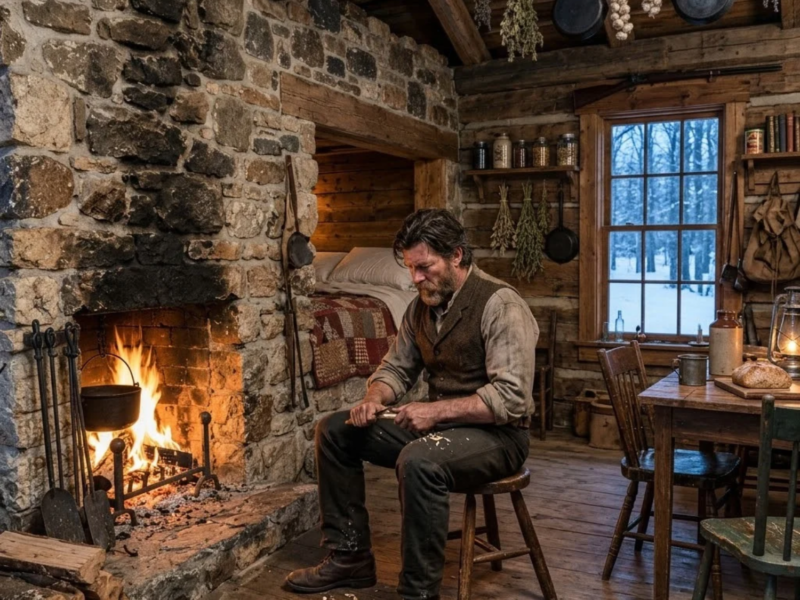
Neighbors Mocked His Frontier Cabin With No Bedroom — Until They Found His Bed Inside the Stove Wall
The Valley of Warm Stone
By late afternoon, the howling fury of the blizzard finally began to downgrade from a blinding whiteout to a steady, manageable gale.
Silas rebuilt the small fire carefully with the fresh wood Harvey and Warren had hauled up. The massive thermal wall steadily gathered heat once more, pumping a gentle, ambient wave of comfort through the cabin until the interior climbed well above freezing.
Ruth removed one heavy quilt from Caleb, then a second. The boy woke up genuinely hungry, eagerly eating a tin plate of warm beans while sitting cross-legged on the very stone bench that had nearly driven his family out of the house twice in forty-eight hours.
Three days later, the sky cleared completely, revealing an alpine world locked in deep, pristine ice.
Sunlight struck snowdrifts that sat nearly level with the cabin windows. Wooden fence posts had vanished entirely beneath undulating white dunes, and several agricultural outbuildings across Cottonwood Draw had suffered collapsed roofs or structural failures.
Two farming families in the valley had burned through nearly all their winter firewood reserves trying to stay ahead of the sub-zero plunges.
The Mercers, by contrast, had consumed less than half of what Silas had originally calculated their ordinary wood needs would be. But Silas didn’t spend the crisp morning counting stacked logs. Instead, he took the upper section of the thermal wall apart yet again.
Harvey Cole arrived before noon with a leather-bound notebook tucked under his arm. Then Warren Pike stopped by. And the following day, old Otto Weiss arrived in a horse-drawn wagon wrapped tightly in horsehair blankets.
The ancient stonemason studied the cracked mortar joint Silas had pointed out. Silas showed him every modification: the pressure problem, the half-open bypass damper, and crucially, the ingenious lower air intake port that had stabilized the volatile draft during the height of the storm.
Otto listened in absolute silence, his rheumy eyes darting across the masonry layout. When Silas finally finished his technical explanation, Otto reached out and ran one calloused finger gently along the damaged channel seam.
“You kept fixing the places that broke,” Otto noted quietly.
Silas nodded.
Otto pointed a gnarled finger upward toward the roofline. “But the wind was the thing breaking them.”
Silas looked toward the wooden ceiling. “Yes.”
Otto slowly lowered himself onto a wooden chair, exhaling a long sigh. “Then change what the wind sees.”
That spring, Silas Mercer changed the exterior chimney design permanently. He didn’t just make it taller; he completely rebuilt the upper crown and altered the exterior stone cap so that the high-velocity northwest gales slipped past the opening with minimal aerodynamic turbulence and downward suction.
He permanently enlarged the emergency bypass zone. He redesigned the internal iron damper mechanism so that thermal binding could never lock it shut again.
He added a second cleanout access hatch near the base, and he rebuilt the troublesome upper channel using wider, mathematically calculated expansion buffers to ensure the stones could flex safely under extreme fire loads.
Every single structural modification was born directly from a catastrophic failure. Nothing about the finished wall was hidden or masked; when curious neighbors came by to inspect the marvel, Silas showed them the damaged, scarred stones first.
By April, people from all across the valley no longer arrived to mock him or ask where his invisible bedroom was hidden. They came carrying surveyors’ rules, carpenter’s pencils, and detailed room sketches.
Harvey Cole brought a blank notebook. Warren Pike brought exact interior dimensions from his own farmhouse. A widow named Margaret Bell rode six miles on horseback through the melting mud carrying a rough, charcoal-drawn floor plan of the cramped room where her two orphaned grandsons slept through the winter.
Silas consistently refused to hand anyone a single set of standardized numbers and call them universally correct.
Instead, he visited their homesteads, inspected their stone foundations, studied their roof slopes, and asked pointed questions: Which direction does your worst winter wind strike? What kind of seasoned timber do you burn? How fast do your fires naturally draw?
Sometimes, after careful calculation, he bluntly told them not to build a complex thermal stove-wall at all, recommending a simpler, modest masonry heating bench set beside an ordinary, reliable cast-iron cookstove instead.
Slowly, methodically, Cottonwood Draw stopped treating the strange Mercer cabin as a dangerous local trick.
By the following autumn, two more homesteads in the valley boasted their own custom-built heated sleeping benches. Neither of them copied Silas’s design slavishly: one utilized a shorter, direct smoke path to accommodate a smaller room; another substituted high-density firebrick through the majority of its inner core.
Warren Pike built no sleeping bench of his own, but he completely overhauled and raised his cabin chimney, adding massive stone collars around his standard stove. Harvey Cole built a small, heated stone platform directly beside his north wall where his elderly mother slept in total comfort.
When winter returned to the high Nebraska plains that November, the community jokes were entirely gone.
On the very first hard freeze of December, snow pressed against the Mercer cabin walls once again. Silas fed three dry splits of cottonwood into the iron firebox, and the rebuilt chimney pulled with a clean, deep, musical hum. Ruth checked the bypass damper before climbing beneath the covers—a nervous habit she would likely never break.
Caleb was nine years old now. He climbed onto the warm stone bench with a thick adventure book in his lap, reading quietly by the light of a single tallow candle until his eyelids drooped and closed.
Near midnight, the fire burned down to a bed of glowing coals. Outside, a gentle wind moved softly over the roof shingles, whispering through the eaves. Inside, the stone wall hummed its ancient, steady song.
Silas woke up once during the night, listening intently in the dark.
There was no hacking cough, no smell of acrid smoke, and no drafts of freezing air sweeping across the pine boards—only the low, pleasant sound of air quietly migrating up through the masonry flues. He turned his head toward the north wall.
A single broken, jagged piece of old mortar still sat proudly on the dusty shelf above the pine table, right where he had left it at the end of the previous winter. Silas had never thrown it away, and he never would.
At sunrise, Caleb stepped out barefoot from the warm stone bench onto the chilly morning floorboards, immediately pulling his foot back with a sleepy giggle. Ruth laughed softly beneath the quilts.
Silas opened the heavy iron door of the stove and laid in the fresh morning wood. Outside, pristine snow covered Cottonwood Draw from the windswept ridge down to the frozen creek.
Inside, the stone wall was still quietly giving back yesterday’s fire.









