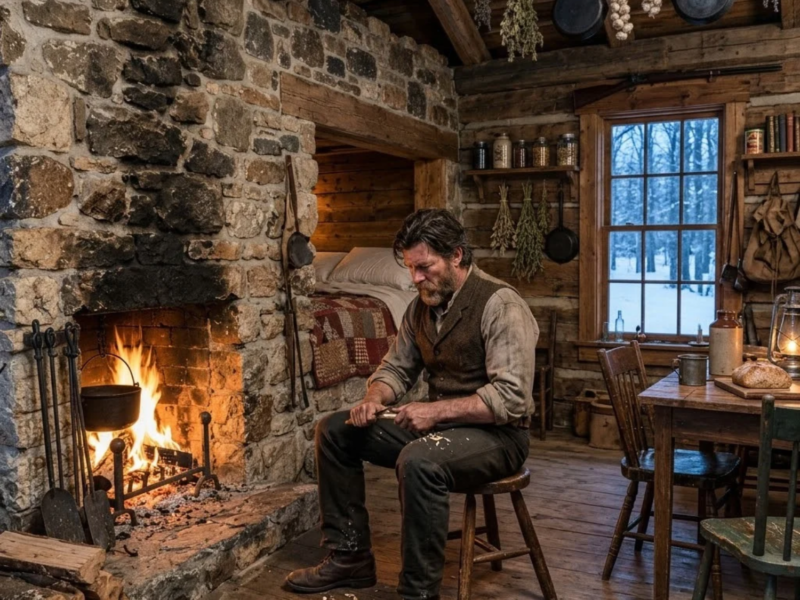
Neighbors Mocked His Frontier Cabin With No Bedroom — Until They Found His Bed Inside the Stove Wall
The Cleanout and the Cure
By seven o’clock in the morning, pale, anemic daylight finally filtered down into Cottonwood Draw, though nobody inside the Mercer cabin could see it. Heavy, wind-packed drifts covered nearly the entire window, turning the room the uniform, depressing gray of a damp cellar.
Silas sat on a low stool beside the stone wall, armed with a heavy steel hammer and a sharp cold chisel, staring directly at the cracked mortar joint at eye level. He had stopped watching the storm raging outside; there was nothing out there he could control. The wall, however, was an entirely different matter.
Ruth stood silently directly behind him, holding Caleb wrapped tightly in two patchwork quilts. The boy had stopped coughing for several agonizing minutes, but each intake of breath still sounded terrifyingly dry and tight.
Silas tapped the cold chisel lightly with the hammer. A thin, brittle piece of lime mortar broke loose, falling into his lap. Behind it, the underlying fieldstone looked dark and sound, but the mortar was failing structurally. He chipped out another section, then another.
Ruth leaned closer, her voice tight. “What are you looking for?”
“Where the crack actually ends,” Silas muttered, striking the chisel again.
The damaged seam ran deeper into the heart of the masonry than it had appeared on the surface. Weeks of relentless thermal expansion, combined with the extreme external wind pressure, had forced a microscopic fracture corridor straight through the inner core.
Silas laid his hammer down on the floorboards. He could slap a quick patch of wet mortar over it, but fresh lime needed time to cure and dry before facing extreme heat, and they didn’t have the luxury of time. He looked back at the woodpile: six lonely pieces of cottonwood left, plus one half-burned chunk resting beside the firebox.
The emergency bypass remained stubbornly open. Every single flame leaping inside the firebox was now sending the vast majority of its heat straight up the vertical metal flue and out into the sub-zero sky, leaving the cabin to steadily lose its thermal battle.
Ruth understood the grim mathematics of their situation before he even articulated it. “You want to close the bypass again?”
“Partway.”
“The wall leaked smoke.”
“I know.”
“The wind outside hasn’t let up for a second.”
“I know,” Silas repeated, his jaw clenched so hard his teeth ached.
She looked down at Caleb. The boy sat with his small knees pulled up under his chin, his stockinged feet resting against the very last warm section of flagstone near the floor. The cabin had maneuvered them into a corner of terrible, binary choices, and every exit path looked perilous.
This time, Silas didn’t touch the iron damper handle. Instead, he stood up abruptly, walking over to the pine table where his dog-eared sketches and chalk drawings were scattered.
He spread the papers flat across the scarred wood: the smoke path, the bypass layout, the cleaning access ports, the calculated chimney heights. Every single modification and correction he had scrawled since October sat right there before his eyes in black charcoal.
Then, his finger stopped on a minor detail he had overlooked in his panic.
The very first internal failure weeks ago had happened near the lower bend of the internal flue. This new crack sat much higher, near shoulder level. Different physical locations, certainly—but they shared the exact same side of the masonry wall.
And both structural failures had manifested precisely when a violent northwest wind bore down heavily upon the external chimney stack.
Silas stared at the drawing, the gears turning in his head.
Ruth came to stand beside his shoulder. “What is it?”
Silas drew a firm pencil line from the chimney down through the wall, intersecting the smoke channel. “The smoke isn’t just randomly finding random cracks. The wind outside is creating a massive pressure wave down the stack.”
Ruth waited, listening.
“The pressure is backing up through the whole internal passage,” Silas explained, tapping the paper urgently. “I’ve spent weeks fixing individual leaks, treating every crack as a separate flaw. But the storm is showing me something much bigger. The masonry wall isn’t just failing under heat expansion; it’s being pressurized from the top down by the wind.”
He pivoted away from the table, striding rapidly back to the stone wall. The firebox coals barely glowed, dim and tired.
Silas reached down and threw the lower air intake control wide open. The remaining embers inside brightened instantly, and the internal draft strengthened with a sharp, metallic whoop. But a second later, another violent gust slammed against the roof, flattening the tiny flame right back down.
Silas watched it with microscopic focus. There. When the wind struck the exterior chimney mouth, the internal draft plummeted, stalled, and then pushed backward.
He had raised the chimney earlier in the winter, and it had helped tremendously, but this freak blizzard possessed a kinetic violence unlike anything he had tested against.
Silas stood tall, dropping his tools. “I need to get up on the roof.”
Ruth intercepted him instantly, stepping squarely into his path. “No.”
“I have to modify the cap, Ruth. If I don’t break that downward air pressure at the summit, the wall is going to blow apart from the inside.”
“If you go out on that shingle roof in this wind, you’ll be blown off the eaves before your boots even touch the ice,” she said, her voice cracking with terror.
Silas looked toward the buried window, knowing she was entirely right. He could barely navigate thirty feet across the level yard to the woodshed with a guide rope; attempting to scale an ice-coated roof in the pitch of this gale was sheer suicide.
Caleb spoke up quietly from his bench. “What about the cleanout?”
Silas stopped, spinning around to look at his son.
The boy pointed a pale, slender finger toward the small, sealed iron access port near the floor—the very hatch Silas used to rake out accumulated soot during routine maintenance.
“You said opening things up changes how it pulls,” Caleb reminded him softly.
Silas stared at the boy, stunned by the sheer, unclouded logic of an eight-year-old mind unburdened by engineering dogmas.
He dropped to his crouch beside the lower cleanout hatch. During normal operating conditions, that port remained hermetically sealed with clay. But what if he cracked it open just a fraction? Fresh room air would be drawn directly into the base of the lower masonry channel.
It might strengthen the directional momentum through the underground passage without forcing an erratic, raging fire inside the box—or, conversely, it could backfire catastrophically and dump a cloud of smoke straight into the living room.
Silas picked up the tallow candle from the table, lit the wick, and held the trembling flame right beside the edge of the lower cleanout door. He cracked the iron latch open no wider than the thickness of his smallest finger.
The candle flame didn’t blow out; instead, it leaned inward, greedily bending toward the opening.
Air was rushing in, not coming out.
Silas held his breath, waiting one full minute. Then two. Deep within the masonry core, the hollow, rushing sound of the thermal draft audibly deepened, shifting from a wheeze to a confident, chest-deep hum.
He nudged the emergency bypass damper closed by a tiny fraction. The firebox didn’t choke or push smoke backward; it swallowed the adjustment cleanly.
Silas waited another minute, watching the upper mortar joint. The hairline crack remained dry and dark. No gray thread appeared.
He locked the adjustment right there: half open, half closed. A delicate, engineered compromise between safety and warmth, draft and mass.
For the next hour, Silas changed nothing. That exercise in pure restraint was infinitely harder than swinging a hammer or tearing stones apart. He simply sat on his low stool near the masonry wall and watched the steady candle flame.
Ruth watched Caleb. The small wood fire burned with a quiet, efficient rhythm. Slow, gentle heat re-entered the heavy stones. Some thermal energy escaped directly through the open bypass, yes, but a vital portion smoothly navigated the long channel.
The arrangement undeniably wasted heat compared to a fully closed, optimal run—but it wasted a vanishingly small fraction of what they had been losing, and it kept the air strictly breathable.
By nine o’clock, the inner stone bench began warming up again, barely perceptibly at first, but enough that Ruth noticed the change through the quilting. She placed her palm flat against the flagstones, felt the rising tide of heat, and looked up at Silas.
He didn’t speak. He simply added one single, modest piece of dry cottonwood to the firebox. No more.
Outside, the unrelenting wind battered the cabin without mercy. At times, the entire log structure shuddered on its foundation, and fine, powdery snow managed to force its way beneath the front door until Silas had to pack a folded grain sack tightly against the gap to keep the drifts at bay.
Caleb slept for an hour, then another. His breathing remained remarkably steady, free of wheezing or rattles.
Near noon, the gray, oppressive light framing the upper corner of the buried window brightened perceptibly. Silas stood up, scraping the thick accumulation of frost away from a tiny corner of the glass pane.
At first, nothing was visible except a blinding, featureless white wall of storm. Then, a dark shape detached itself from the blowing haze.
A horse appeared out of the snow, staggering forward. Then another.
Warren Pike was riding in front, his face unrecognizable beneath a mask of frozen rime. Harvey Cole followed closely behind him, struggling to drag a small, improvised wooden hand-sled loaded down with precious split firewood.
Silas didn’t wait for them to reach the gate; he threw the heavy wooden door open and lunged out into the drifts before the riders could even dismount.
Warren almost toppled headfirst from his saddle when his boots hit the packed snow, his legs shaking violently from exhaustion. Harvey’s wool scarf was frozen completely solid into a sheet of ice beneath his chin.
Neither man wasted a single breath on small talk.
Working with frantic, silent urgency, they carried the firewood inside, armful after heavy armful, stacking it neatly against the pine wall near the stove. Ruth quietly accepted the wood, stowing it securely. Caleb watched wide-eyed from the safety of his warm stone bench.
Harvey finally paused, wiping his streaming eyes, his gaze traveling around the orderly interior. His eyes stopped on the partially open lower cleanout port, then flicked to the hairline crack in the mortar, and finally to the half-open bypass handle.
“What happened here?” Harvey demanded, panting.
Silas firmly pushed the heavy cabin door shut against the howling gale. “Wall leaked.”
Harvey stared at him in disbelief. “Different place than last time?”
Warren Pike pulled off his stiff leather gloves, holding his raw hands near the warm stove. “Are you still sleeping against that thing, Mercer?”
Silas looked over toward Caleb, who gave a small, reassuring nod. “For now.”
Harvey stepped closer to the masonry, reaching out to touch the broad stone bench. “It’s… warm,” he whispered, looking from the small, efficient firebox over to the generous stack of dry wood they had just hauled inside. “How in God’s name did you manage this?”
Without a word of boasting, Silas walked him through it: the pressure crack at the upper joint, the bypass sitting halfway open, and crucially, the small, seemingly counterintuitive lower air intake port that acted as a pressure-release valve for the entire system.
“So you’re feeding cold room air straight into the hot channel?” Warren asked, furrowing his brow.
“Just a crack’s worth,” Silas explained, pointing to the latch. “It breaks the vacuum wave when the wind hits the chimney top. It keeps the draft moving forward instead of blowing backward.”
Harvey shook his head slowly, a profound, dawning appreciation in his eyes. “That means it still doesn’t work right, Silas. Not automatically.”
Silas looked back at the hairline mortar crack on the wall. “No,” he admitted quietly. “It works better than it did.”
There was no false pride in his voice, no defensive bluster—only the raw, undeniable reality of the stone wall standing right in front of them.
Warren Pike straightened up, pulling his mittens back onto his red, chapped hands. “Well. That’s enough engineering for one day.”









