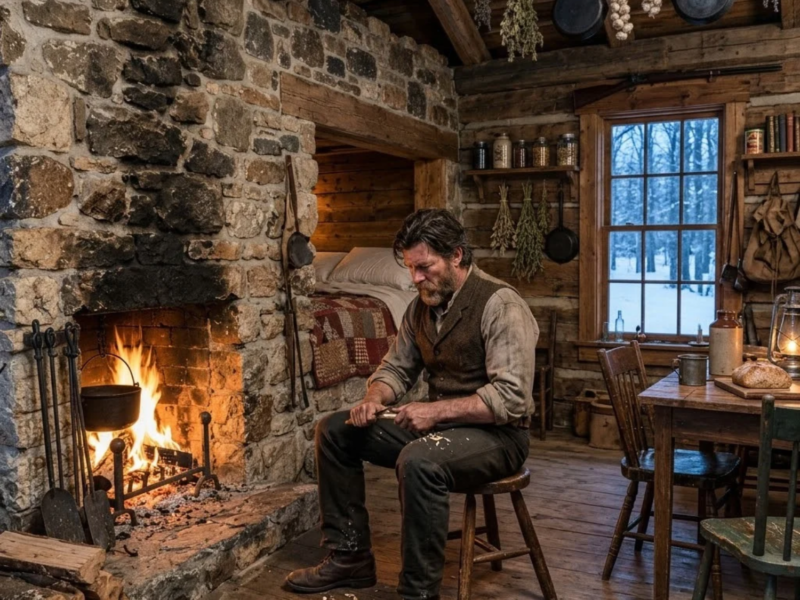
Neighbors Mocked His Frontier Cabin With No Bedroom — Until They Found His Bed Inside the Stove Wall
The First Burn
By October 20th, the thermal wall was declared ready for its first full, unsparing burn.
Silas opened the emergency bypass damper, clearing a straight path to the stack, and lit a bundle of dry cottonwood kindling beneath the iron firebox. The orange flame climbed quickly, greedily licking the iron walls. The metal chimney pipe began to ping as it expanded, and a healthy, steady roar echoed from the flue.
Satisfied the draft was clean, Silas closed the bypass little by little, forcing the hot combustion gases to enter the long, labyrinthine passages hidden deep inside the masonry core.
For the first ten minutes, nothing happened. The room smelled faintly of drying lime and damp earth. Then, slowly, the physics of the wall asserted themselves: one granite block warmed to the touch, then another, then a cluster of bricks near the center.
An hour later, the center of the stone bench felt pleasantly warm beneath Silas’s open palm. Caleb crept over, pressing both hands flat against the masonry. His thin shoulders lifted in surprise, a tiny, disbelieving smile breaking across his pale face.
Outside, Ruth checked the chimney exit. A thin, pale ribbon of smoke rose cleanly into the crisp autumn air, dissolving into the wide Nebraska sky.
Silas fed the fire for another hour, keeping a steady, moderate feed of dry wood, then let the flames die down. That was the crucial moment he had been waiting for. The bright orange flames dropped; the fiery coals dimmed into a dull red glow; the ambient air of the room began slowly cooling as dusk fell.
But the stone did not.
Two hours later, the stone sleeping bench still held a deep, ambient warmth. Four hours later, it remained noticeably warmer than the bare pine floorboards.
At midnight, Caleb lay down on the bench beneath two wool quilts. Ruth lay beside him, her arm curved protectively over the boy. Silas took the outer edge, his long legs hanging slightly off the stone.
For the first time since arriving in Cottonwood Draw, the family had gone to bed without dragging three heavy chairs and a table together to barricade themselves against the drafts, and without piling every spare rag over the boy’s shivering chest.
The fire was nearly gone. Outside, a hard white frost climbed the window glass, tracing delicate, fern-like patterns across the panes. Caleb’s breathing stayed slow, deep, and rhythmic.
Ruth reached beneath the quilts, pressing her palm directly against the flagstones. Silas watched her face in the weak, dying orange glow of the hearth.
She gave one small, solemn nod.
Then the wind changed.
It came howling down off the high ridge without warning, striking the north side of the cabin hard enough to make the heavy oak timbers groan. Silas opened his eyes in the dark.
A few seconds later, something sharp and acrid reached his nose. Burned cottonwood. Not from the open firebox door—from the wall itself.
He sat upright instantly. A thin, ghostly gray thread of smoke was visibly slipping out from a mortar joint less than three feet from Caleb’s pillow.
Before Silas could throw his legs over the side of the bed, Caleb coughed—a dry, hacking rattle.
Ruth pulled the boy upright, panic flashing in her eyes. The boy pressed a small fist against his aching chest, his breath coming short and shallow, while another curling gray thread pushed aggressively through the drying mortar joint right beside the sleeping bench.
“Silas!” Ruth cried.
Silas lunged across the floor, his fingers finding the iron bypass damper. He yanked it hard. A dull, protesting metal scrape echoed from deep inside the masonry.
The physics of the fire shifted instantly. Instead of dragging the hot gases through the long, obstructed stone passages, the smoke abandoned the labyrinth and took the short, direct route straight up the emergency chimney stack.
Silas threw open the heavy cabin door. A blast of sub-freezing night air rushed across the floor, scouring the room.
Ruth wrapped Caleb tightly in his quilt and carried him outside into the snow-dusted yard to clear his lungs. Silas stayed behind, dropping to one knee beside the leaking mortar joint. He watched the gray thread waver, thin out, and finally stop as the draft normalized.
The cabin cleared slowly. Outside, the wind pushed the dry prairie grass flat against the frozen ground. Ruth stood beside the open doorway, Caleb buried against her shoulder, the boy’s face hidden in the folds of wool.
Silas stepped out into the freezing dark and pulled the heavy door shut behind him. For several long seconds, nobody spoke. The wind howled across the roof, mocking them.
Then Ruth looked through the small glass window at the stone wall. “You said the bypass would clear it.”
“It did,” Silas rasped, staring at his boots.
She looked down at the coughing boy. “After the smoke got through.”
Silas rubbed both hands hard over his face, scrubbing away the cold and the exhaustion. Caleb coughed again—a sharp, wretched sound that ended any further discussion.
They spent the rest of that freezing night huddled on the wooden floor near the opposite wall, far away from the masonry. The fire was kept small and miserable; the emergency bypass remained stubbornly open; and the great stone structure Silas had spent weeks designing stood cold, treacherous, and utterly useless beside them.









