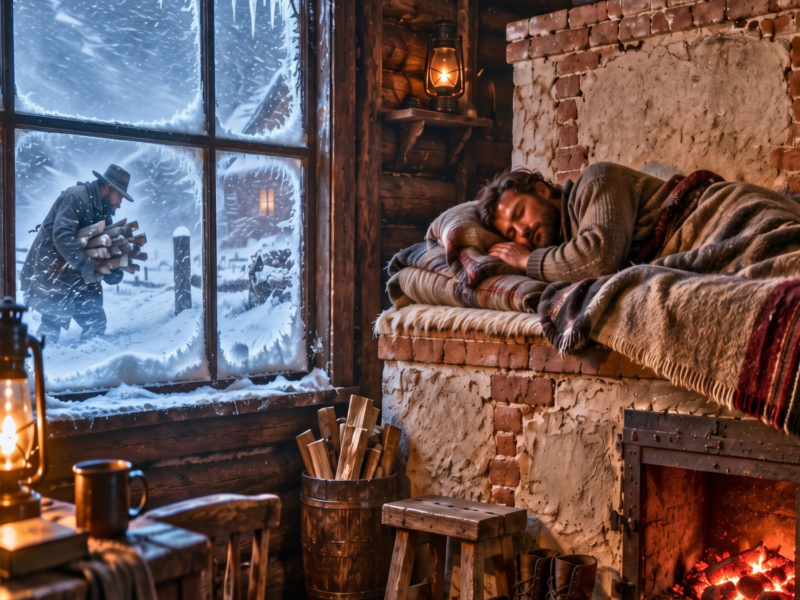
Neighbors Mocked His Giant Brick Stove—Until They Fought the Cold While He Slept Warm
The Legacy of the Stone
When the brutal, week-long storm finally weakened and the skies cleared to a blinding, icy blue, the questions in Ash Creek Crossing changed.
Emtt Row came to the Varic cabin the next day. He didn’t bring his blacksmith hammer; he brought a spring scale and a small, leather-bound notebook. He no longer asked whether the heater worked. He was a man of metal and math, and he wanted numbers.
“How much wood goes into one firing?” Emtt asked, pencil poised.
“Twenty pounds,” Jonas answered.
“How many hours does the masonry remain useful after the fire is dead?”
“Twelve to fourteen, depending on the outside wind.”
“How high is the chimney after you raised it?”
“Ten feet above the ridge.”
“Why did one end of the bench overheat during the second test?” Emtt pressed, looking at the patched mortar. “What did you change inside the passage?”
Jonas answered each question patiently, including the uncomfortable ones. He showed Emtt where the original flue had ended too low. He described the smoke roll-back, making no excuses. Then, he sketched the internal bell chamber on a scrap of paper and showed Emtt exactly where he had moved the baffle to force the gases to travel further.
Warren Hail agreed to another comparison, driven by his own curiosity. Emtt meticulously weighed the wood Warren used through a single overnight heating cycle to keep his cabin at a survivable temperature. Then, he weighed Jonas’s single evening charge.
The figures were staggering, but they did not make the iron stove useless. Emtt was fair in his assessment. Warren’s stove still produced heat instantly on a freezing morning. That mattered on the frontier. The massive difference, the life-altering difference, was what happened afterward.
Warren had to rebuild that useful heat three or four times through a bitter night, burning through his winter reserves at an alarming rate. Jonas built it once, stored the excess energy in the thermal mass of the masonry, and slept peacefully while the brick released it slowly.
Emtt wrote the last figure in his notebook. Then he closed it with a snap. He looked up at the massive heater, no longer staring at the iron door or the tin chimney. He was looking at the structure itself.
“How wide did you make that upper chamber, Jonas?” Emtt asked.
The argument was over. Now, he just wanted the dimensions.
By March, the snow began pulling away from the south-facing walls of the cabins, revealing the muddy earth beneath. The thaw had begun.
Warren Hail had survived the winter, but he had made his decision. He was not throwing out his cast-iron box stove. He was a practical man, and he still valued what it did perfectly well: it heated a freezing room instantly, it cooked food easily on the flat top, and it made sense on crisp autumn mornings when warmth was needed fast but not all day.
But he no longer wanted to spend another winter serving the iron beast through the dark hours of the night.
Before the next cold season arrived, Warren decided to move his stove farther inward toward the center of his cabin. He planned to build a compact masonry mass directly behind it, wrapping the flue in brick before it exited the roof. The iron would provide the quick, instant heat. The brick would capture a large portion of the exhaust heat that normally escaped up the pipe, storing it, and releasing it more slowly through the night. A hybrid system.
Emtt Row went to his forge and designed new, heavy-duty damper hardware specifically for masonry applications.
Ruth Row spent afternoons with Elena, asking when stored heat was best for keeping stews warm after the main firing. Elena showed her the timing she had learned through the long, dark winter, pointing to the chalk marks on the brick.
When the ground finally thawed enough to dig a proper foundation, Warren Hail asked Jonas to come over and help him lay the first course of brick for his new thermal wall.
There was no formal apology. Out West, actions spoke louder than words.
No neighbors gathered to watch or mock them. Jonas arrived at the Hail cabin carrying his old mason square, the handle worn smooth. He handed it silently to Warren.
Together, the two men spread the thick mortar across the prepared stone base. They lowered the first salvaged kiln brick into place. Warren took the square from Jonas and pressed it carefully against the brick’s edge. The brick was slightly out of plumb.
Warren frowned. He moved it. He checked it again. He tapped it with the handle of his trowel, adjusting it once more until it sat perfectly, mathematically straight.
The rancher who had laughed at a bed built into a stove was now meticulously measuring his own first course of masonry.
By the autumn of 1889, Ash Creek Crossing looked much as it had the year before. The cottonwoods still lost their leaves in November. The wind still howled down from the north. But the insides of some of its cabins did not look the same.
One crisp afternoon, a rancher from the far eastern side of the basin stopped his wagon at Warren’s cabin to trade supplies. He had heard rumors at the Cheyenne supply depot about the changes Warren and Emtt had made after the brutal, week-long blizzard of ’88.
Salvaged kiln bricks were stacked high in the bed of the rancher’s wagon.
Warren welcomed the man inside. He showed him the iron stove, and then he showed him the compact, heavy masonry mass built solidly behind it. The visiting rancher took careful measurements, ran his hand over the warm brick, asked about the custom damper Emtt had forged, and wrote several figures in a leather pocket notebook.
Nobody went across the yard to fetch Jonas Varic to explain it. There was no reason to. The proof was built into the walls.
Across the settlement, Jonas was in his yard, swinging his ax, cleanly splitting lodgepole pine beside his cabin. Inside his home, the giant brick heater still occupied the dead center of the floor, taking up the exact same space his neighbors had once called a foolish waste.
It had not been proven right simply because the technology was old in Moravia. Warren’s iron stove had not been proven wrong simply because it was a newer, American invention.
Winter had judged something far simpler, far more unforgiving.
Heat made quickly had undeniable value on the frontier. But heat that remained when a tired, broken man desperately needed to sleep—that had a value that could not be measured in cords of wood.
The visiting rancher climbed back onto his wagon, snapped the reins, and turned his horses east toward his own homestead. The salvaged bricks went with him, destined to become another fortress against the cold.
Jonas Varic raised his ax and brought it down hard, splitting another piece of pine cleanly in two. The sharp crack echoed across the frosty basin. He never even looked up as the wagon left Ash Creek. He just reached for the next log, his work speaking for itself in the silence of the coming winter.









