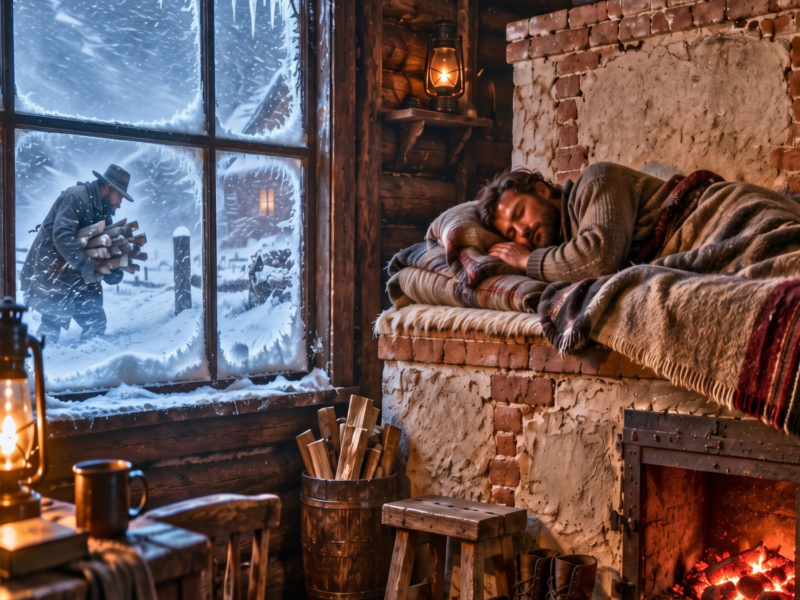
Neighbors Mocked His Giant Brick Stove—Until They Fought the Cold While He Slept Warm
The Uneven Warmth
It was Elena who found the second flaw.
Later that night, as the fire burned down to glowing coals, she sat on the masonry bench and moved her bare hand along its smoothed surface. She frowned.
The end of the bench nearest the firebox chamber had become dangerously hot—too hot to sit on comfortably, let alone sleep on. But several feet away, at the far end of the bench, the stone was only lukewarm.
Jonas came over and checked it himself, pressing his broad palms against the masonry. His brow furrowed. The heat was moving through the stone, yes, but it was not moving evenly. The thermal mass was unbalanced.
Word traveled fast in a small settlement. Warren heard about the second problem the next morning at the trading post. To him, it simply confirmed his suspicions. An iron stove needed a pipe, a damper, and wood. That was it. Jonas’s complicated machine seemed to need constant correction and endless tinkering. It was over-engineered folly.
Jonas offered no defense to his neighbors. He went home, took a piece of white chalk, and marked the dangerously hot section of the bench. He waited an agonizing twenty-four hours for the massive masonry block to cool completely.
Then, he picked up his hammer and chisel.
He began knocking the hardened mortar from the bricks he had painstakingly set just days before. He tore down the outer wall of the bench. Behind it lay the internal passage he had built for the exhaust gases. He knelt in the rubble, studying the route. The gases were taking the path of least resistance, rushing too quickly past the far end of the bench.
He mixed fresh mortar. He shifted the internal brick baffle, extending the maze, forcing the path of the hot gases to travel the full length of the bench before they were allowed to descend toward the flue.
He cleaned every single brick he had removed, scraping away the old mortar. Then, he started again. Rebuilding. Re-leveling.
The third firing began on a night when the temperature plunged to eight degrees above zero. The windows of the cabin were rimmed with thick, crystalline frost.
Jonas filled the firebox with his driest, most seasoned lodgepole pine. He opened the draft wide and let it burn hard. For two and a half hours, the flames roared, moving through the newly rebuilt internal chambers while the thousands of pounds of brick and stone slowly, greedily absorbed their thermal energy.
By nine o’clock, the last flames were fading into a bed of pulsing, cherry-red coals.
Jonas closed the heavy iron damper at the precise time he had marked. He closed the firebox door. The cabin was silent. He added nothing more.
Warren, sitting in his own cabin across the property line, looked out his window and saw no smoke rising from the Varic chimney. He told Matilda that the Varic cabin would be an icebox before morning. It was a reasonable guess based on everything the frontier had taught him. There was no fire left to tend; therefore, there could be no heat.
But inside the Varic cabin, the room did not cool.
The massive masonry monolith, now fully charged, continued releasing what it had taken. It was a gentle, radiant heat. It did not scorch the air like iron; it wrapped around the room like a heavy wool blanket.
Jonas walked over to the bench. He ran his hand along the surface. It was perfectly, evenly warm from end to end, without the searing hot spots Elena had found before.
Jonas smiled in the dim light. He spread a thick wool mattress over the brick bench. He and Elena blew out the oil lamp and settled in for the night.
Around two o’clock in the morning, Elena woke. The cabin was dead silent. No wood cracked in the firebox. No orange light danced erratically across the log walls. She lay perfectly still, expecting the familiar, bone-deep chill that usually crept into a cabin in the dead of night.
She pushed one bare foot out from beneath the heavy wool blankets.
The stone beneath the mattress was radiating a steady, comforting heat. She sighed, closed her eyes, and fell back into the deepest sleep she had experienced since leaving Moravia.
By dawn, the ambient air in the room had cooled slightly, but it remained comfortable enough to dress without rushing desperately to strike a match. A tin kettle left near the upper ledge of the heater had no film of ice across its water; it was still warm to the touch.
Jonas woke, rested and alert. He checked the masonry walls. They were still pleasantly warm. He opened the firebox. Only a bed of fine gray ash remained.
He took a piece of chalk and marked the wooden wall beside the heater. One line recorded the exact time he had closed the damper the night before. Another line marked the morning hour, noting when the masonry finally began to lose its useful, radiating warmth.
For the first time, the strange brick mass had answered Warren Hail’s question without uttering a single word.
The flame was gone. The heat had stayed.









