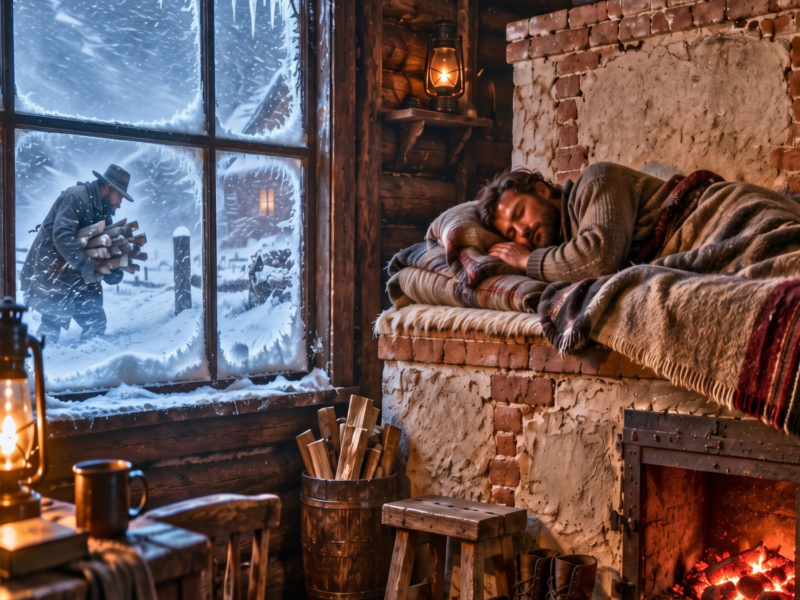
Neighbors Mocked His Giant Brick Stove—Until They Fought the Cold While He Slept Warm
The Brick Mountain
By the end of the week, the rectangle on Jonas’s floor had become impossible to ignore.
The heater measured five feet, four inches long by four feet, eight inches wide at its base. And Jonas intended to carry it a little over seven feet high. It was a monolith, a silent giant rising in the center of the modest cabin. Around the central firebox, Jonas used refractory brick he had bought for pennies from an abandoned kiln out near Cheyenne. Farther out, he laid salvaged regular kiln brick and local river fieldstone, binding the massive weight with a thick lime-clay mortar he mixed by hand in the freezing yard.
Finished, it would weigh roughly seven thousand pounds.
Elena Varic, Jonas’s wife, sat in the corner mending a wool shirt, watching the structure claim more of their cabin each day. She was a practical woman, hardened by the journey from Moravia to this desolate American frontier, but the sheer size of the thing frightened her.
She did not tell him it was foolish. She loved him too much for that. But she asked the harder questions.
“Where would the table go, Jonas?” she asked quietly, eyeing the narrowing space between the bricks and the kitchen wall.
“The table can move,” he replied, scraping excess mortar from a joint.
“What happens if the masonry cracks from the heat?”
“A crack can be opened, chipped out, and repaired.”
“What if the chimney refuses to draw?” Elena pressed, her voice tightening. “And what if deep winter arrives before all that wet mortar has properly dried? We will have ice on the inside of the windows, Jonas.”
Jonas stopped. He wiped his hands on his canvas trousers. He answered each question without a grand speech. The chimney would be tested before the hard cold arrived. The masonry would be fired slowly at first to drive out the moisture.
He had worked around massive masonry ovens and heated stone walls in Moravia before coming West. He had learned from old men with bent backs and scarred hands—men who trusted the earth more than they trusted iron, men who trusted their hands more than academic titles. Jonas never called himself an engineer. He was simply a builder.
“Brick has to be given time, Elena,” he said softly, offering her a rare, reassuring smile. “It has a memory. It remembers the fire long after the fire is dead.”
Then he checked another mortar line with his worn square and set the next brick.
By evening, the structure was too large to ignore. Elena lifted one end of their heavy pine dining table while Jonas took the other. Together, they moved it against the far window. The unfinished stove already owned the center of the room, and it was still growing.
The next day, the bench appeared.
Jonas began building it along the right side of the heater, carrying the masonry outward until it formed a solid ledge about thirty-four inches above the floorboards. He kept the top perfectly level, checking each course meticulously before smoothing the mortar with his trowel.
When Warren Hail stopped by again to check on their progress, he stared at the new addition, utterly bewildered.
“Well,” Warren chuckled, shaking his head. “At least you remembered somewhere to sit while you freeze.”
Jonas shook his head, not looking up from his trowel. “Sleep, too. On the coldest nights.”
Warren laughed out loud. It was a booming, hearty sound. “You’re building a bed into a stove, Jonas? I’ve seen some crazy things out West, but a man sleeping on a brick oven takes the prize.”
Jonas kept working. Let the rancher laugh. Warren didn’t know what Jonas knew. Where Jonas had grown up in the old country, peasant families had not always tried to keep a flame alive until morning. Wood was scarce. Nights were brutal. A hard, incredibly hot fire was built to heat the brick and stone. Then, the fire went out. The masonry stayed warm. On the bitterest nights, people slept close to that stored heat and let the walls do what the flames no longer could.
Elena had heard the idea before. During Jonas’s first winters in America, working the rail lines and living in drafty boarding houses, he had watched settlers feed thin iron stoves hour after hour, burning through massive cords of wood, only to wake to rooms that cooled to freezing the moment the fire weakened.
“They burn the heat,” he had once told her, watching a man shove another log into a glowing iron box. “Then they watch it leave through the tin pipe.”
He rarely said more than that. But years earlier, he remembered a masonry wall in a Moravian farmhouse that had remained warm beneath his palm the morning after the household fire had gone entirely dark. That memory had stayed with him longer than the fire itself.
Warren left the cabin, smiling at the strange brick bed, eager to tell Emtt about the foreigner’s folly. Jonas stayed on his knees beside the bench, drew his trowel across the final mortar joint, and made the surface perfectly smooth.
One day, he intended to sleep there.









