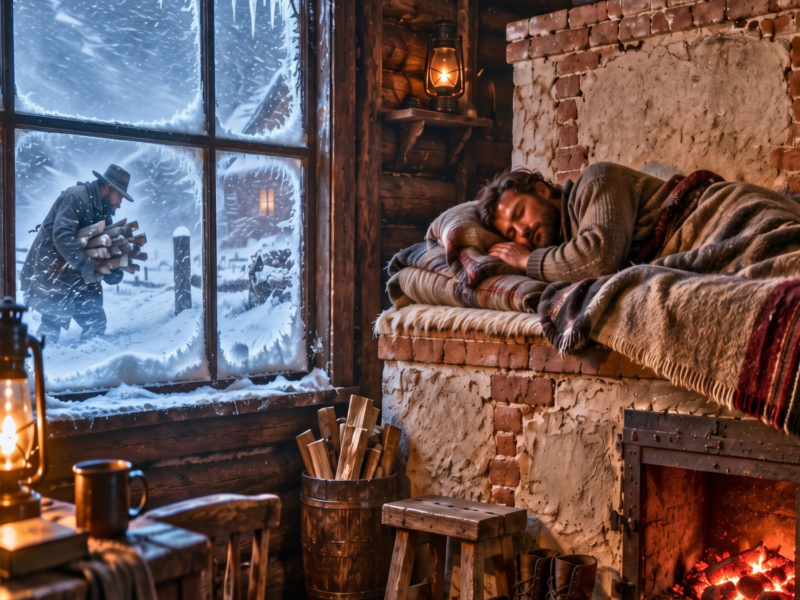
Neighbors Mocked His Giant Brick Stove—Until They Fought the Cold While He Slept Warm
The Flaw in the Flu
Back in his own cabin, Jonas finished the internal workings of the heater—the secret anatomy no neighbor would ever see once the outer courses of brick were closed.
The firebox sat low inside the mass, lined with the refractory brick. But above it, he built something entirely foreign to the ranchers of Ash Creek: a bell chamber.
In an iron stove, hot gases rushed directly from the flame up into the stovepipe. But in Jonas’s heater, the hot gases would rise into this large upper chamber first, spreading outward, blooming against the heavy brick. As the gases transferred their heat to the masonry, they would cool, become heavier, and naturally fall through a secondary side passage before finally reaching the chimney.
The physics were simple, but profound. Iron held very little heat compared to a heavy body of brick and stone. Iron warmed quickly because there was less mass to warm, but it cooled just as fast. Masonry behaved differently. It required immense energy and time to heat up, but once it was warm, it became a battery. It could release that stored thermal energy slowly, evenly, for hours upon hours.
Jonas was not trying to keep a small, smoky fire alive all night like his neighbors. He wanted a clean, incredibly hot, roaring burn for a short period—and then no fire at all. The flame would do its violent work once. The masonry would do its gentle work afterward.
Elena watched with bated breath as he fitted the heavy iron damper into the flue and moved it through its travel several times. Clack. Clack. Nothing scraped. Nothing caught.
Jonas checked the final course of brick with his old mason square. Two faded initials—J.V.—remained carved into the wooden handle, nearly polished away by decades of use.
Outside, the weather changed. The first real, accumulating snow of the season began falling over Ash Creek. It settled heavily on the fence rails, filled in the deep wagon tracks, and gathered thickly on the canvas protecting the last of his salvaged bricks.
Jonas worked until the light at the window turned a bruised, dusky gray. Then, he lifted the final fieldstone for the upper chamber, spread a thick layer of mortar, and pressed it firmly into place. The mountain was finished.
He gave the masonry several days to cure, allowing the mortar to harden and dry before he dared trust it with a real fire.
When the day finally came, Jonas laid seasoned lodgepole pine into the firebox, arranged dry kindling, and struck the first flame. He and Elena stood back, watching the fire catch.
One hour passed. The cabin was still freezing.
The fire burned hot, and the inner refractory brick was taking heat, but the outer stones remained cold to the touch. Almost none of the warmth had reached the room. Jonas touched the sleeping bench. It was barely lukewarm.
A second hour passed.
By then, Warren Hail had stopped at the cabin, stomping snow from his boots. He stood near the doorway, his heavy coat still buttoned to his chin, and watched Jonas feed more wood into a massive stone monument that seemed determined to warm only itself.
Warren didn’t need to say a word. He didn’t need to remind Jonas that the Hail cabin would have been comfortable an hour and a half ago. Jonas knew it.
Jonas opened the firebox door and reached for another split log.
Suddenly, smoke curled out of the door and into the room. Not just a wisp. A thick, acrid gray roll. Then another.
Elena moved at once, coughing, and cracked the window to let the smoke escape.
Jonas froze. He watched the flame bend unnaturally inside the firebox, starved of its upward draft. He looked toward the ceiling, then silently pulled on his heavy wool coat and stepped outside into the biting cold.
A sharp northwest breeze was sliding violently over the ridge of the cabin roof. Jonas narrowed his eyes against the blowing snow. Each gust spilled downward, curling over the shingles and pressing directly against the chimney draft that Jonas had expected to rise cleanly. The wind was creating a high-pressure cap. He stood in the snow and watched three more gusts cross the roof, visualizing the invisible air currents.
Inside, the massive brick body was finally beginning to radiate a gentle warmth, but that no longer mattered. The first firing had exposed a critical flaw.
When Warren left, he offered no joke and no argument. He simply walked home through the snow, shaking his head. His silence followed Jonas back inside, where the smell of woodsmoke still hung heavily above the warming bench.
The stove had exposed what Jonas had missed. But Jonas did not blame the wind. A master builder blames only himself.
At first light the next morning, despite the freezing temperatures, Jonas dragged a ladder through the snow and climbed to the icy roof. He studied the black soot around the flue, then crouched near the ridge, watching the air move across the shingles. The chimney ended too low. He had expected a clean upward flow, but the roof’s pitch was throwing the northwest gusts directly into the space around the cap.
He spent the morning removing the cap and laying more brick, raising the flue another thirty inches into the sky. Emtt, despite his skepticism of the whole project, helped him out by hammering a simple, aerodynamic sheet-iron wind hood at his forge to protect the draft.
“Fixing your pipe doesn’t prove your brick mountain works, Jonas,” Emtt said, handing over the blackened iron hood.
“No,” Jonas answered, taking it. “It only proves I was wrong yesterday.”
That evening, they fired the heater again. This time, the draft held beautifully. The fire roared like a captured beast. Jonas opened the firebox door to add wood, and the flame leaned inward, pulling hungrily toward the flue. No smoke rolled into the room.
One problem was gone. The correction had worked.
But the heater was still not ready.









