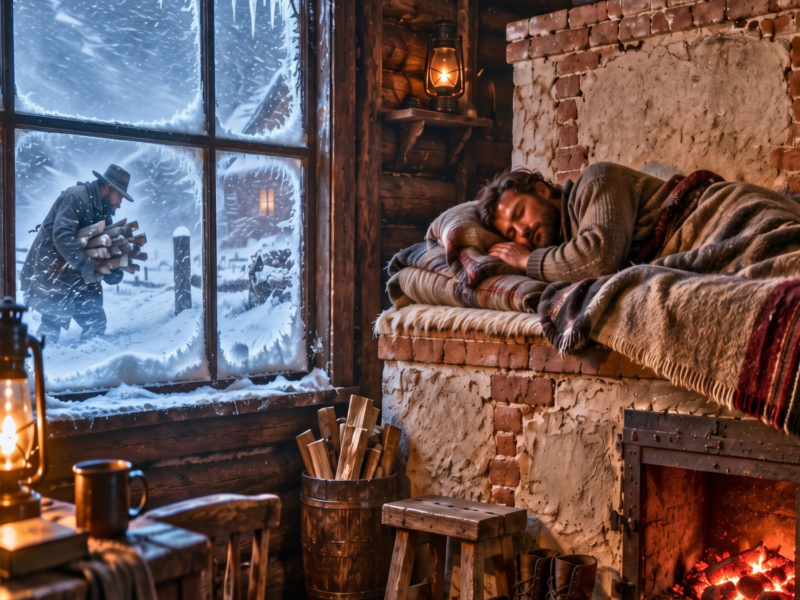
Neighbors Mocked His Giant Brick Stove—Until They Fought the Cold While He Slept Warm
The Woodpile Calculus
The days that followed through December were cold, but not yet cruel.
That distinction mattered, because for ordinary winter weather, Warren Hail’s iron stove worked beautifully. The Hail cabin warmed within ten minutes each morning. Matilda could set her skillet on the top plate and have boiling water and frying bacon before breakfast.
But as the calendar turned to January and nighttime temperatures consistently settled near zero, the true cost of that instant heat began to reveal itself outside the cabins.
To keep the iron hot, the fire had to burn constantly.
Warren stood in the snow one morning, his breath pluming in the freezing air, dragging the heavy heel of his leather boot where his massive stack of split lodgepole pine had ended just weeks ago. A deep trench in the snow marked where the wood used to be. It was vanishing. Far faster than he had calculated in October.
He wasn’t the only one noticing. Down the road, the rapid, insatiable burn rates of the iron stoves were forcing every man in Ash Creek to calculate what they had left against the long months of winter that still lay ahead.
Jonas, however, was following a completely different rhythm. He fired his massive masonry heater hard in the late afternoon, burning a precise, calculated amount of wood for two hours. Occasionally, if the wind was particularly biting, he added a very small morning charge. His stack of wood, sheltered in the lean-to against the cabin, barely seemed to shrink.
The iron stoves across Ash Creek were doing exactly what was asked of them. But the rapidly shrinking woodpiles were beginning to answer a very different question: at what cost?
As the deep cold held its grip on the basin, the settlement began paying for it not just in timber, but in physical comfort and broken sleep. No two cabins were losing exactly the same fight, but the struggle was universal.
Because the iron stove threw fierce, aggressive heat locally, it created extreme temperature zones. Emtt Row and his wife, Ruth, found themselves completely abandoning the outer corners of their cabin. Frost lingered heavily on the window sills, turning to thick ice. Ruth was forced to cluster their entire living space—the dining table, the wash basin, her knitting chair—dead center in the room, huddled around the glowing black iron.
Arlland Pike, a sixty-three-year-old widower living alone at the edge of the settlement, faced a much worse dilemma. He lacked the youthful strength to chop enough dry wood in the autumn. With his seasoned pine already gone, he was forced to burn green, damp cottonwood. The wet wood hissed and spat in the firebox, providing little heat and choking his narrow tin stovepipe with a thick, highly flammable dark creosote residue.
But the most common, insidious toll the iron stoves took was exhaustion.
Warren Hail woke at 1:00 AM when the room cooled. He threw off his blankets, shivering in his long underwear, fed the fire, waited in the dark for the draft to catch, and returned to bed. At 4:00 AM, he did it again. Cycle after cycle. Matilda felt the mattress shift every single time he woke, her own sleep fractured and shallow.
Inside the Varic cabin, the outer walls remained cold—Jonas could not change the weather—but the center of the room offered a steady, enduring refuge. The sheer mass of the masonry continued giving back heat long, long after the firebox went dark.
Elena could leave damp kitchen cloths hanging on a line near the brick bench and find them bone-dry and warm the next morning, without Jonas ever striking a midnight match. Jonas accepted a slightly cooler room overall in exchange for an unbroken, restorative eight hours of rest.
Outside, the woodpiles kept shrinking.
Inside, Warren woke more often. Emtt avoided his freezing corners. And old Arlland sat in his rocking chair, wrapped in blankets, listening to wet wood hiss while his breath plumed in his own living room.









