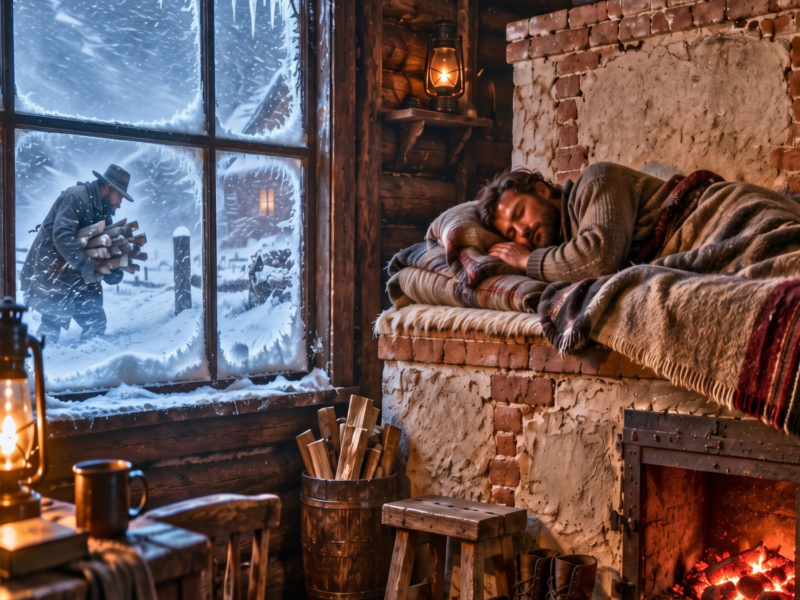
Neighbors Mocked His Giant Brick Stove—Until They Fought the Cold While He Slept Warm
Sanctuary
The coldest night came on the fourth day, after the storm had already worn everyone’s spirits down to the bone.
Outside the Hail cabin, the glass thermometer nailed to the porch post plummeted to thirty-eight degrees below zero. The wind drove loose, powdery snow across the yard, pressing the lethal cold through every weak seam, every microscopic gap in the log walls.
Warren kept the iron stove hot, but never dangerously red. He knew the metal well enough now to respect its limits; over-firing it could crack the cast iron or ignite the ceiling. That meant feeding it steadily, in smaller batches. Midnight. Again after two o’clock.
Near four in the morning, Warren pushed back the heavy quilts and put his boots on once more. He crossed the freezing room to the woodbox, added another load, and waited for the draft to strengthen.
He walked to the frosted window and scraped a small circle clear with his thumbnail. He peered through the glass, through the moving curtains of snow. He could just make out the dark silhouette of the Varic chimney.
There was no smoke.
Warren stared at it, his bleary eyes narrowing. Jonas’s fire had gone out. In thirty-eight below zero, with a blizzard raging, a dead fire was a death sentence. Warren assumed the Varic cabin must be cooling fast, the immigrant and his wife freezing in their bed.
Morning gave him the answer.
The wind finally broke at sunrise, though the cold remained absolute. Warren bundled up in his heaviest gear and waded through the chest-high drifts across the yard. He found Jonas outside, calmly clearing snow away from his front door with a wooden shovel.
Jonas looked worn by the days of isolation, but his eyes were clear. He did not look like a man who had spent the last four nights rising every two hours in a desperate panic.
Warren stopped at the edge of the shoveled path, breathing heavily. “When did you feed it last, Jonas?”
Jonas rested the shovel against the log wall. He looked at the sky. “After supper. Nothing more.”
Warren stared at him in disbelief. He pushed past Jonas and followed him inside the cabin.
The firebox was pitch black. No flame moved behind the heavy iron door. No smoke rose from the ashes. Warren walked directly to the massive masonry bench and placed his bare palm flat against the brick.
Jonas watched him silently.
It was not hot. It did not need to be. Deep in the core of the masonry, a steady, radiant warmth remained. It was enough to take the deadly edge from the room. It was enough to keep water from freezing. And it was enough to keep a sleeping man comfortable beneath his blankets until the sun rose.
Warren left his hand there for a long time. He felt the heat seeping into his calloused palm. He did not say Jonas had been right. For the first time since they had met, he did not need to.
By the fifth day, the storm was still technically holding Ash Creek, the snow deep and impassable.
Arlland Pike had not run out of wood. That was not the problem. The dry cottonwood he had carried inside before the storm was completely gone. His larger stack remained behind the shed, but the wind had built a massive, six-foot drift across the path. He was too weak to dig through it. What remained within his reach was damp, rotten, and dirty.
His chimney was completely failing. When the wind changed, the draft weakened. If Arlland burned the stove hard enough to actually warm the cabin, the smoke pushed back into the room, choking him. If he lowered the fire to stop the smoke, the room instantly cooled to freezing. There was no good choice left.
Warren found him that afternoon, sitting beside the cold stove in his heavy coat, hat, and mittens, shivering uncontrollably, his lips tinged blue.
Weeks earlier, Warren might have pointed toward his own cabin. He might have trusted iron, wood, and sheer persistence to solve the old man’s problem.
He did not.
“You’re coming to Jonas’s until this wind drops, Arlland,” Warren said, helping the frail man to his feet.
Arlland looked toward his useless stove, too tired to argue, and nodded.
Before leaving the Pike property, Warren waded back to his own home. He went to his shrinking woodpile and took several pieces of his absolute best, driest, most seasoned lodgepole pine. He tied them into a tight bundle with twine and carried them under his arm, trudging through the blowing snow.
The two men crossed to the Varic cabin slowly, fighting the drifts.
Warren knocked. Jonas opened the door. His gray eyes moved first to the shivering Arlland, then down to the bundle of prime wood under Warren’s arm. Beyond them, the storm was still moving hard across the desolate yard.
Elena looked toward the remaining stack in their lean-to. There was enough to survive, but winter had not finished asking for its toll.
Warren stepped onto the threshold and silently set his bundle of dry pine beside the wall. It was an offering. A tribute to the builder. Only then did Arlland enter.
No one mentioned the brick mountain. No one mentioned the crazy foreigner building a bed into a stove. Jonas simply opened the door wider, his face impassive, and let both men inside.
Arlland sat heavily on the masonry bench without removing his coat. For several minutes, he just sat there, shivering. Nothing happened. There was no sudden, face-melting blast of heat. No roaring fire waited to meet him.
But slowly, surely, the warmth simply moved through the brick beneath his weight. It seeped through his heavy wool coat, thawing his frozen muscles, relaxing his spine. After a while, Arlland pulled off his mittens. Ten minutes later, he unbuttoned his coat.
Matilda Hail and Ruth Row arrived an hour later, fighting through the trenches Warren had dug. They brought a loaf of bread, dried salted meat, and a covered pot of beans. Their mittens were soaked with snow from crossing the yard, so Elena took them and hung them near the masonry mass instead of over an open flame, where they would scorch. They began drying evenly, radiating steam.
A tin kettle rested on the upper ledge. The main fire had been reduced hours earlier, yet when Ruth touched the kettle, the water inside remained hot enough for tea.
Warren sat quietly in the corner, watching Jonas prepare the evening firing. It was a masterclass in efficiency. One load of dry pine. A hard, clean, oxygen-rich burn. Then, the fire would be allowed to die completely. There would be no midnight feeding. No scraping of ashes at 3:00 AM.
Ruth studied the bench, her pragmatic mind working. She asked Elena where the masonry stayed hottest, and when the remaining heat was most useful for keeping a stew warm without boiling it over, or for finishing the baking of bread.
Elena pointed proudly to the chalk marks beside the heater. Some recorded firing times. Others marked how long the useful warmth had lasted after the flames disappeared.
Near the firebox, an old, dark soot stain remained on the brick from the very first failed draft. Jonas had never scrubbed it completely away. The heater carried its mistakes proudly beside its proof. It was a monument to learning.
Arlland leaned back against the warm masonry wall. His gloves lay forgotten beside him now. His coat hung open. Before Jonas’s evening fire had even burned itself down to coals, Arlland’s head lowered against the warm brick.
A few minutes later, the old man was fast asleep, his breathing deep and even for the first time in a week.
Nobody woke him.









