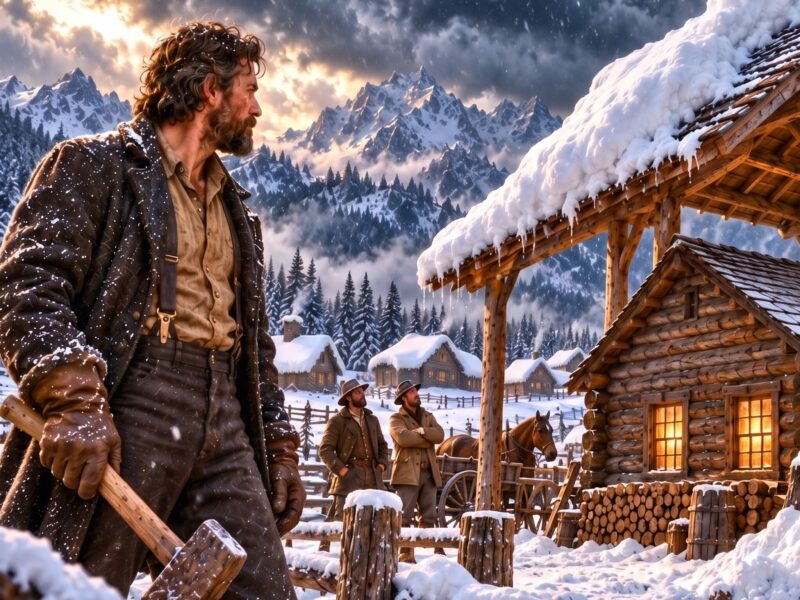
Neighbors Mocked His Strange Two Roof Cabin—Until Heavy Snow Made Every Other Roof Groan
The Aftermath of the Ice
Morning revealed what the darkness had hidden. Hawthorne Basin lay deep under a pristine, unbroken blanket of snow.
One shed had lost a corner entirely. A porch awning was completely gone. Silas’s workshop stood, though the floor beneath his buckets was wet.
Bram Talcott came over with a shovel and helped Nolan clear the southeast path. When they finished, Bram stepped beneath the second roof, looked up at the old shakes, tapped one from below with his shovel handle, and studied the snow line beyond the posts.
“That old roof carried almost none of it,” Bram noted with quiet wonder. “Not much,” Nolan replied.
Bram looked overhead again, squinting. “That’s what the other one was for.” “That was the idea.”
Nothing more needed to be said between them.
Silas arrived later that morning. He went directly to the northwest side and found the shifted peg, his experienced eyes following the joint down to the X-brace Nolan had added after September.
“Wind still found it,” Silas observed. “It did.” “Didn’t find the same weakness twice, though.”
Nolan nodded. Silas had been right about the danger of the wind catch. Nolan had been right that it could be managed with engineering. Under the roof that Hawthorne Basin had once laughed at, a family was drinking hot coffee in safety.
Neither man needed the other to be entirely wrong, and Bram Talcott did not laugh again.
Act V: The Valley Adapts
Chapter 10: The Spring That Followed
Spring came slowly to Hawthorne Basin in 1888, washing the valleys in a flood of gray meltwater.
Nolan Straoud did not become famous, nor did the basin suddenly fill with two-roof cabins. His structure required far too much timber, too much exhausting labor, and too much open space to make sense for every standard homestead.
Yet people remembered what the winter had shown them.
When Bram Talcott rebuilt his collapsed equipment shed, he gave it a sharper roof pitch and deliberately left the snow-drop side clear of obstructions. Silas Broom later built an independent weather cover over a tack room, then another over a smokehouse, using independent posts. One family moved their winter woodpile fifty yards away from an ewe fall-line.
Others began paying significantly closer attention to prevailing wind directions, drift accumulation, and the insidious places where heat from inside a building reached the snow above it.
The seasonal pattern established during that brutal winter repeated with variations over the next several years. Each cold season provided fresh examples of the double-roof system’s superior performance—measured in structural integrity maintained, repair costs avoided, and the simple ability to function normally when conventional cabins became hazardous traps.
The transformation in how neighbors approached construction began with specific technical questions rather than broad philosophical discussions. A rancher forty miles south built his new barn in a modified plan that incorporated independent roof framing for heavy-snow zones.
These local innovations connected to broader patterns of frontier adaptation. Traditional builders had never truly abandoned the wisdom of independent structural layers, whether in the form of double-roofed barns in the northern timberlands or the multi-layered insulation of indigenous earth lodges.
By the 1890s, as territorial Wyoming approached statehood, the lessons of the double roof had woven themselves into the practical folklore of the region. Carpenters working on mining outposts and rail stations noted the performance during particularly severe storms, and builders began incorporating independent snow-shedding layers over critical equipment sheds and livestock shelters.
Epilogue: The Whisper of the Shakes
Years later, when Sam Straoud had grown to manhood, taking over the ranch operations alongside his aging parents, he would walk visitors out to the edge of the timber and point up at the strange, crooked cabin.
The outer cedar roof had weathered to a deep, silvery gray. Rain had struck it; snow had loaded it; decades of sun and ice had aged the pine boards. But below it, the old cabin roof remained in its dry, protected shadow—untouched by the rot that had threatened it on the day his parents first arrived.
The round stone house across the territory may have mastered thermal mass, but the Straoud cabin had mastered the sky.
Nolan never called the roof truly finished. There was always another joint to inspect, another weathered shake to replace, another winter coming down out of the Bitterroot Mountains to test the strength of the posts.
The old cabin still stood, its walls solid, its air dry, wrapped in the silent security of a roof built over a roof. Proof that the people who survived the harshest frontiers were those who listened to the land, anticipated its violence, and understood that sometimes, to protect what is precious underneath, you have to build something larger to take the blow first.









