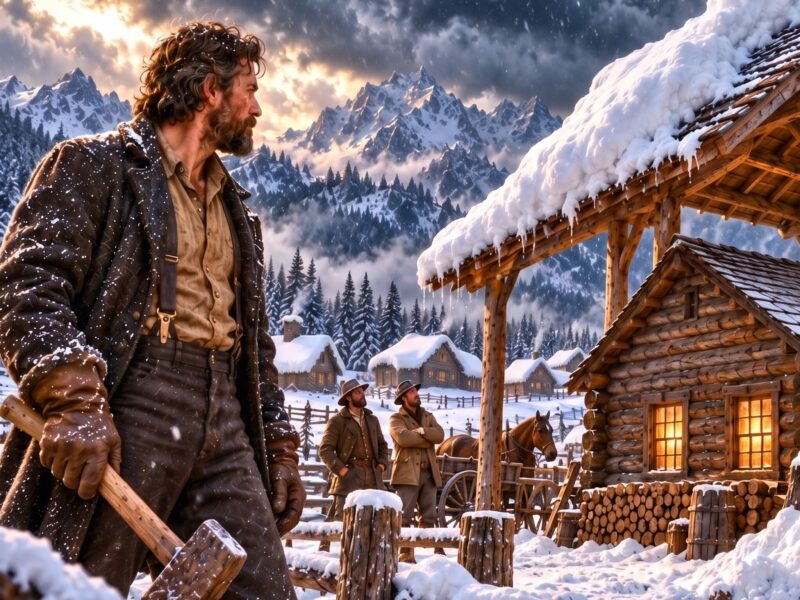
Neighbors Mocked His Strange Two Roof Cabin—Until Heavy Snow Made Every Other Roof Groan
The Night of the Great Frost
The sounds began before dark. A shed groaned near the creek. A barn beam answered farther up the road. Iron nail heads ticked inside old rafters like clockwork.
Across the basin, people realized the danger and began working their roofs in the freezing dark. At Bram Talcott’s place, he and his two daughters worked in frantic turns. The girls cleared what they could reach along the lower edges while Bram climbed higher with a wooden shovel, pushing one heavy load over the side, only to watch fresh snow fill the space again.
At Silas’s workshop, the warmth rising from beneath had softened the lowest snow layer before the sudden freeze. Water found old, forgotten nail holes. Silas set metal buckets beneath the first drips, moved his valuable tools, and went outside to inspect the dangerous buildup on his own eaves.
Elsewhere in the valley, an abandoned shed folded inward at one corner. A livestock lean-to lost an entire bay. Hawthorne Basin was not universally collapsing, but nobody was laughing about roof loads anymore.
At the Straoud cabin, the south pitch released snow in rhythmic intervals: a scrape, a rush, a heavy impact. Beneath it, the old cabin roof carried almost none of the new snow.
Inside, Eliza climbed quietly into the loft. The familiar tin basin still sat beneath the warped board and the old water stain. She lifted the basin. Completely dry. She ran her hand inside, then looked up at the stained boards overhead.
Outside, another sheet of snow slid from the outer roof with a muffled roar. The basin remained dry. Just before dawn on the third day, the northwest wind returned with a vengeance, striking the outer roof hard.
The structure trembled. The X-braces tightened, released, and tightened again. A metal-on-wood connection on the windward side began to emit a high-pitched squeak with each violent gust.
Nolan heard it clearly from inside. He took the lantern. Eliza reached for the dry gloves hanging near the stove and handed them to him without a word.
Outside, driving snow turned the darkness into a blinding wall. Nolan entered the gap beneath the outer roof and raised the lantern toward the northwest frame.
The ridge drift was still there, packed like concrete. The windward oak peg had moved perhaps half an inch—just enough. He checked the reference points first; the frame was still square.
Nolan set the lantern low, took his heavy mallet from his belt, and drove the oak peg back into its joint with three hard, decisive strikes. He did not climb onto the roof. He did not try to clear the ridge drift in the middle of a gale. There was nothing to prove up there.
Another powerful gust hit. The roof moved, the braces creaked, but the heavy posts stayed firmly planted. No footing rotated. No bay began to rack.
Behind the cabin, a heavy snow slide had buried the old path to the pump, exactly as the first snow had warned it could. But the southeast route remained wide open. Sam stood inside that warm doorway, watching the lantern light move beneath the roof. He stayed safely behind the threshold.
Hour after hour, the wind tested the northwest edge. The structure gave slightly, absorbed the kinetic load, and returned to true. By daylight, the gusts began to weaken. The roof was still standing.
It was standing not because Nolan’s first design had been infallible, but because the September wind had found its weakness months earlier, and Nolan had listened before February came to test the same mistake twice.









