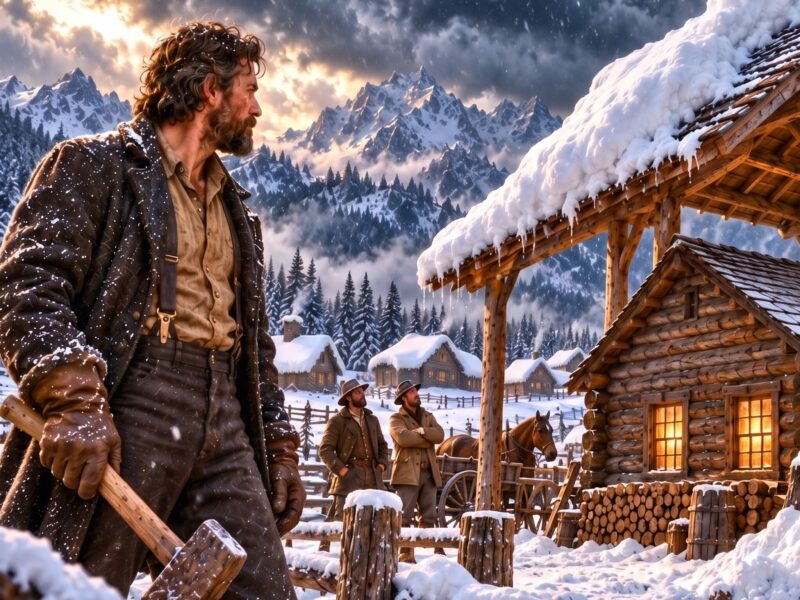
Neighbors Mocked His Strange Two Roof Cabin—Until Heavy Snow Made Every Other Roof Groan
The Iron Grip of February
By early January, the second roof had become familiar enough that most people in Hawthorne Basin no longer stopped on the wagon road to point and stare.
Gideon Hill still did, though. At sixty-four, the retired freight teamster had spent more than thirty years hauling heavy loads across treacherous mountain passes, where weather could close a road between breakfast and dark. He stopped at the Straoud place one freezing afternoon and walked around the cabin without making a single joke.
He studied the old snow lines on the supporting posts. He pressed a gloved hand against the northwest upright, feeling for any sway. Then he stepped beneath the outer roof and looked straight up at the underside of the weathered pine boards.
“Does the stove heat reach that upper skin?” Gideon asked, his breath pluming in the frigid air.
“Not enough to matter,” Nolan answered from the woodpile.
Gideon held his glove against a board for a long, meditative moment, then nodded. He moved outside again and studied the uneven traces left by earlier snow slides. “Northwest side holds more. When the wind packs it, it forms a crust.” He looked toward the mountain gap. “You’ll have to watch that weight.”
He did not call the roof clever. He did not say Nolan had solved winter. But he didn’t mock it either. He simply identified the two things Nolan could not afford to lose: a cold outer roof and a clear way out when winter finally pressed down hard.
Word eventually reached Silas Broom that Gideon had inspected the strange roof. Silas offered no public opinion; there was little to argue about yet. The roof had shed a few modest snows, the braces had survived ordinary wind, and the old leak had not returned. But January weather in the Rockies was not December weather. Gideon had recognized what others had missed, and even he had offered no premature promise. He had only identified the stakes.
The warning mattered on February 7th.
Hawthorne Basin passed through an unusual, deceptive warm spell that melted the surface snow into slick slush. Then the sky plummeted in color, the fierce wind faded to a dead calm, and fresh snow began falling while the temperature hovered dangerously near freezing.
It was the wrong kind of snow—not dry powder, but large, wet flakes that stuck like heavy plaster to fence rails, pine branches, and wagon tongues. By afternoon, Nolan’s outer roof had turned solid white. He pushed a marked stick into the yard and checked the level repeatedly. The accumulation climbed steadily.
Toward evening, part of the south pitch finally released. Snow moved at once, a heavy sheet sliding over the ewe and striking the cleared drop zone below with a heavy thud. Later, another section followed.
The northwest side behaved differently. The wind, funneling through the mountain gap, pressed the heavy, wet accumulation tightly against the upper pitch. It clung there stubbornly, forming a growing, thick band of ice just below the ridge.
Night brought sub-zero polar air down into the basin. The wet layer settled under its own immense weight, and the soft snow turned to solid, armored ice. Then more snow fell, covering the ice layer and adding fresh, crushing weight below it before the older ice could slide free.
Nolan stayed on the ground. He walked the perimeter of his structure in the freezing dark and checked the charcoal alignment mark on the northwest post.
It was still aligned. He put his fingers against the oak peg installed after the September squall; it was still seated firmly. Above him, another section of the south pitch released with a dull, echoing rush. The roof was shedding weight, just not all of it.
Nolan stepped back far enough to see the ridge in the starlight. The northwest drift had thickened exactly where Silas had pointed out months earlier, and the storm was still building from the north.
Then the deep, biting cold came down into Hawthorne Basin fast. What had been a heavy, wet blanket suddenly turned to solid, unyielding glacier ice. The structures across the valley were no longer carrying mere snow; they were bearing the crushing weight of frozen slabs.









