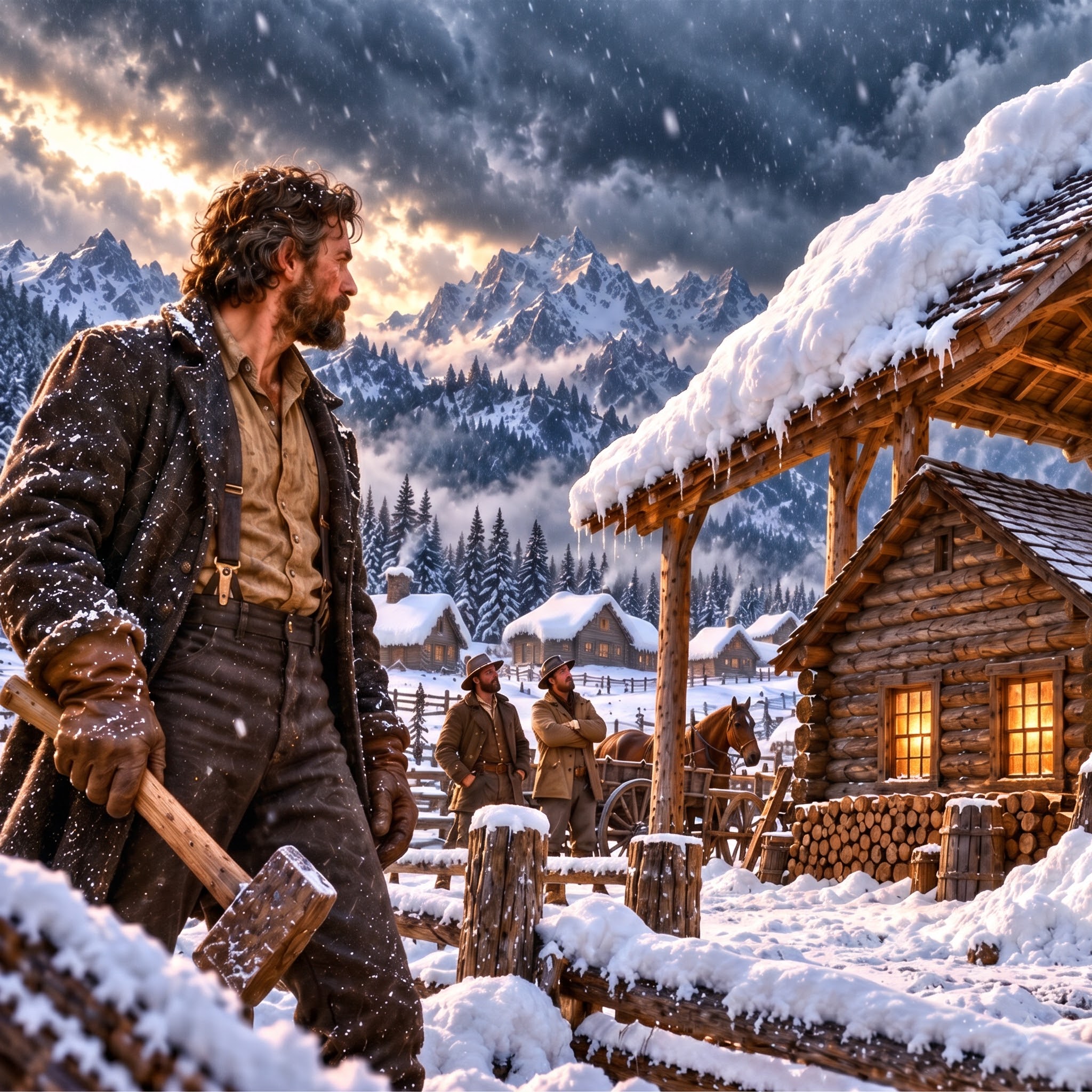
Neighbors Mocked His Strange Two Roof Cabin—Until Heavy Snow Made Every Other Roof Groan
The Blueprint of Doubt
By late August of 1887, the bitter winter was still months away, but the Montana sun was already losing its high-summer bite. Nolan Straoud was thirty-eight years old when he moved his family to the western side of Hawthorne Basin. His wife, Eliza, was thirty-five. Their son, Sam, was eleven.
The cabin they purchased measured eighteen by twenty-six feet. Its lodgepole pine walls were solid enough, and the fieldstone hearth had plenty of years left in it. But a small loft sat uncomfortably beneath a low board-and-shake roof pitched at a lazy four-in-twelve angle.
The price of the property had been unusually low, and the reason for the discount hung directly overhead. Someone had repaired that roof many times over the decades, but never all at once. Old, silvered cedar shakes lay beside newer, mismatched pine ones. Several nail lines had turned black with rot.
Up in the loft, one particular board had warped deeply from repeated, chronic dampness. A grain chest left behind by the previous owner carried a pale, circular water stain across its lid where spring meltwater had dripped year after year, indifferent to human frustration.
Nothing had failed suddenly. That was almost worse. The cabin had simply learned to leak slowly, quietly rotting from the top down.
Eliza studied the rotting roof, then pointed to the stack of replacement shakes stacked beside the back wall. She suggested stripping the worst sections and replacing them before the cold weather arrived. It was a sensible, familiar, affordable plan.
Nolan did not disagree with her logic. But before touching a single shingle, he spent several autumn evenings walking the perimeter, studying where the old water marks began and where the structural sag was deepest.
Eliza expected Nolan to start pulling cedar shakes the next crisp morning. Instead, he carried a shovel, a wood auger, and a heavy iron digging bar to the northwest side of the cabin. He drove wooden stakes into the ground, measured between them with a frayed hemp cord, moved one stake, and measured again. Then, without a word of explanation, he started digging.
By noon, the first footing hole was deep enough to swallow most of the digging bar.
Sam watched from the woodpile, his curiosity finally pulling him closer. “How does digging a hole fix the roof, Papa?”
Nolan paused, clearing damp dirt from the spiral of the auger. “Because this one won’t sit on the house.”
That cryptic answer gave Sam plenty more questions, but Nolan simply shouldered his tools and returned to work.
Heavy lodgepole uprights went into the deep holes. More appeared along the opposite wall, forming a wide perimeter. Nolan checked each towering post with a plumb line before packing heavy earth tightly around its base. Over the following days, massive timber beams began connecting them. A rectangular timber frame slowly rose around the small cabin, noticeably wider and significantly taller than the building beneath it.
Nothing touched the old log walls. Nothing rested on the fragile old roof.
Eliza watched the strange shape grow day by day. She also watched their meager lumber pile shrink at an alarming rate. Some of those thick pine boards had originally been cut and set aside for repairs to the livestock lean-to before winter arrived. She said nothing. Instead, she quietly separated those boards from the rest, stacked them neatly beside the barn, and tied a piece of rough twine around them.
Nolan noticed the twine. He kept building.