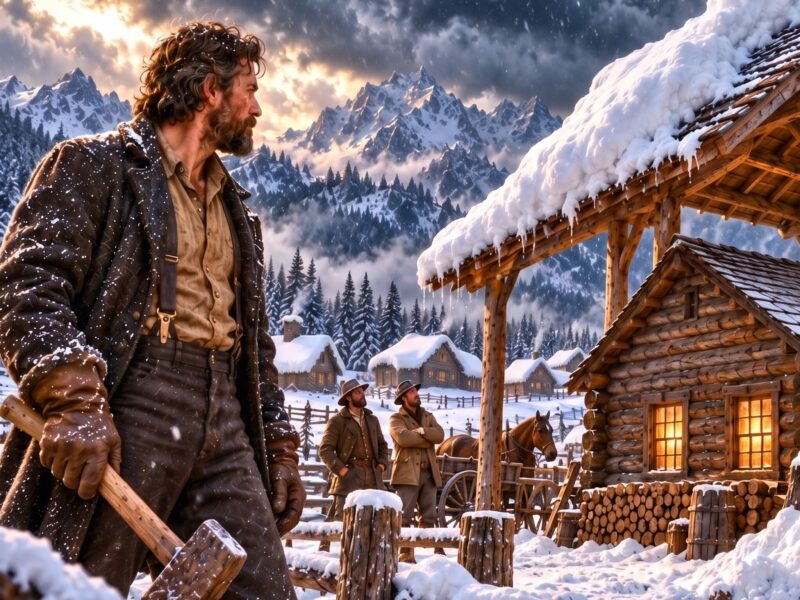
Neighbors Mocked His Strange Two Roof Cabin—Until Heavy Snow Made Every Other Roof Groan
The Carpenter’s Verdict
Once the uprights rose visibly above the cabin ridge, wagons began slowing down on the dusty road.
Bram Talcott, a forty-six-year-old homesteader on the neighboring spread, finally stopped his team beside Nolan’s property. He sat high in his buckboard, studying the towering posts. “You building a barn? No porch?”
Nolan kept fitting a timber joint with a wooden mallet. “A weather roof.”
Bram looked at the cabin’s existing roof, then back up at the towering frame surrounding it. “Over that roof?”
Nolan nodded.
Bram laughed, a dry, dismissive sound. But beneath the mockery, there was practical sense. Good timber cost hard labor. Every straight lodgepole cut for Nolan’s outer frame was one less pole available for fencing, livestock shelter, emergency repairs, or winter fuel. Bram knew exactly how quickly a woodpile could shrink once cold weather settled into the basin.
He pointed toward the old shakes on the cabin. “You could strip that roof and cover it again with half this lumber.”
Nolan knew that.
Bram stepped down from his wagon and looked at the frame once more, squinting against the sun. “Why protect a bad roof instead of replacing it?”
Nolan set his mallet down on a stump. “Because the old roof isn’t the whole problem.”
Bram waited for an elaboration. None came. He climbed back onto his wagon and drove away, shaking his head at the stubbornness of men.
By evening, another neighbor had stopped to stare. Then another. The strange frame was becoming impossible to ignore in a valley where everyone’s business was public property.
Silas Broom came several days later. At fifty-seven, the millwright and carpenter had spent decades raising barns, sheds, and covered bridge structures across the surrounding country. Unlike the others, he did not arrive with a joke or a grin.
He walked the entire perimeter of the construction. He studied the spacing between the heavy posts, pressed the heel of his boot against a freshly packed footing, looked along the unfinished overhead beams, and finally stopped beneath the longer northwest overhang.
Silas saw three distinct problems immediately: First, that broad western edge would catch the wind like the sail of a schooner. A hard northwest gust could pull upward on it with surprising, destructive force. Second, the tall posts could remain upright while the frame itself twisted sideways. A tall structure did not need to fall to fail; it only had to rack far enough for its mortise-and-tenon joints to loosen. Third, the snow load. A steep roof could shed its load quickly, but not always evenly. If one side released while the other remained heavily packed, the frame would carry an uneven, twisting burden.
Nolan listened to the older carpenter without interrupting a single time. When Silas finished, Nolan looked toward the vulnerable northwest edge. “Would you shorten the west side?”
Silas shook his head slowly. “I’d put the weather back on the roof you already own.”
There was no insult in Silas’s tone. That made the warning infinitely harder to dismiss. Silas left without another word. Nolan remained beside the frame, looking upward at the long western edge, weighing the carpenter’s wisdom against his own memories.









