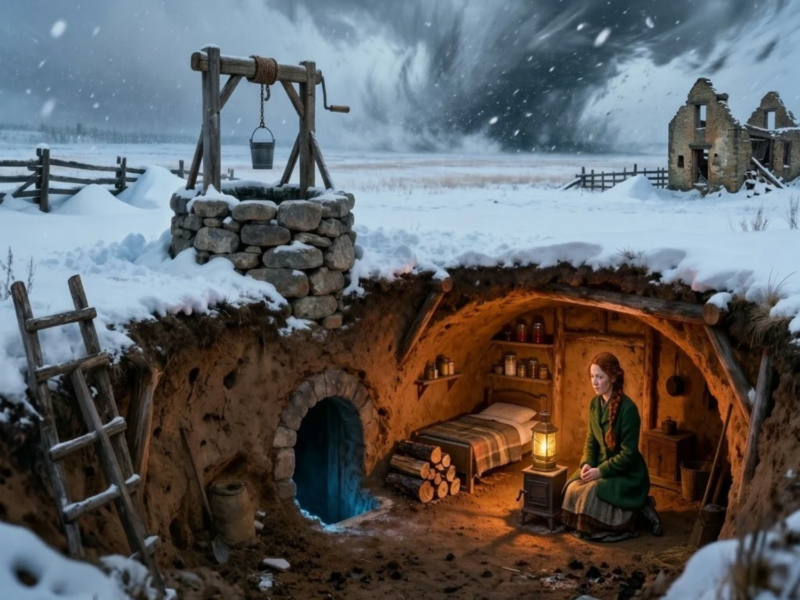
She Inherited Nothing but a Dry Well Then Built a Home Inside That Survived the Great Blizzard
The Engineer’s Ledger
The battered leather ledger clutched in her apron pocket was her father’s legacy. He had spent his life as a railway drainage engineer, a man who spoke of hydraulic gradients and hydrostatic pressure the way ordinary men quoted scripture. When he died, he left her his working notebooks—meticulously inked diagrams of culverts, subterranean footings, and detailed notes on how ancient Roman builders had moved water and air through solid stone.
In the first week of September, sitting by the flickering, amber light of a single kerosene lamp, Clara had traced one of those faded diagrams and suddenly seen the dry well in a completely different light.
It wasn’t a failed water source. It was a pre-built foundation.
The plan she formulated was brutally simple. The well was a naturally stable cylinder of earth. She just needed to make it livable. But livable meant materials, and she couldn’t afford a trip to the mercantile. Instead, she became a scavenger of the surrounding mining camps and abandoned rail spurs, dragging home discarded lengths of corrugated iron and two crushed iron stovepipes.
To anyone watching from the wagon road, she looked like a solitary crow picking over a carcass.
On the tenth day, Miller’s young assistant, a clerk named Bennett, rode out to check on her progress. He reined in his horse, stared at the pathetic pile of rusted metal and rope, and laughed aloud.
“You planning on breathing through a straw, Mrs. Garrett?” Bennett mocked, leaning against his saddle horn. “There isn’t any gold down there, and there sure as hell isn’t any water.”
Clara didn’t look up from her work, her calloused hands busy knotting hemp rope. “The air is free, Mr. Bennett. I suggest you save yours for the ride back.”
She was rigging a double pulley system to a sturdy tripod built from salvaged fence posts. It was a simple machine, but mathematically clever. With a three-to-one mechanical advantage, she could lift a hundred pounds of heavy clay while pulling with a mere thirty-five pounds of force. She wasn’t building a cabin. She was excavating her survival.
The key to the entire design was the gap—a dead airspace between the shaft wall and her interior living quarters. The earth itself would act as a massive thermal battery. Summer heat takes months to soak deep into the subsoil; by the time winter arrived, the trapped warmth of September would finally reach her inner walls—a delayed thermal reaction that the townspeople, living in their thin-walled pine shacks shivering in the wind, would never understand. They lived in the wind. She intended to live in the history of the soil.