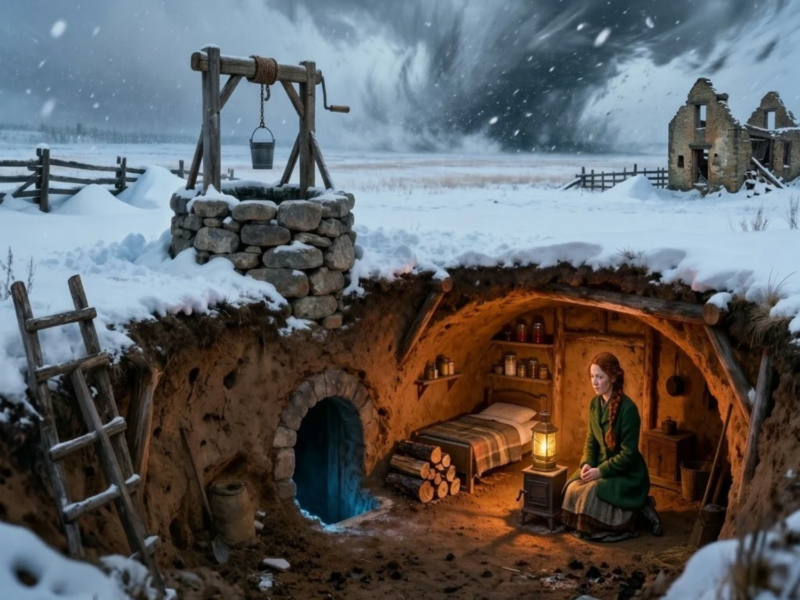
She Inherited Nothing but a Dry Well Then Built a Home Inside That Survived the Great Blizzard
The Soil Owns the Sky
Mr. Miller, facing the absolute financial ruin of his speculative investments and the cold, unyielding reality of his own poor planning, approached Clara two weeks after the spring thaw. He came hat in hand, stripped of his arrogance, carrying no notices of reclamation. Instead, he carried a formal business proposal.
“Mrs. Garrett,” Miller said quietly, staring down at his dusty boots. “The people are terrified to rebuild above ground. They see timber as a fatal trap. I want to hire you to oversee the construction of a new district… what the papers are already calling the settler’s vaults. We have the labor and the stone, but we don’t have the math. Name your price.”
Clara didn’t take his blood money to become a traditional real estate developer. She took it to establish a permanent school of practical frontier engineering. She had no desire to become a land baron; she simply wanted to ensure that the next generation of settlers never again had to rely on the blind mercy of the prairie wind.
Five years later, the rolling ridge looked radically different. Iron intake and exhaust pipes dotted the slope across the valley, and nearly half the population of Three Oaks lived safely underground. The town had effectively abandoned its traditional skyline, replacing tall wooden facades with gentle green mounds and neat iron hatches—a resilient, quiet civilization that had wisely traded the empty vanity of tall buildings for the absolute safety of the soil.
Then came the catastrophic drought of the 1930s.
The infamous Dust Bowl scoured the American Midwest, burying everything above ground in suffocating, blinding silt and searing, apocalyptic heat. But the Garrett-style homesteads remained the only residences that stayed genuinely habitable. While surface temperatures swung wildly from freezing desert nights to scorching, 110-degree days, those underground rooms held steadfastly to the exact same fifty-five degrees Clara had harnessed decades prior. It wasn’t luck; it was immutable physics, proven durable across changing eras and punishing climates.
In the twenty-first century, university archaeologists systematically excavated the original well site.
The dry-stacked stonework was found to be as tight, plumb, and structurally sound as the day Clara had laid the stones into place. They uncovered the original iron hatch, the lead-lined drainage sumps, and formally noted in their survey reports that the architectural design had been centuries ahead of its time in passive geothermal efficiency.
The historical record no longer remembers Clara Garrett as a helpless widow or a tragic victim of the frontier. The heavy bronze plaque mounted at the Three Oaks Historical Museum officially honors her as the pioneering genius of subterranean vernacular architecture.
The dramatic story of the American West is far too often told exclusively through the lens of those who built tall and loud. The Garrett legacy offers a much quieter, more enduring correction: the exact same fifty-five degrees of earth-stored warmth that saved Henderson’s life in the freezing winter of 1886 would go on to protect generations through the scorching dust storms of the Great Depression.
The earth’s memory of September never truly forgets.
The monument standing on that ridge today is not a crumbling historical ruin. It is living, permanent proof that Clara Garrett did not fight the earth—she simply invited the planet to protect her. And in doing so, she taught the frontier a lesson it took decades to fully absorb:
The wind may temporarily own the sky, but the wise soul owns the ground beneath it. Every mathematical calculation, every precise angle of dry-stacked stone, and every inch of packed clay had been a deliberate refusal to gamble with nature. The Garrett well stands today as enduring proof that human grit, paired intelligently with the overlooked laws of physics, can successfully turn the harshest liability into a timeless legacy.
She didn’t build upward toward the fickle sky; she built smarter into the earth. And that, in the end, made all the difference.









