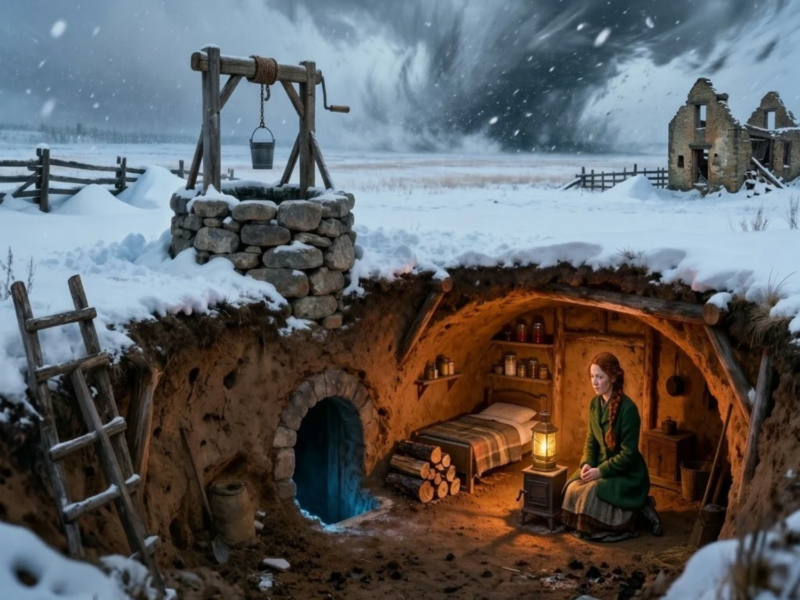
She Inherited Nothing but a Dry Well Then Built a Home Inside That Survived the Great Blizzard
The Rescue
The blizzard reached its chaotic crescendo on the third night—a sustained, deafening roar that sounded less like wind and more like the grinding tectonic friction of the earth itself. Visibility above ground was absolute zero. A blinding wall of frozen needles moved at sixty-five miles per hour, stripping paint from the few standing structures and forcing its way through the microscopic cracks in window frames.
Down in the settlement, the situation had deteriorated into a catastrophic failure of thermodynamics.
Mr. Henderson’s general store—serving as a makeshift refuge for three unfortunate families whose clapboard roofs had already collapsed under four-foot snowdrifts—was rapidly failing. The indoor temperature had plummeted to a bitter fifteen degrees. The terrified breath of the huddled children hung thick in the freezing air like ghostly fog.
As Henderson watched thick white frost creep aggressively across the wooden floorboards, a terrifying realization gripped his heart: within six hours, they were going to begin losing the youngest among them to systemic hypothermia.
In the grip of desperation, his mind flashed back. He remembered the two iron pipes protruding from the dirt out on the Garrett claim two miles up the ridge. He remembered the mockery in the saloon, and the stubborn “badger widow” and her ridiculous hole in the ground.
In that crystal-clear moment of absolute clarity born of survival, Henderson understood the truth: if Clara Garrett was still alive out there, it wasn’t due to mere luck. She had engineered herself entirely outside the path of the wind’s kinetic energy.
Gathering the strongest men left standing, Henderson barked orders. They wrapped themselves in every heavy woolen blanket they owned and began a brutal, blind crawl up the ridge toward the claim.
There were no horses—the animals would have frozen mid-stride in the open. There was only a frayed guide rope, a pocket compass, and a landscape that had been utterly obliterated by towering drifts. They were searching blindly for a grave that just might turn out to be a lifeboat.
The frantic, muffled drumming on Clara’s iron hatch sounded like human knuckles hitting solid iron.
It took Clara ten full minutes of concentrated effort to chip away the rock-hard ice that had accumulated around the rim—ice formed instantly when her warm exhaust breath met the sub-zero air at the surface vent.
Throwing the heavy bolt back, she heaved the iron lid upward.
She was instantly met by a blinding wall of white and the nearly frozen, frost-blackened face of Mr. Henderson. His beard was a solid, grotesque mask of ice; his eyes were narrowed to painful slits. Behind him, two other men slumped heavily in the snow, their movements agonizingly slow and uncoordinated—the classic neurological prelude to terminal hypothermia.
Clara didn’t waste precious breath asking questions. She reached out, grabbed Henderson by the thick collar of his heavy wool coat, and hauled him bodily toward the open shaft.
“Get them down the ladder one at a time!” she shouted over the screaming gale. “Do not stop to pray, and do not stop to talk!”
The transition was a visceral physical shock. The refugees tumbled downward from forty degrees below zero into the heavy, silent, embracing warmth of the underground chamber.
The sudden, radical rise in temperature hit their freezing bodies like a physical weight. Their frost-stiffened clothes immediately began to steam, filling the confined space with the sharp, humid smell of wet wool, melting ice, and human sweat.
Henderson collapsed onto the packed clay floor, gasping raggedly as warm blood rushed painfully back into his freezing extremities with a severe, stinging heat. He blinked rapidly, looking around the subterranean room: whitewashed stone walls, a dry, comfortable bedroll, a single steady candle, and absolute stillness. There was no roaring fire, no belching stove, no brick hearth.
Yet he felt no chill. It was a complete sensory contradiction that his freezing, exhausted mind struggled to process.
He watched Clara calmly re-securing the heavy hatch overhead, seeing no panic, no frantic desperation in her dark eyes. She wasn’t a desperate survivor of the storm; she was a calm, composed resident of the earth itself.
His voice cracked, splintered by the ice that had formed in his lungs. “How… how is it hot in here? You don’t have a stove. You don’t have a hearth. The world is ending up there, and you’re sitting in a summer afternoon.”
Clara calmly sat down on her shipping-crate desk and poured a cup of crisp, clean water from a earthenware pitcher that wasn’t even skimmed with ice. She looked down at Henderson and the shivering men, watching their bodies slowly thaw in the fifty-four-degree sanctuary.
“It isn’t hot, Mr. Henderson,” she replied quietly, her voice devoid of triumph. “It is merely the earth’s memory of September. You spent your entire life building flimsy wooden boxes to fight the wind, and then you act genuinely surprised when the wind takes what you give it.”
She gestured to the walls. “I didn’t build a fragile house. I reclaimed a constant.”









