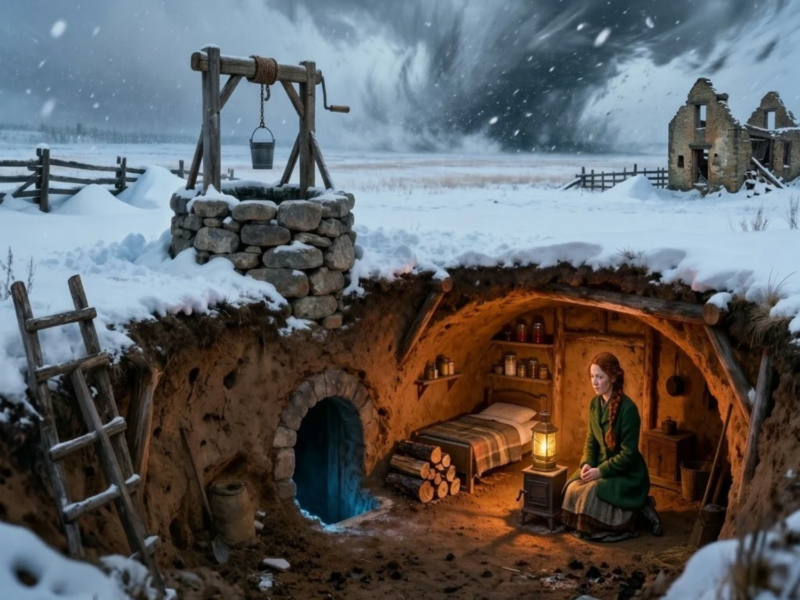
She Inherited Nothing but a Dry Well Then Built a Home Inside That Survived the Great Blizzard
The Great Blizzard of 1886
The old-timers had been reading the atmospheric signs for days, though most had ignored them in favor of wishful thinking. Cattle out on the open range had begun bunching together in tight, nervous clusters, refusing to graze. Migratory birds had vanished overnight, fleeing south before the shift in pressure.
During the first week of December, the sky turned a bruised, heavy leaden purple, and the barometric pressure dropped so sharply that people walking the streets of Three Oaks felt their ears violently pop. This was no standard winter blow. It was the terrifying vanguard of what history would come to record as the Great Blizzard of 1886.
When the storm finally struck, the temperature plummeted a staggering forty degrees in a mere three hours. The howling wind shrieked at sixty miles per hour, driving a fine, razor-sharp crystalline snow that instantly blinded anything caught in its path.
In town, the flimsy pine shacks immediately began to groan and twist under the assault. Heat generated by frantic wood-burning stoves was violently sucked out through gaps in the poorly fitted floorboards almost as fast as the settlers could feed timber into the hearths.
The pioneers had built their homesteads using eastern architectural traditions—thin pine boards and balloon framing that relied entirely on a continuous, frantic combustion of fuel to survive. But the local timber was green and wet, the stone chimneys choked on violent downdrafts, and the sheer velocity of the Arctic wind pulled heat out through forced convection faster than any hearth could possibly replace it.
Clara quietly retreated to her well.
She pulled the heavy iron hatch shut behind her and dropped the thick bolt into place. She didn’t need to peer up at the screaming sky; she knew her physics would hold. She had six months of dried provisions stored neatly in her cellar alcoves, and a passive ventilation system that driving snow could not choke.
While the world above her transformed into a white, screaming void of frozen death, she sat comfortably in the absolute silence of fifty-four degrees, reading her father’s engineering ledgers by the steady, unblinking light of a single tallow candle.
She was the only human being for miles around who wasn’t locked in a desperate, losing war with the storm. She was simply letting it pass over her head.









