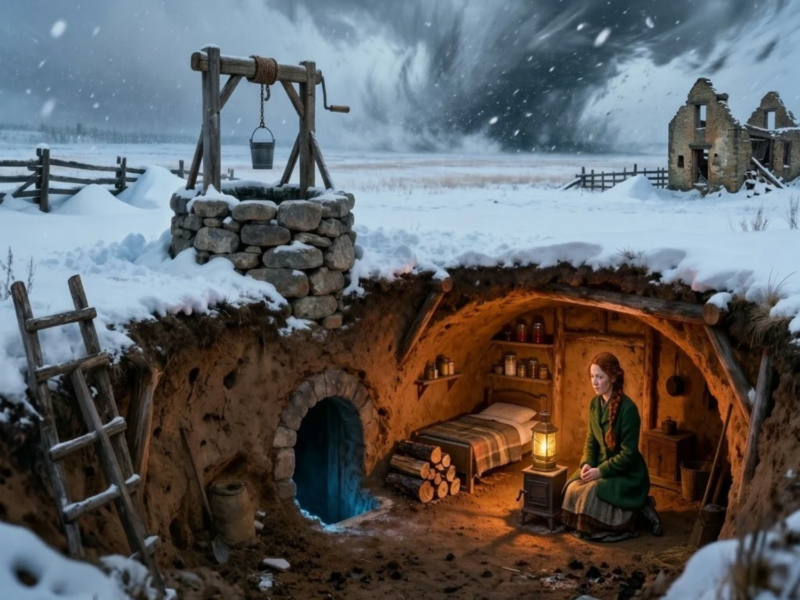
She Inherited Nothing but a Dry Well Then Built a Home Inside That Survived the Great Blizzard
Carving the Dark
Before any of the thermal physics could matter, however, she had to carve the space out of the solid earth.
On the twelfth day, alone and unassisted, Clara began her descent into the shaft with a short-handled pick in one hand and a fierce, desperate geometry guiding her mind. Fourteen hours a day were spent in the cool, oppressive dark of the shaft. The labor was rhythmic, grinding, and utterly suffocating.
Strike the clay. Fill the bucket. Climb the ladder. Haul the pulley. Dump the waste. Repeat.
By the end of September, she had expanded the bottom of the narrow four-foot water shaft from a cramped circle into a vaulted subterranean chamber ten feet across. The fieldstones she had pried from the surface over the summer were systematically laid into a dry-stack retaining wall. There was no mortar—she couldn’t afford it—but the structural physics were elegant. Each stone was tilted slightly outward, using the immense lateral pressure of the surrounding earth to lock the entire masonry ring into a self-supporting, compressive arch. Gravity, she realized, could be your greatest anchor if you gave it the right angle.
Local merchant Mr. Henderson stopped his wagon one afternoon to watch her operations. He saw the wooden pulley spinning furiously, casting a fine spray of gray dust from the hole. He called it outright madness.
“Even if you manage to finish it, Mrs. Garrett,” Henderson warned, shouting down into the gloom, “the first heavy autumn rain will turn that hole into a soup pot. You’ll drown in your own cellar.”
Clara wiped the gritty sweat from her forehead, her chest heaving. She didn’t bother explaining the drainage channel she was cutting into the porous shale layer two feet below her planned floor level. She didn’t tell him about the charcoal and crushed lime sump she had designed to filter and neutralize any underground seepage.
Instead, she offered a dry, humorless truth: “The rain hasn’t come for three years, Mr. Henderson. I’ll take my chances with the water if it means escaping the wind.”
Shaking his head at her stubborn folly, he whipped his horses and drove on. Later that evening at the town saloon, he told the patrons she had finally lost her mind to the desert heat.
But Clara remained singularly focused on her measurements. She needed a ceiling height of at least seven feet to ensure proper air stratification. Because warm air naturally rises, she installed a simple baffle—a rusted sheet of iron suspended four inches below the shaft’s surface opening.
It created a textbook Venturi effect: as the prairie wind whistled across the top of the well, it generated a low-pressure zone that constantly sucked stale air up and out of her chamber. Simultaneously, a secondary intake pipe buried six feet deep brought in fresh, naturally tempered air from a distance. It was a completely passive ventilation system—no fuel, no moving fans, silent, invisible, and perfectly efficient.
Or so the mathematics of her father’s ledger promised. The chamber was carved, and the walls were braced. But the system remained entirely untested, and the first killing frost was only weeks away.









