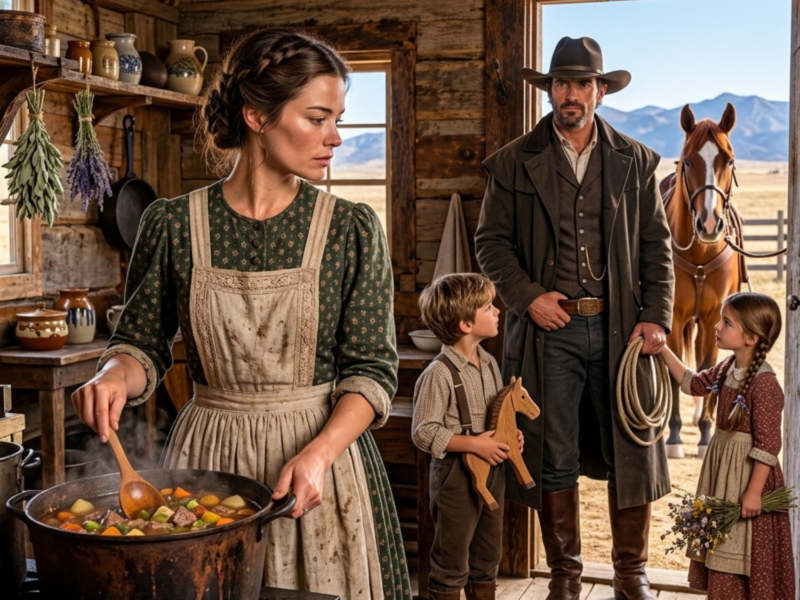
She Prayed While Cooking Her Last Meal…Then a Rich Rancher Asked, “Will You Cook for My Children?”
The Offer
Nathaniel Cross stood on her small, sagging porch.
He immediately removed his expensive felt hat, holding it respectfully at his side.
Up close, under the yellow light spilling from her doorway, he did not look like the terrifying, ruthless, wealthy titan of the county. He looked exhausted. He didn’t look tired from one hard day of riding the fence line; he looked deeply, profoundly tired. It was the specific, heavy exhaustion of someone who had completely forgotten what restful sleep felt like.
“Mrs. Anders,” Nathaniel said, his voice a low, gravelly baritone.
“Mr. Cross,” Ruth replied, her voice cautious. “I’m sorry to call so late.”
Ruth glanced past his massive shoulder toward the wagon waiting in the gloom. The boy staring back at her looked to be about eight years old, his face tense and guarded. The little girl sitting huddled beside him could not have been more than five. Her eyes were huge and frightened in the dark.
“What can I do for you, Mr. Cross?” Ruth asked, pulling her shawl tighter against the biting wind.
Nathaniel turned his hat once in his large, gloved hands, looking down at the brim.
“May I come in for a moment?” he asked softly. “I’ll explain myself plain, I promise.”
Ruth stepped aside, opening the door wider. “Please.”
Nathaniel stepped over the threshold. The small, one-room cabin suddenly seemed impossibly smaller with a man of his immense size standing inside it.
He didn’t pry, but his sharp eyes moved exactly once across the room. He took in the bare, rough-hewn wooden shelves. He saw the empty, folded flour sack resting on the counter. He saw the single, pathetic pot of watery soup simmering on the failing stove.
He said absolutely nothing about what he saw. He did not offer pity, which she was immensely grateful for.
“I’ll come straight to it, Mrs. Anders,” Nathaniel said, turning back to face her. “My wife, Margaret… she passed a year ago this past spring. A sudden fever.”
Ruth’s guarded expression instantly softened. The universal language of grief transcended wealth. “I’m very sorry for your loss.”
“Thank you,” he nodded stiffly. He looked over his shoulder, toward the small, frosted window facing the wagon outside. “It left me with Caleb and Josephine out there. Eight and five.”
For the very first time, the powerful rancher’s voice lost some of its commanding steadiness. It wavered.
“I know exactly how to run four thousand head of angry cattle,” Nathaniel continued, his voice tight with frustration. “I know how to keep a dozen rough, hired men working happily through a blinding blizzard. I know how to sit at a table and bargain with cattle buyers from Chicago who would gladly skin their own mothers for two cents a pound.”
A faint, bitter, completely humorless smile touched his lips. “But I do not know how to help two children who still wake up crying in the middle of the night, asking for their mother.”
Ruth stood silently by the stove. She said nothing. She let him speak.
“I hired cooks, Mrs. Anders,” Nathaniel said, gesturing vaguely. “Three of them since Margaret died. Good cooks, too. Women who knew their business in a kitchen. It didn’t matter.” He glanced toward her pathetic pot of soup. “Those children out there do not need a better cook. It took me nearly a year of watching them fade to finally understand that.”
“What do they need, Mr. Cross?” Ruth asked quietly.
His answer came out as a raspy whisper. “They need somebody who sees them.”
The words landed much harder in Ruth’s chest than she expected.
Nathaniel drew a long, shaky breath, regaining his composure. “I was in town today at the mercantile. I heard your name from a woman at the church. She was talking about you.”
“People talk,” Ruth said defensively.
“She said that before your husband died, if someone in the valley was sick, you brought hot soup to their door before anybody even asked,” Nathaniel continued, ignoring her defense. “She said if there was a funeral, you stayed long after everyone else had gone home, and you washed all the dishes in the church kitchen. She said you had a very specific way of making folks feel… less alone.”
Ruth looked down at her worn boots, embarrassed. “That woman talks entirely too much.”
“She may,” Nathaniel agreed, a tiny trace of genuine warmth finally entering his exhausted eyes. “But I’m deeply glad she did.”
He squared his massive shoulders. Then he asked the question Ruth would remember with crystal clarity for the rest of her life.
“Will you come and cook for my children, Mrs. Anders?”
For a long moment, the only sound in the entire world was the soft, dying pop of the final log in the wood stove.
Ruth looked at the powerful man standing in her kitchen. She looked at her empty pot of soup. Then she looked toward the window, where the two children sat freezing in the wagon.
“Mr. Cross,” Ruth said, her spine straightening with fierce pride. “I don’t need your charity.”
“I’m not offering charity,” Nathaniel replied instantly, his voice snapping back to authority. “I’m offering hard wages. A warm room on the property. Good food. And as long as you work for me, you will be treated with absolute respect by every man on my payroll.”
His gaze flicked exactly once toward the empty flour sack, and then immediately back to her eyes.
“But make no mistake, Mrs. Anders,” Nathaniel said, his voice dropping to a plea. “I am the one standing at your door because I need help. I am begging you. My children haven’t laughed properly since the day their mother died. I would gladly trade half my entire herd just to hear it once.”
Ruth looked through the window again.
Josephine, the little girl, was watching the cabin door from the wagon. She wasn’t watching impatiently or eagerly. She was watching carefully. It was the exact, heartbreaking way a child watches a door when she has already learned the brutal lesson that people she loves can disappear through one and never, ever come back.
Something deep inside the empty rooms of Ruth’s chest shifted. A door unlocked.
“I’ll come,” Ruth said softly.
Nathaniel’s broad shoulders physically dropped two inches as the tension left his body. “Tomorrow morning?”
“Tomorrow morning,” she confirmed.
She hesitated, her hand on the doorknob. “But you should know, Mr. Cross. I am not saying yes because I don’t need the wages. I desperately do.”
“Then why are you?”
Ruth looked past him, locking eyes with the little girl through the glass. “Because I know exactly what it costs to lose someone you love, and still be forced to wake up the next morning.”
Nathaniel held her gaze. He gave one slow, profound nod of understanding.
As he stepped back out into the biting cold and pulled his hat low, Ruth closed the heavy door and leaned her back against it. Only then did she look toward the small, scarred wooden table where her untouched, watery potato soup waited.
An hour earlier, she had firmly believed tomorrow held only three terrible options: public humiliation, begging for charity in town, or absolute surrender to starvation.
Now, she had a real job. She had a warm room. She had food. And she had two frightened, motherless children waiting for her to arrive.
She did not know yet whether this was a literal answer to her desperate prayer. She only knew, with absolute certainty, that it had miraculously arrived before her soup even went cold.









