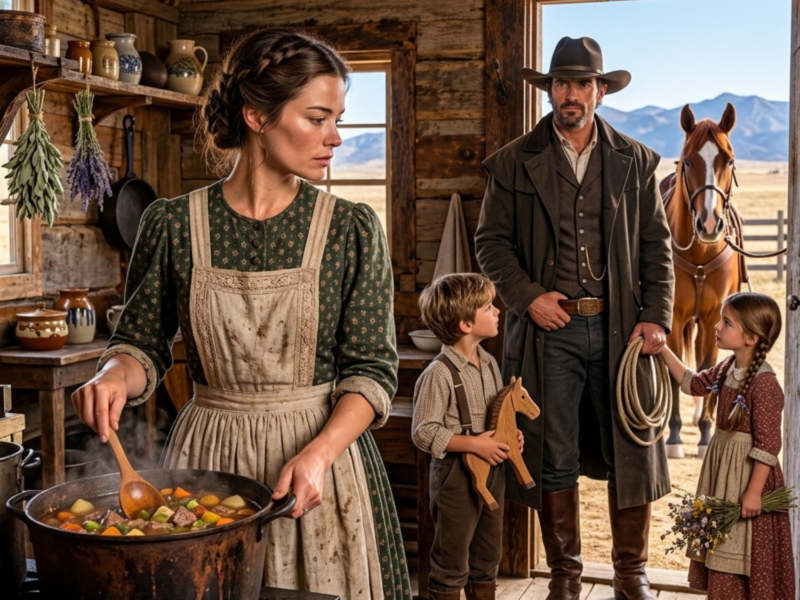
She Prayed While Cooking Her Last Meal…Then a Rich Rancher Asked, “Will You Cook for My Children?”
The Thaw
By November, the massive house on the Cross Ranch physically sounded different.
The heavy, oppressive silence had lifted, blown out like dust from an open window. Josephine now chattered endlessly through breakfast, telling long, complicated stories about the barn cats. Caleb actively argued with her over whose turn it was to violently stir the thick sausage gravy, occasionally laughing when she made a face.
One evening, while standing in the upstairs hallway, Ruth stopped dead halfway through folding a clean linen towel.
She heard genuine, unbridled laughter echoing up from the parlor below. She closed her eyes and leaned against the wall. She had almost completely forgotten how much joy could physically fill a house, expanding into the empty corners.
Nathaniel began coming in from the freezing cattle range significantly earlier in the afternoons.
He loudly claimed to the ranch hands that the days were simply getting shorter, and the light was failing. But Ruth deeply suspected the truth when she saw him standing silently at the kitchen door one afternoon, his hat in his hand.
He was watching, a huge smile breaking across his weathered face, as Caleb accidentally dropped a massive, sticky lump of raw bread dough directly onto his own leather boot. Josephine laughed so hysterically at her brother’s clumsiness that she got the hiccups.
Nathaniel closed his eyes for one long, agonizing second, leaning his head back against the doorframe. He had finally, miraculously, heard the joyous sound he had once sworn to Ruth he would trade half his empire to hear.
After that afternoon, something fundamental shifted between the adults.
Nathaniel no longer retreated to his dark study with a glass of whiskey after supper. He began lingering in the warm kitchen long after the children had been sent upstairs to bed.
Ruth would pour him a cup of coffee, and she found herself eagerly listening for the heavy, rhythmic thud of his boots on the porch stairs.
They sat at the table and spoke. They talked about the impending winter weather, the logistics of the local schoolhouse, the price of cattle in Chicago. And eventually, slowly, they talked about the dead.
Nathaniel told her, his voice low and fond, that Margaret had absolutely loved the violent, crashing spring thunderstorms that rolled across the plains, but that she had fiercely, passionately hated sewing, often paying the ranch hands’ wives to do it for her.
Ruth told him, smiling wistfully, that her Thomas had once proudly tried to repair a broken leg on a kitchen chair, and had somehow enthusiastically sawed it until the chair was three inches shorter than the rest.
Neither of them became jealous of a memory that mattered. They were two survivors trading stories of the war.
One evening, they were sitting together on the wide front porch. The temperature was dropping rapidly, and the last, golden light of the sun was fading beautifully over the sprawling fields.
“I spent fifteen years building all of this,” Nathaniel said quietly, gesturing out toward the barns and the horizon.
Ruth looked across the massive, successful ranch. “You did incredibly well.”
“I thought so,” he said, staring at his boots. He rubbed his thick thumb slowly along the porcelain rim of his coffee cup. “Then Margaret died.”
Ruth waited.
“I learned a brutal lesson,” Nathaniel continued, his voice tight. “I learned that a massive, twenty-room house can be infinitely emptier than a one-room dirt cabin.”
She looked at his profile in the fading light.
“I had land. I had thousands of cattle. I had tough men working for me. I had serious money in the bank in Cheyenne,” Nathaniel said softly. “And I had two small children sitting exactly ten feet away from me at the supper table every night… who might as well have been a hundred miles away.”
His voice lowered to a harsh whisper. “I couldn’t reach them, Ruth. I didn’t know how.”
“You were grieving, too, Nathaniel,” Ruth said gently. “You were drowning right beside them.”
“I know that now.” He glanced through the kitchen window behind them. Caleb and Josephine were visible inside, enthusiastically cleaning up the supper dishes together—mostly because Ruth had made them strictly responsible for one chore each before bedtime.
“Then you came,” Nathaniel said.
Ruth’s fingers tightened nervously around her cup.
Nathaniel turned his head and looked at her directly. “You didn’t try to make them forget their mother. You didn’t try to replace her.”
“No,” Ruth said.
“You gave them permission to remember her, without drowning in the memory of her,” he said, his eyes filled with profound gratitude.
Ruth swallowed hard. “That’s different.”
“It is,” he agreed.
For a long moment, the only sound was the wind moving through the porch railings.
Then Nathaniel said, simply and heavily, “Thank you.”
Ruth looked away, toward the first bright stars beginning to show in the indigo sky. “You don’t owe me thanks, Nathaniel. It’s my job.”
“I know,” he said softly.
But the answer stayed with her, echoing in her mind, long after she went upstairs to her small, warm bed that night.









