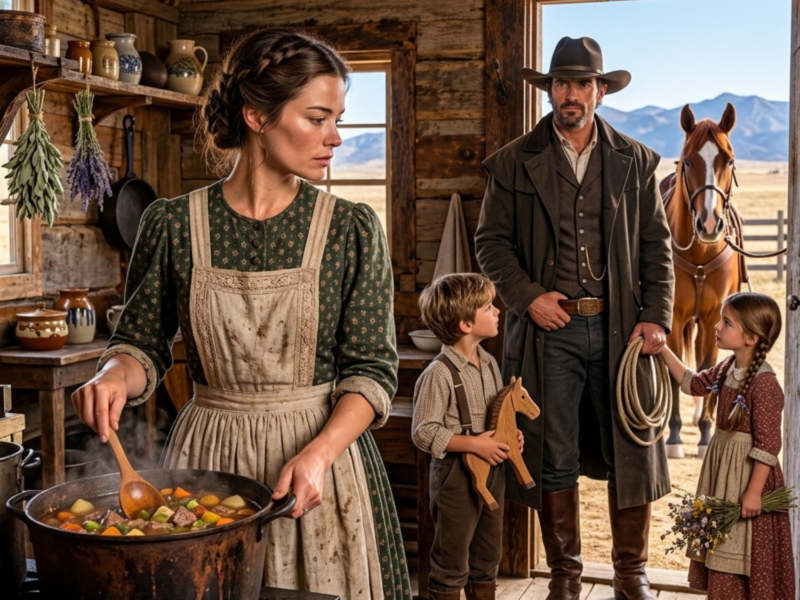
She Prayed While Cooking Her Last Meal…Then a Rich Rancher Asked, “Will You Cook for My Children?”
The Choice
That evening, after the dishes were washed and the children were finally asleep upstairs, Ruth knew she could not delay any longer.
She told Nathaniel.
They stood alone in the quiet kitchen. The fire in the stove was banked low for the night. She reached into her apron, pulled out the Kansas letter, and placed it flat on the wooden table between them.
Nathaniel picked it up. He read only enough of the legal jargon to fully understand the financial implications of what he was holding. Then, he folded it carefully and set it back down.
“That’s a real blessing, Ruth,” Nathaniel said.
His voice was incredibly steady. It was far, far too steady. The voice of a man expertly locking his emotions away in a heavy iron vault.
“You’ve worked hard your whole life,” he continued, not looking at her eyes. “You’ve earned some peace and security.”
“Thank you,” she said, her voice shaking slightly.
“You’ll be able to keep your old place now. Pay off the bank.”
“Yes.”
“And manage it with care. Buy some stock.” He nodded briskly, like a banker approving a loan. “That’s good. That’s very good.”
Ruth waited.
Some foolish, deeply hidden, romantic part of her had desperately hoped he would say something else. She hoped he would throw the letter in the fire. She hoped he would beg her not to go.
He did not. He stood rigidly by the table.
Finally, she couldn’t bear the professional distance. “These months here, Nathaniel… they have meant vastly more to me than I know how to say.”
Nathaniel looked at her sharply, a flash of genuine pain crossing his face.
“Then don’t say it, Ruth,” he said harshly.
She frowned, hurt by the rebuke.
His expression instantly softened, regret filling his eyes. He ran a hand through his hair. “I’m sorry. But you don’t owe this house anything. You certainly don’t owe me an apology for catching a break.”
“What about Caleb and Josephine?” she asked, her voice cracking. “They’ll hurt.”
His jaw tightened defensively. “They’ve hurt before. They’ll survive it. I’ll make sure of it.”
Ruth looked down at the floor, fighting tears. “So will I.”
Nathaniel took a step toward her, then stopped himself. His answer, when it came, was almost too quiet to hear over the ticking of the clock.
“I know you will,” he whispered. “But that doesn’t mean I get to use their grief to turn your hard-won freedom into an obligation to stay here.”
Ruth looked up at him again. For the very first time, looking at the rigid set of his shoulders and the agony in his dark eyes, she understood exactly what his noble, supportive silence was currently costing his heart. He was letting her go because he loved her enough to know how much she had wanted to be free.
“I haven’t said a day I’m leaving yet,” she offered weakly.
“Whenever you choose,” he said formally. “I’ll have the wagon ready.”
He left the kitchen soon after, retreating to his dark study.
Ruth stood there entirely alone beside the life-changing letter. She had finally, miraculously been given the independence she had once fiercely believed would solve every problem in her life. She was free.
Yet, that night, lying in her comfortable bed, she cried harder and longer than she had in months.
She chose Saturday.
Not because she was eager to go, but because she terrifyingly feared that if she delayed the departure any longer, she would lose her nerve and never leave at all.
Josephine sobbed hysterically and clung to her legs when Ruth gently broke the news on Thursday morning. Caleb did not cry at all. He just nodded once, his face a stony mask, and walked out the back door. That, Ruth thought, was infinitely worse.
Friday supper was nearly completely silent. The only sound was the clinking of silverware on china.
After the children went upstairs, Ruth went to her room. She packed Thomas’s worn Bible, a small, framed tintype photograph of her parents, and the few practical clothes she owned into the exact same battered wooden trunk she had brought with her months earlier.
Near midnight, unable to sleep, her mind racing with anxiety and regret, she went downstairs to make a cup of chamomile tea.
A single oil lamp was burning low in the kitchen.
Nathaniel sat completely alone at the large table. In front of him, resting on a wooden trivet, was a single, steaming bowl.
Ruth stopped dead in the doorway, staring at the bowl. “What’s this?”
Nathaniel looked down at the bowl, looking deeply embarrassed. “Couldn’t sleep.”
Ruth walked closer and peered into the bowl. It was potato soup. It was thin, watery, plain potato and onion soup. Absolutely nothing more.
Despite the crushing sadness of the evening, a genuine smile broke across Ruth’s tired face. “So, instead of sleeping, you decided to make soup poorly?”
“I can see that now, yes,” Nathaniel admitted, poking a pale, floating potato with his spoon.
He smiled too, a brief, genuine flash. Then it faded, replaced by something incredibly serious. He pulled out the chair next to him.
“Sit with me,” he asked quietly.
Ruth sat down. For a moment, neither of them spoke. The house was utterly silent above them.
Nathaniel looked down at his large, scarred hands resting on the table.
“I never told you the whole, honest truth about the night I drove the wagon to your cabin,” Nathaniel said.
Ruth’s eyes lifted in surprise. “What truth?”
He took a long, shaky breath, as if bracing himself for a blow. “That morning, before I rode into town… I prayed.”
Ruth said nothing. She waited.
“It was the first real, honest prayer I’d managed to get out of my throat since Margaret died,” he confessed, staring at the watery soup. “I was sitting in my study. I had money. I had land as far as you could see. I had men working for me. I had every practical, material thing a man on this earth could possibly ask for.”
His jaw tightened, a muscle jumping in his cheek. “And absolutely none of it could help my children stop crying in the dark.”
Nathaniel finally lifted his head and looked directly into Ruth’s eyes.
“So I got down on my knees, and I asked God for somebody who could.”
Ruth’s breath caught sharply in her throat.
“I didn’t ask for a cook,” Nathaniel continued, his voice rough with emotion. “I didn’t ask for a wife to manage the house. I didn’t ask for anything I could neatly name or put in an advertisement.”
He reached across the table, his hand hovering inches from hers. “I just said… ‘Lord, send somebody who can reach them. Because I can’t do it anymore.'”
The large kitchen suddenly felt incredibly narrow and intimate around those words.
“That afternoon in town at the mercantile,” Nathaniel said, “I heard your name. I heard the women talking about a young widow out on the edge of town who had almost nothing to her name, but still somehow found ways to quietly care for other people in their grief.”
He gave a small, incredibly sad laugh. “I drove the wagon out there thinking I was riding out to rescue you from starvation. Thinking I was the savior.”
Tears filled Ruth’s eyes, blurring his face.
“It took me a long, foolish while to fully understand,” he said softly.
He moved his hand the final inch and gently covered her trembling fingers with his own.
“I wasn’t answering a prayer for you that day, Ruth,” he whispered. “I was asking God for you.”
Ruth covered her mouth with her free hand, stifling a sob. For a long moment, she could not speak. The sheer, overwhelming grace of the revelation paralyzed her.
“Nathaniel,” she finally whispered, the tears tracking down her cheeks.
He waited, his thumb gently stroking her knuckles.
“The night you came to my cabin,” she said, her voice shaking. “Right before I heard your wagon wheels in the yard… I prayed, too.”
His dark eyes changed, filled with desperate hope.
“I told you, I’d stopped asking God to fix anything,” she confessed, the memory of the freezing cabin rushing back. “I didn’t know what to ask for anymore. I was completely broken. So, I just bowed my head… and I told Him I trusted Him with whatever happened next. That was all.”
Nathaniel stared at her, mesmerized.
Ruth gave a broken, joyful little laugh, wiping her tears. “And then… you knocked on the door.”
Silence filled the warm kitchen. But it was not the old, heavy, oppressive silence of the house she had arrived at months ago. It was not empty, and it was not dead. It was a vibrating, electric silence that securely held everything neither of them had yet said aloud.
Nathaniel slowly stood up from his chair. He stopped himself, his hands hovering, as if terrified that taking one step toward her might be perceived as unfair pressure, leveraging her emotions against her freedom.
“I don’t want you to go to Kansas,” he said, his voice raw.
Ruth’s heart pounded like a drum.
“Not only because the children love you,” he continued, taking a half-step closer, his voice shaking with terrifying vulnerability. “I’m asking for my own sake.”
Ruth did not move. She barely breathed.
“I love you, Ruth Anders.”
The words were plain. There was no grand flourish, no poetic metaphor. It was just the absolute, unvarnished truth, laid bare on a kitchen table in Wyoming.
“I love the way you always remember that Josephine hates the skin on warm milk,” Nathaniel said, a tear finally escaping his own eye. “I love the way you leave a lamp burning in the hall for Caleb, and politely pretend you don’t know why he needs it. I love that you speak Thomas’s name in this house without ever apologizing for having loved him.”
Ruth was weeping openly now, the tears falling freely.
Nathaniel swallowed hard. “And I love that this massive, empty house finally sounds alive again when you’re walking through it.”
He glanced up toward the ceiling, toward the dark rooms where his children slept peacefully. Then he looked back down at the woman sitting before him.
“I am not asking you to stay because we need a cook,” he said firmly. “I am asking you to stay because I want to build the rest of my life with you.”
Ruth closed her eyes, letting the words wash over her soul.
All those lonely, freezing months in the cabin, she had fiercely believed that the Kansas inheritance, the money, the independence, meant absolute freedom. But sitting here, holding the hand of a good man who saw her completely, she realized that freedom was absolutely not the same thing as solitude.
“Nathaniel,” Ruth whispered, opening her eyes. “I thought… I thought going back to my cabin would prove to the world that I could stand on my own two feet. That I didn’t need rescuing.”
“You can stand on your own,” he said fiercely, squeezing her hand. “You already have. You proved it.”
That absolute certainty in his voice broke the very last, stubborn defensive wall around her heart.
Ruth smiled radiantly through her tears. “Then maybe… maybe choosing to stay here with you is profoundly different from staying because I have nowhere else to go.”
“Yes,” he breathed, hope blazing in his eyes.
Ruth stood up. She reached across the small table and took both of his large hands in hers.
“Then I suppose God answered both our prayers,” she said softly.
Nathaniel pulled her into his arms, closing his fingers tightly around hers, burying his face in her hair.
“Just not in either shape we knew to ask for,” he murmured against her neck.









