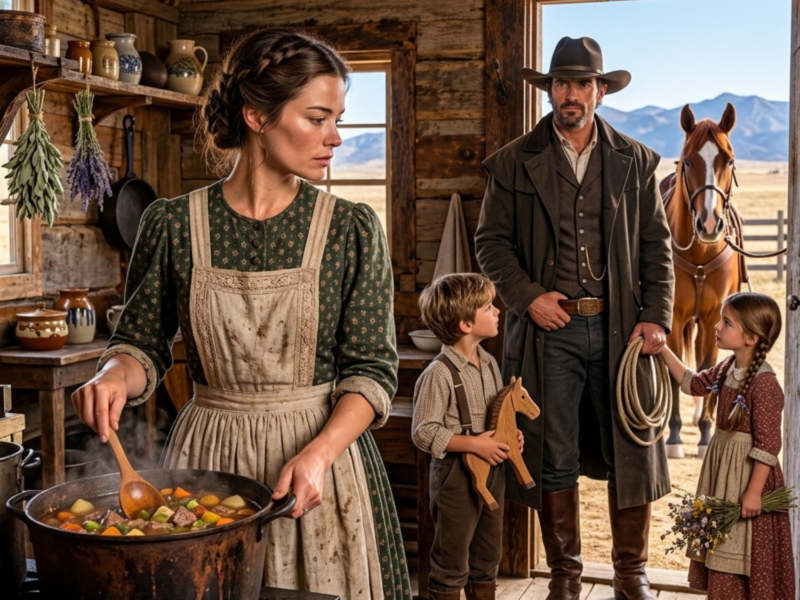
She Prayed While Cooking Her Last Meal…Then a Rich Rancher Asked, “Will You Cook for My Children?”
The Inheritance
Three days later, the stagecoach brought the mail, and a formal letter arrived from Kansas.
Ruth immediately recognized the elegant, looping surname written on the return address of the thick envelope. It was her mother’s cousin. A wealthy, distant branch of the family that she had not heard a single word from in over ten years.
She slipped the letter unopened into her apron pocket, because Josephine was calling frantically from upstairs about a spider in her room. For most of the busy day, baking and cleaning, she entirely forgot about it.
That night, finally alone in the quiet of her room, she trimmed the wick on her oil lamp and opened the envelope.
By the time she reached the bottom of the second page of elegant, legal cursive, she had to sit down heavily on the edge of her bed. Her hands were shaking violently.
An elderly aunt she barely remembered had died peacefully in her sleep. She had been a spinster, and had meticulously divided her estate. There was an inheritance.
It was not a staggering, life-altering fortune that would buy a mansion in Boston. But to a widow working as a frontier cook, it was a miracle. It was enough.
It was enough cash deposited in a bank in Cheyenne to immediately pay off the remaining, suffocating debt against her old, abandoned homestead. It was enough to hire men to properly repair the leaking roof. It was enough to buy good seed in the spring, and a new plow horse.
It was enough that she would never, ever again have to depend on the charity or the wages of another employer for a safe bed or a hot meal.
For eight agonizing months, since the day Thomas died, that exact scenario had been her singular, desperate dream. Independence. Her own locked door. Her own hot stove. Her own quiet, beholden-to-no-one future.
Ruth read the lawyer’s letter twice, her eyes scanning the numbers. Then, she folded it incredibly carefully and slid it under her pillow.
The next morning, she carried the letter folded in her apron pocket. It felt as heavy as a brick of lead.
At breakfast, Josephine excitedly climbed directly into Ruth’s lap because she had scraped her knee on a porch step and demanded comfort. Ruth held the little girl tightly with one arm, kissing the top of her head, while expertly pouring hot coffee for Nathaniel with the other.
The stiff paper of the letter pressed uncomfortably against her hip as the child leaned back.
At noon, Caleb shyly approached her at the counter. He held a wooden spoon. He asked if she would finally teach him her secret of making perfect bread dough without measuring the flour in cups.
“You can’t learn that by feel in one single afternoon, Caleb,” Ruth laughed softly, wiping her hands.
“Then teach me every day until I can,” the boy said stubbornly, looking up at her.
The letter in her pocket seemed to grow heavier.
That evening, Nathaniel came in through the mudroom, shaking heavy snow from his broad shoulders. He took off his coat, hung his hat, and smiled the absolute moment he saw her standing by the stove.
It was not a grand, theatrical smile. It was not a romantic, sweeping declaration. It was just the quiet, profoundly relieved smile of a tired man who was incredibly glad to have found someone exactly where he desperately hoped she would be.
Ruth smiled back, but her heart was pounding in her ears. She went to bed that night without telling him about the money.
For three agonizing days, the letter remained folded in her apron pocket. And for three days, wrestling with her thoughts in the quiet moments, Ruth discovered something absolutely terrifying about herself.
The clear, simple choice she had once prayed for weeping in the dark—the miracle of independence—had finally arrived. And she no longer knew, with any certainty, which answer she actually wanted.









