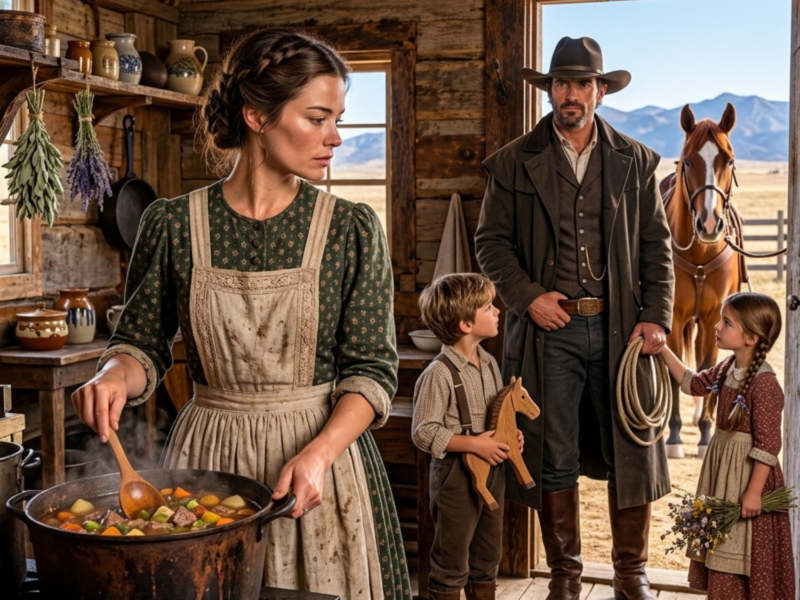
She Prayed While Cooking Her Last Meal…Then a Rich Rancher Asked, “Will You Cook for My Children?”
Learning the Ghosts
Ruth did not magically heal the Cross children in a week. That would have been infinitely easier, and entirely false.
Instead, over the next agonizingly slow month, she learned them. She studied their grief the way a scholar studies a complex map.
She learned that little Josephine absolutely hated the thick, wrinkly skin that formed on the top of warm milk, so she always skimmed it off before handing her a cup. She learned that Caleb, the eight-year-old stoic, would eat hearty beef stew only if the carrots were diced incredibly small; if they were cut thick and chunky, he would stubbornly push the bowl away.
She noticed that Josephine slept tightly curled in a ball, always with one small hand tucked safely under her cheek.
But Caleb’s grief was darker, and more complex.
Ruth noticed that Caleb aggressively avoided the upstairs hallway after dark. He would rush past it, or refuse to go up without a lantern.
She quickly deduced why. His mother’s bedroom remained at the very far end of that long hallway. The heavy oak door was closed tight, kept exactly, perfectly as it had been the day she died of the fever. A shrine of stagnant air and preserved memories.
Ruth never once opened that door. She never asked Caleb why he occasionally stood at the top of the stairs, staring at the brass knob in the gloom.
She simply began leaving a small, glass oil lamp burning cheerfully on the hall table every single night, casting a warm, golden pool of light that pushed the terrifying shadows away from his mother’s door.
The children noticed the light. They noticed the skimmed milk. They noticed the diced carrots.
Nathaniel noticed it all, too.
Josephine warmed to Ruth remarkably quickly. She was young enough that her need for maternal comfort easily overpowered her loyalty to a ghost. She began following Ruth around the kitchen, holding onto her apron strings, asking endless questions about baking.
Caleb, however, did not.
For the boy, affection felt incredibly, physically dangerous. He had fiercely loved his mother, and the universe had brutally taken her away from him. Some deep, primal, protective part of his eight-year-old brain had stubbornly decided that he would never, ever allow himself to need another person enough to be hurt that profoundly again.
He was polite to Ruth, but he was a fortress.
The inevitable trouble came on a freezing Tuesday morning in late November.
Ruth had been exploring the vast depths of the pantry and had found a precious tin of ground cinnamon hidden behind some jars. Inspired, she decided to make the simple, sweet, spiced apple cakes that Josephine had excitedly mentioned remembering from her mother’s kitchen before the sickness.
The rich, intoxicating smell of baking apples, butter, and cinnamon filled the entire house, chasing away the usual smell of woodsmoke and dust.
Josephine came running into the kitchen, clapping her hands in pure delight. “My Mama made those!” she squealed, climbing onto a stool.
Ruth smiled warmly, pulling the hot pan from the oven. “So you told me. Let’s see if they taste right.”
Caleb entered the kitchen just as Ruth set the first plate of steaming cakes down on the table.
He stopped dead in his tracks. His face radically changed. The polite, stoic mask shattered. He stared with horror at the plate, smelled the cinnamon in the air, and then looked up at Ruth with eyes full of absolute, blazing betrayal.
“You’re not Mama,” Caleb said, his voice a low, hostile growl.
The warm room went instantly, terrifyingly quiet. Josephine stopped smiling and looked at her brother, confused.
“Caleb…” Ruth started gently, wiping her hands on her apron.
“No!” His voice shook violently now, cracking with unshed tears and rage. “You’re not! You’re trying to be her, but you’re not!”
Ruth set down the dishcloth very carefully. She did not raise her voice. “No, Caleb. I’m not her.”
“Then stop making her things!” Caleb screamed, his small fists clenched at his sides.
Nathaniel had just entered through the back mudroom door, pulling off his heavy winter gloves. He heard the scream. His jaw instantly tightened with paternal authority.
“Son,” Nathaniel barked sharply, stepping into the kitchen. “Do not speak to Mrs. Anders that way—”
Ruth lifted one hand, palm out, stopping Nathaniel dead in his tracks. “Let him speak,” she said softly, but with iron command.
Caleb’s eyes finally filled with the tears he had been holding back for a year. He glared at his father, then at Ruth.
“Everyone acts like things are magically better just because she’s here cooking!” Caleb sobbed, his chest heaving. “You act like we’re a family again! But Mama’s still dead! She’s still gone!”
No one in the kitchen answered.
The grandfather clock ticked loudly in the hallway. There was absolutely no answer in the world that could change the brutal, devastating truth of what the boy had just said.
Finally, Ruth walked slowly around the table. She pulled out a chair opposite him and sat down, close enough that he could feel her presence, but far enough away that he did not feel trapped. She kept her voice incredibly calm.
“You’re right,” Ruth said.
Caleb blinked, the tears freezing on his eyelashes, completely thrown off guard. He had expected to be punished, or yelled at, or given a religious lecture.
“I am?” he hiccuped.
“Yes,” Ruth said, folding her scarred hands on the table. “I’m not your mother, Caleb. I never, ever will be.”
Josephine’s small face crumpled in distress at the harsh words.
Ruth leaned forward, locking eyes with the boy. “And I would never, ever ask you to stop missing her, or stop loving her, just so I can feel useful in this kitchen.”
Caleb stared down at the scuffed toes of his boots, his shoulders shaking.
“If the apple cakes hurt too much,” Ruth continued, her voice incredibly gentle and steady, “I won’t ever make them again. I promise.”
His lower lip trembled violently.
“But,” Ruth added softly, “loving something she used to make doesn’t mean you’re replacing her in your heart. And liking me, someday… wouldn’t mean that either.”
That was the exact moment the fortress walls finally crumbled.
Caleb let out a ragged, agonizing sob that seemed to tear out of his very soul, and he finally cried.
Nathaniel crossed the room in three massive strides. He dropped to his knees on the hard floor and gathered his weeping son tightly against his chest, burying his face in the boy’s hair.
Ruth stood up silently and looked away out the window. She knew, instinctively, that some moments belonged exclusively to fathers and sons. She gave them the dignity of privacy.
That night, the plate of spiced apple cakes remained exactly where she had left it on the kitchen table. untouched.
But near midnight, when Ruth returned to the dark kitchen to fetch a glass of water, she glanced at the table in the moonlight. She smiled softly.
There was one cake missing from the pile.
The next morning, the kitchen was bright and cold. Caleb entered while Ruth was violently kneading a massive mound of bread dough on the floured counter.
He stood silently beside her for a full minute, watching her work. He did not speak. Then, slowly, he pushed up the sleeves of his flannel shirt.
“Need help?” Caleb mumbled, not looking at her.
Ruth smiled, hiding it by looking down. She used her hip to slide the heavy, ceramic bowl of dough toward him.
“I reckon I do,” she said casually.
She never once mentioned the missing apple cake. And neither did he.









