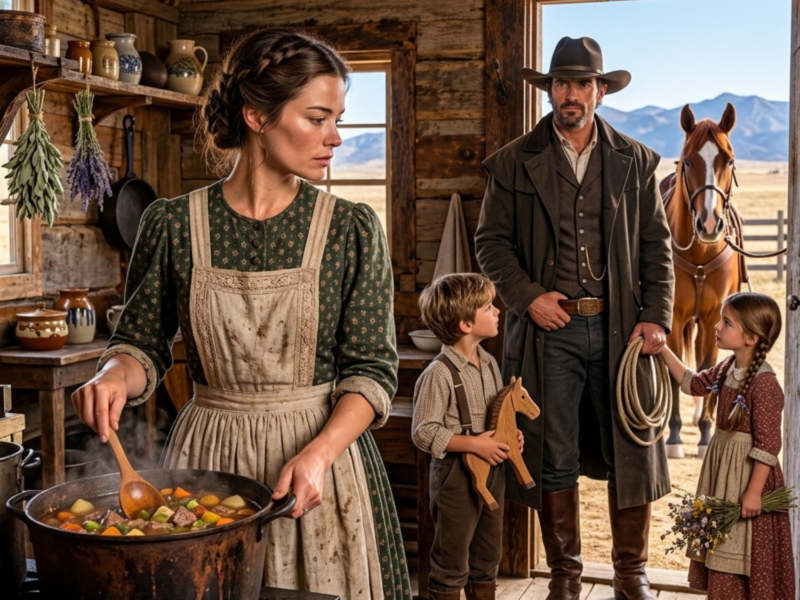
She Prayed While Cooking Her Last Meal…Then a Rich Rancher Asked, “Will You Cook for My Children?”
The Wild Asters
Ruth did not leave the next morning.
Caleb discovered this miraculous fact when he crept downstairs long before sunrise, his heart heavy, and found her battered wooden trunk still sitting squarely beside the bottom of the stairs.
He stopped dead in his tracks. He stared at it, confused. Then, he looked up and saw Ruth walking out of the kitchen, carrying a fresh pot of coffee.
“You forgot your trunk,” Caleb blurted out, pointing at it defensively.
“No, I didn’t,” Ruth smiled.
His young face radically changed, fluctuating between desperate hope and suspicion.
Josephine appeared suddenly behind him on the stairs, her hair a wild, tangled bird’s nest from sleep, rubbing her eyes. “What’s happening?” she mumbled.
Ruth set the coffee pot down on the hall table. “I’m staying.”
Josephine let out a high-pitched scream of pure, unadulterated joy loudly enough to wake half the ranch hands in the bunkhouse outside. She ran down the remaining stairs and launched herself into Ruth, wrapping both arms tightly around her waist.
Caleb remained exactly where he was on the stairs for one long, agonizing second. Then two.
Finally, the stoic eight-year-old walked slowly down the steps, walked over to Ruth, and wrapped his own arms awkwardly, fiercely around her waist from the other side, burying his face in her apron.
He said absolutely nothing. He did not need to.
Over the top of his head, Ruth looked up at Nathaniel, who had just stepped out of his study, leaning against the doorframe. Nathaniel smiled, a look of profound, unbelievable peace settling over his features.
They were married the following spring.
The ceremony was incredibly small, held right on the front porch of the ranch house. Caleb stood tall and proud beside his father as his best man. Josephine skipped enthusiastically down the makeshift aisle ahead of Ruth, scattering handfuls of wild purple asters she had gathered from the fields, because, as she had loudly explained to everyone who would listen, no proper, respectable wedding could possibly happen without them.
Ruth wore a simple, elegant white cotton dress she had painstakingly sewn herself by lamplight.
Before the ceremony began, she stood alone for a quiet moment in the ranch kitchen. The warm spring sunlight lay in bright squares across the long oak table. Freshly baked bread cooled fragrantly near the stove.
Upstairs, she could hear Josephine laughing uncontrollably at something. Outside the window, Caleb shouted an enthusiastic order at one of the ranch hands about the horses. The massive house was completely, joyously full of sound.
Ruth closed her eyes and thought of another kitchen. A colder one. A much smaller one.
She remembered two pale potatoes, one sad onion, a rock-hard heel of stale bread, and a desperate prayer made by a woman who had finally, completely stopped telling God what the answer was supposed to look like.
Ruth never used the Kansas inheritance money to reclaim her old, drafty homestead.
At her strict insistence, she and Nathaniel sold the property to a young, struggling couple just starting out. Much of the inheritance money went into a quiet, unpublicized church fund she established specifically for local widows, orphaned children, and frontier families struck by sudden, catastrophic hardship.
She knew exactly, down to her bones, what unexpected mercy could mean to someone standing shivering at the very edge of despair.
Caleb and Josephine grew up in that warm, loud ranch house without ever once being asked or expected to forget their mother. Years later, when they were grown, Margaret’s name could be spoken freely and fondly at Ruth’s crowded supper table without anyone awkwardly lowering their eyes or changing the subject.
Ruth did not magically erase their grief. She simply, patiently made a vast amount of room right beside it for a new life.
And Nathaniel Cross, the wealthy titan of the valley, learned the most profound lesson of his life: that the absolute most important, valuable things in his massive home could not be bought with cattle or gold.
A small oil lamp left faithfully burning in the dark hallway for a frightened boy. The smell of fresh cornbread on a freezing morning. A child laughing hysterically upstairs.
And a woman who stayed. Not because she had nowhere else in the world to go. But because she was finally free enough to choose exactly where she belonged.









