Single Mom Filled an Empty Pond With Minnows—Then the Worst Drought in 60 Years Arrived
THE PLAT OF 1964
Two weeks later, Mara was clearing the north end of the barn loft, hauling out sixty years of someone else’s abandoned decisions, when she pulled a flat tin case out from under a stack of rotted seed sacks.
Inside was a survey plat from the summer of 1964, folded in quarters, the paper gone the color of weak tea. A mouse had taken a semicircular bite out of the lower right corner and carried off whatever had been printed there. But the elevation contours were still legible, and so was a thin blue line—hand-inked rather than printed—that entered the property from the southwest, bent once, and ran straight toward the center of the basin before stopping abruptly at its edge. There was no note beside it, no arrow, no symbol she recognized from any modern standard.
Mara carried the plat into the house, flattened it under glass on the kitchen table, and did not mention it to a single person in Dry Creek.
What Mara did over the following six weeks convinced the whole county that she had no idea what she was doing. And in fairness, from the road, it looked that way. She did not deepen the pond. She did not order a water truck, which two of her nearest neighbors did that same spring at four hundred dollars a load. She did not drill a new well, even though the drilling outfit out of Hollis had a two-month backlog.
Instead, she spent her days on things that produced nothing anyone could point at and sell. She cleared the old drainage swales on the west half of the property by hand and with a borrowed loader, one length at a time. She seeded the entire slope above the basin in native grass—big bluestem, switchgrass, and indiangrass—which cost her less than two thousand dollars and would not look like anything for at least one full season.
She cut six wooden stakes out of a fence post, drove them into the basin floor in a line from the rim to the lowest point, and marked each one in red paint at one-inch intervals. Every morning at seven, before Josie’s bus came up the section road, she walked the line and wrote six numbers in a spiral notebook.
Then a storm came through on a Tuesday night and dropped an inch and a quarter of rain in ninety minutes.
In the morning, there was water in the bottom of the basin. Not a pond—nothing like a pond—just a brown puddle, maybe forty feet long and six inches at the deepest point. The kind of thing that evaporates into a damp ring by Friday and is a memory by Sunday.
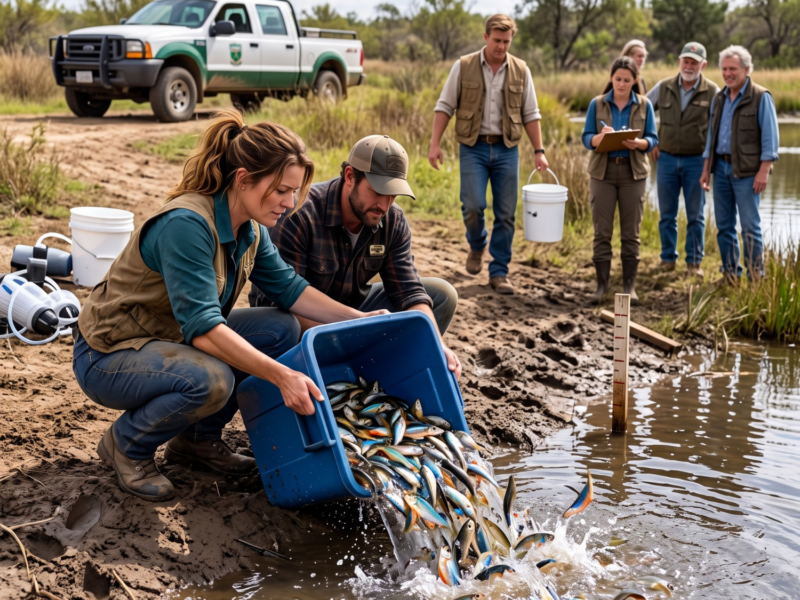
Within an hour of seeing it, Mara drove ninety miles to a bait and stock operation outside Wilmore and bought fathead minnows by weight, as many as the tanks could give her: a little over four thousand fish for two hundred and twenty dollars. She drove them back in aerated coolers, carried them down the bank one at a time, and poured them into six inches of muddy water in a basin that had been dry for most of two decades.
Grant Barington happened to be coming up the section road with a load of mineral tubs, and he stopped. He stood on the rim with his thumbs in his belt and watched a woman empty a cooler of live minnows into a puddle. He laughed so hard he had to set his coffee on the hood of his truck. He asked whether she was stocking fish or burying money—a line he would repeat so often over the next four months that he stopped remembering it had ever been funny.
Mara capped the last cooler, drove the red-marked stake at the waterline, wrote the level in her notebook, and walked up the bank past him without saying one word.
By six o’clock that evening, the story was at the Ridgeline Cafe on Main Street: The new woman out east is raising fish in a mud hole.
That was the sentence, and it did what sentences like that do in a town of eleven hundred people. Grant gave the place a name, because naming a thing is how you make a joke permanent, and within a week everyone in Dry Creek used Whitlock Marina without thinking. Somebody got a piece of weathered barn board, burned the words into it with a wood-burning kit, and wired it to her gate post one night when she was asleep.
Josie found it on her way to the bus and asked her mother if they should take it down.
Mara looked at it, then said, “No, leave it. That way, people will know where to find us.”
She went to town that same afternoon for pipe fittings, and when the counter clerk accidentally called her “fish lady” and turned bright red, Mara just told him the size she needed and paid. She did not defend herself once, which disappointed everybody. A woman who writes down six numbers twice a day and keeps her face still is simply a mystery nobody has the patience for.
The only person in Dry Creek who looked at her operation and felt something other than amusement was Wade Hollister—sixty-three years old, who had pulled and set pumps and wells in that county since he was nineteen, and who had been hired to inspect the ancient transfer pump in her barn.
Wade walked the property on his own time and stood at the rim of the basin with his hat off, studying the shape of the land above it the way other men study a horse’s legs. He noticed that the swales she had cleared did not run toward the basin the way a person would dig them to fill a pond. They ran across the slope, slowing water down rather than carrying it in—which is what a person does when they want water to go into the ground instead of across it.
He asked her straight out whether she had put the minnows in to raise them.
She said, “No,” and went back to checking the hose. Wade drove home that evening, thinking about it the whole way.
That night, Mara took a flashlight down the bank at a quarter to eleven. She crouched at the edge of the water and put the beam into it, and the surface broke into a thousand small flickers as the minnows scattered and regrouped—alive, three weeks after the men on the rim had given them a weekend. She moved the light to the nearest stake and read the paint line against the water.
The level stood just under half an inch higher than her entry from the previous morning. It had not rained in Dry Creek for three days. The humidity had been under twenty percent, and the daytime high had touched eighty-six.









