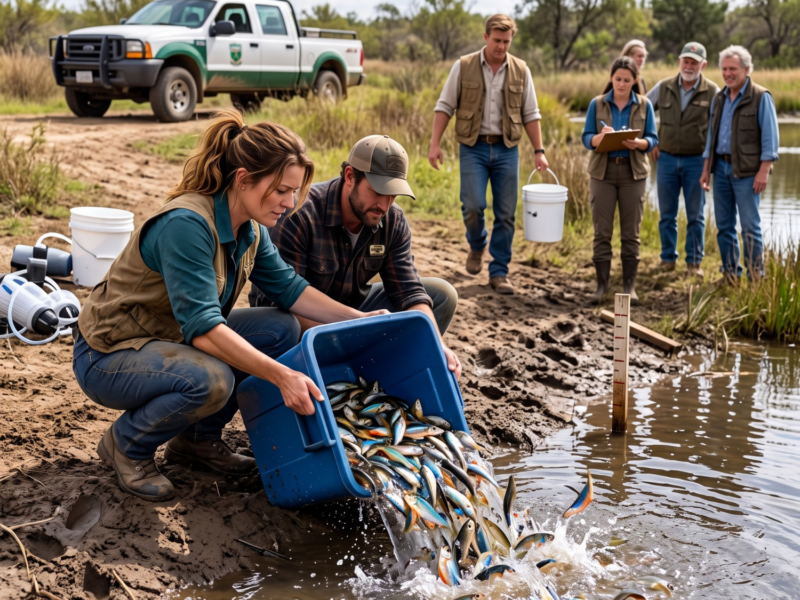
Single Mom Filled an Empty Pond With Minnows—Then the Worst Drought in 60 Years Arrived
THE LOGIC OF THE MINNOWS
A spring is not a faucet. And this is where Mara’s eleven years in the field became the only thing in the room that mattered.
Cutting off the surface recharge had starved the basin and dropped the local water table below the pond floor, which is why it went dry and stayed dry. But it had not emptied the formation itself. Deep under that basin, the ground still carried water because the basin sat at a structural low point where an underlying confining layer pinched out and the formation came close to the surface—which is precisely why there had been a spring there in the first place.
In a year when regional pressure shifted, when heat drove transpiration down and big neighboring withdrawals changed the gradient, water could still find its old exit. But it was a locked door, and nobody for sixty years had thought to check whether the key was still around.
This is where the county’s laughter since April revealed its own blindness.
Fathead minnows live about one year, tolerate filthy water, and survive temperatures that kill nearly everything else. But they cannot survive what a closed, stagnant, rainfed puddle does in a hundred-degree Kansas August. In such conditions, the water heats from top to bottom, oxygen crashes, and within six weeks a stocked population becomes a crust of dead fish on a mudbank. That is what should have happened at Whitlock Marina by the middle of June, and the men on the rim had expected it so confidently that they stopped driving past to check.
Mara had not bought four thousand fish to raise them, sell them, or eat them. She had bought them because a professional hydrogeologic survey of a seventy-property tract—complete with test borings, a pump test, and lab analysis—would have cost between nine and fourteen thousand dollars. In February, she had fifty-four hundred dollars left after closing.
Minnows cost two hundred and twenty dollars. And they do something no instrument does for that price: they are a living sensor distributed across the entire basin floor. They respond to differences in temperature and oxygen too small for a cheap probe to resolve reliably, and they do it continuously, every hour, for free, while the owner is fixing a fence.
If there was no groundwater contribution, they would die, and the question would be answered. If there was, they would not die randomly—they would concentrate.
And they did concentrate. By the second week of May, Mara’s notebook column showed the school holding day after day over a patch of the basin floor roughly thirty feet across, about forty feet east of the lowest point. They weren’t there because it was deepest, because it wasn’t.
She waded out with the probe in June and found what she already knew she would find: the water over that patch ran four and a half degrees cooler than water fifty feet away in the same pond at the same hour. It was what happens when water of a stable, deep temperature enters from below continuously in small volumes, getting mixed and swallowed by a pond losing twice as much to the sky.
That was the month Mara knew. It was the second week of June. The drought was four weeks old, and she had located a working spring seep on a property that every person in Dry Creek—including the man who sold it to her—had written off as dead ground.
She could have kept pumping quietly, let the town run dry, and sold water at whatever the market would bear by September, which would have yielded an extraordinary amount of money. Instead, she went the other direction entirely. And that choice is the reason the Bingtons eventually lost something they could not buy back.









