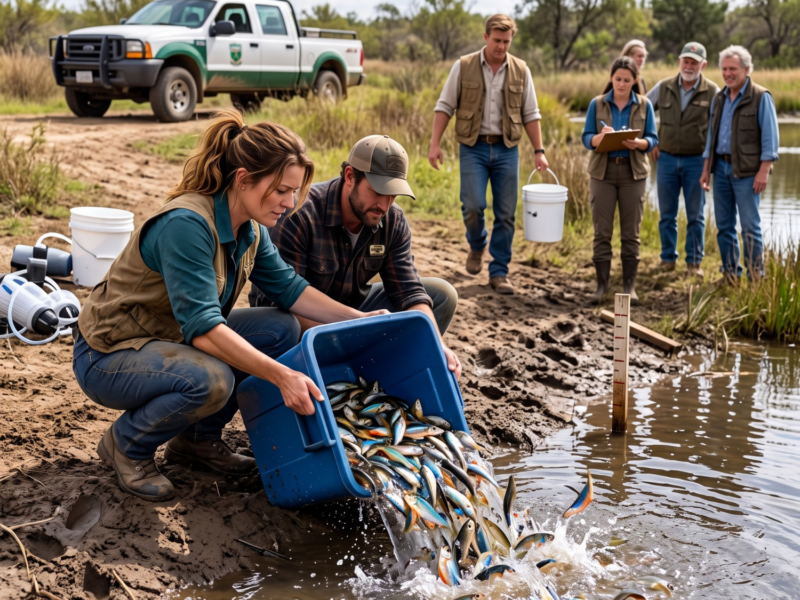
Single Mom Filled an Empty Pond With Minnows—Then the Worst Drought in 60 Years Arrived
THE WATER FINDS ITS WAY BACK
Nothing collapsed that night in a dramatic crash. Silas Barington did not go broke, and anyone hoping for that cinematic ending was in the wrong county. What they lost was smaller than their fortune and far more valuable than any piece of it: the unspoken authority to decide who in Dry Creek got to survive a dry year.
After September 9, water in that town was something the town worked out together—with records, maps, and a rotation schedule taped inside the council room door. No family’s goodwill ever again stood between a man and his herd.
The work started that same week, unglamorous in the way real repair always is. They reopened sixteen hundred feet of the lateral that had been filled in 1967, rebuilt two shallow catchments above the basin, keyed in a low berm so runoff soaked in instead of running straight to the ditch, and seeded the disturbed ground in the exact native mix Mara had planted back in April. Grant Barington ran a tractor for four days of it. Silas neither helped nor objected.
The rain returned on the second of October, not as a violent storm, but as a gray morning drizzle that started before sunrise and kept on for nineteen hours—the kind of rain that does not run off. By evening, there were small rings spreading across the surface of Whitlock Pond where the drops landed.
Mara stood at the rim in a jacket and watched them, and Wade stood beside her. After a while, he asked the question he had been carrying since April: “Why minnows?”
She told him about the fourteen thousand dollars she didn’t have and the two hundred and twenty dollars she did; about oxygen, temperature, and the simple fact that a living thing will find the one good spot in a bad pond and stay there.
And then she told him the other half—the part she had never told anyone, not Josie, not the county, not the two hundred and forty people in the gymnasium.
When she had first flattened that 1964 plat under the glass on her kitchen table in March, she had spent most of a night going over it with a magnifying glass. In the white margin along the bottom edge, in pencil half-rubbed away, was a line of handwriting left by whoever had walked this ground with a chain and a rod sixty years ago. It wasn’t a measurement, a coordinate, or an X over anything. It was four words written the way a man writes something down because it struck him and he had nowhere else to put it: Minnows remained through August.
Every owner of that property since 1964 had presumably seen that plat at some point and read right past it because it looked like nothing. It looked like a random sentence about fish. But Mara Whitlock had spent eleven years logging water behavior for people who paid her to notice exactly that kind of thing, and she understood what the surveyor had actually recorded without knowing it: A rain-filled basin in that climate does not keep minnows alive through August.
If small fish had lived in that basin through the dry end of a Kansas summer in 1964, then that basin was not holding rain. It was being fed from below. The man with the chain had written down the proof in the margin and then gone home.
So in April, Mara had not been gambling. She had been running the only experiment the note allowed her to run: putting the same indicator back into the same basin to find out whether what had been true in 1964 was still true.
The worst drought in six decades—the thing that destroyed herds, emptied wells, and broke four generations of families across that county—had done one other thing entirely by accident. It had removed every drop of rainfall from the equation for one hundred and thirty consecutive days, turning the whole basin into a perfectly controlled test of a single penciled observation that had been sitting unread in a barn loft for sixty years.
On a cool morning in the first week of October, Mara stepped out onto the porch with coffee while Josie waited at the end of the drive for the bus.
The pastures beyond the fence still carried long brown scars from the drought and would carry them into the following summer. But in the low ground behind the barn, in a ring maybe thirty feet wide around the water, new grass was coming up—a green so fresh it looked out of place in that landscape.
There was no moment anywhere in that autumn when anybody in Dry Creek stood up and told Mara Whitlock she had been right, and she never once asked for it. There was only Mara on the porch, Wade’s truck coming up the road with a load of pipe, and a sound at the east end of the basin so faint you had to stop walking to hear it: water finding its way back to the surface of the ground, heading where it had been going for a very long time before anyone in that county was born.
Grant Barington drove past a little after eight, slowed, and stopped. The weathered barn board was no longer wired to the gate post where someone had hung it in April; Mara had taken it down, cleaned it, and set it on two posts at the edge of the water facing the road: Whitlock Marina.
Grant looked at it for about four seconds, lifted two fingers off the steering wheel, and drove on.
Mara smiled, and it was not the smile of a woman who had beaten anybody. Silas Barington was still rich. She smiled because of something smaller and more private: for five months, every person in Dry Creek had looked at that pond and seen fish. They had seen a joke, a mud hole, a woman wasting the last of her money. Not one of them had ever once asked the only question that was worth asking—not whether the fish were alive, but where exactly those fish had chosen to swim, and why they would not leave that one cool patch of water sixty feet from the deepest part of the pond.
Sometimes what makes a person a joke is not that they are wrong. It is that they are looking at something nobody else has the patience to look at long enough to understand.
Mara Whitlock did not beat a drought with money, land, leverage, or a louder voice at a meeting. She beat it by measuring the same six things twice a day while people laughed from the road, by trusting a four-word note a stranger left in a margin sixty years before she was born, and by refusing to let anyone else’s certainty replace what she could prove.









