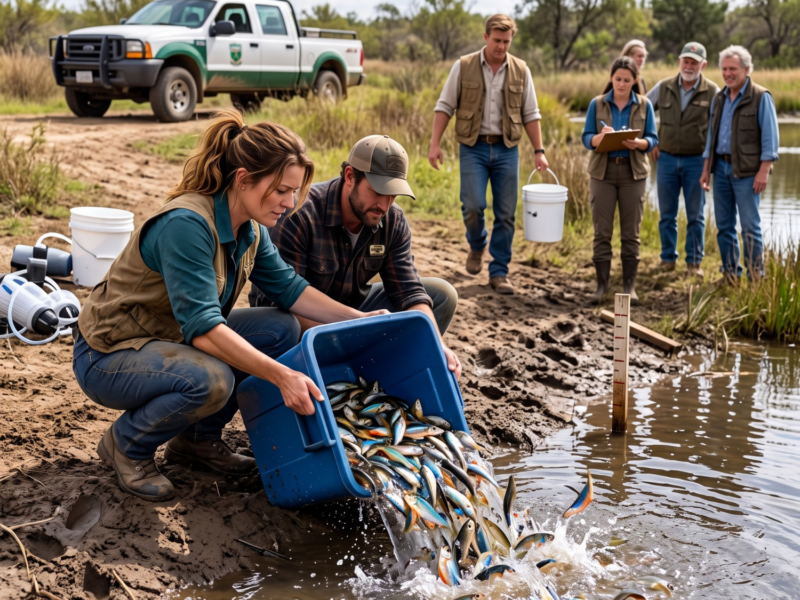
Single Mom Filled an Empty Pond With Minnows—Then the Worst Drought in 60 Years Arrived
THE DRY CREEK GYMNASIUM
By the third week of August, the drought reached a point where the arithmetic stopped working for everyone.
The Bington Reservoir had been designed to be refilled by seasonal flow out of the West Fork, and the West Fork had produced nothing since the second week of May. For one hundred and six days, the largest body of water in three counties had been a bank account with continuous withdrawals and zero deposits. The intake tower stood in the open air at the north end like a chimney in a burned house, and the shoreline had retreated far enough that cattle were walking out onto cracked flats to reach it and getting permanently stuck.
Silas cut outside sales to four hundred gallons per operation per week on the eighteenth, and on the twenty-second he suspended them entirely with a letter that used the phrase operational necessity.
That letter changed Dry Creek faster than anything the drought had done on its own. The Haskin family sold ninety head in one morning at a loss that ended four generations of cattle on that ground. The men who had spent the spring saying Whitlock Marina out loud now drove past that fence line slowly in the heat, looking at an oval of standing water with minnows breaking the surface at dusk, and found that the words simply stopped forming in their mouths.
Grant Barington came up her driveway on the twenty-sixth of August at eight in the morning, alone and uncharacteristically hesitant. He had one hundred and forty pairs on a lease pasture with a tank that was pulling air by noon every day, and his father’s suspension letter applied to him the same as everyone else. He asked if she would sell him water, offering four times the going rate. He didn’t call her “fish lady,” and he didn’t look at the sign on the gate post.
Mara could have made him stand there a long time. Instead, she asked him how many head and over what distance, got a pencil, and told him the truth: what she had was not an infinite solution, and anyone who treated it like one would kill it. The seep produced roughly two thousand gallons a day, and that number would fall if she drew the pond down too hard.
She would commit nine thousand gallons a week total to be divided among operations that were actually on the brink, with the Haskins first in line. She would charge the rate Bington had charged in June—not a cent more.
And there was a condition, which she had written out two weeks earlier, waiting for someone to come ask: Anyone who took water agreed to put labor and equipment into reopening the old lateral along the West Fork and rebuilding the catchment above her basin, so that whenever rain finally came, the recharge path filled in 1967 would carry water back toward the formation instead of straight to the Bington reservoir. No lawsuits, no claims against anybody—just labor.
Grant read the single page twice, and he understood with perfect clarity what it meant: the water in Dry Creek was about to stop having a single owner.
Silas understood it faster. He came to her door on the thirtieth of August without an appointment and without any pleasantness left. For the first time, he raised his voice, which Mara noted the way she noted everything. He told her that the water under her property was part of a system his family had developed and paid taxes on for three generations, and that his attorneys would file for an injunction within the week and tie her farm up in court until she had nothing left to defend it with.
He was not entirely bluffing. In a water rights fight in that state, the person with the longer history and the bigger legal budget usually wins, and he had both.
Mara let him finish. Then she went to the kitchen table, came back, and laid three things in front of him without a word:
-
The 1958 quadrangle with Old Spring Basin printed across her property in federal ink six years before his father’s first petition.
-
The certified copies of all four drainage district approvals from 1966 through 1969, with the line about abandonment of a non-productive channel marked in pencil.
-
Her water temperature logs—four locations, twice daily, from April 2 through September 8—alongside the stake measurements.
She told him quietly that if he filed, all of it became public record and the subject of testimony. The family that had spent sixty years being the reason Dry Creek survived its dry years would spend a trial explaining what they had quietly done to someone else’s water in 1967.
Silas Barington looked at those three pages for a long moment, and he did not say anything at all. That silence was the loudest thing that had happened in that county all summer.
The community meeting was held in the Dry Creek School Gymnasium on the ninth of September, called by the council to discuss emergency water coordination. Roughly two hundred and forty people came—nearly everyone who wasn’t milking or hauling.
Silas Barington spoke first, and he spoke well. He talked about sixty years of his family making water available to neighbors at cost. He said it was difficult to watch an outside party arrive with no history in the community, discover a temporary advantage during a natural disaster, and attach conditions to it, and that he worried about where that logic led. He didn’t need to overstate it; when he sat down, people in that gymnasium nodded in agreement.
Mara Whitlock walked to the front with a cardboard box. She did not argue with anything Silas had said, denying the room the direct fight it had come for.
Instead, she laid out the 1958 quadrangle and read the three printed words aloud. She set out the 1964 plat with the hand-inked line and the mouse-chewed corner. She set out the four drainage district approvals, the dates, and the single sentence about the abandoned channel.
She laid out her water temperature logs and passed the open notebooks down the front row so that men who had farmed for fifty years could see the handwriting change color where she had run out of blue ink in the middle of June.
Finally, she placed one last item on the table: a photograph taken on the fourteenth of April with a cheap camera on a timer, showing a dry gray basin, a six-inch puddle, a wooden stake with a red mark at the waterline, and the date burned into the corner by the camera itself.
Four months before the drought was declared—before any person in that gymnasium had a reason to care what the water level was on a worthless farm east of town—every measurement she had just handed them began on a day when there was nothing in Dry Creek worth measuring. No one in that room could stand up and say she had assembled a story after the fact to fit a disaster.
Grant Barington was standing against the wall by the trophy case, and the arithmetic ran across his face in front of two hundred people. The woman he had named in a feed store parking lot had understood the ground under this county from her very first spring on it, while his family, with four thousand acres and a reservoir and eleven employees, hadn’t noticed that their entire system had quietly become a rain gauge.
Old Hollis Dempsey—seventy-one years old, who had laughed the loudest at the cafe in April and told the mud-hole joke to his own grandchildren—turned around in his folding chair and said, loud enough for the back rows, that it appeared the “Mud Hole” knew more about water than any of them did.









