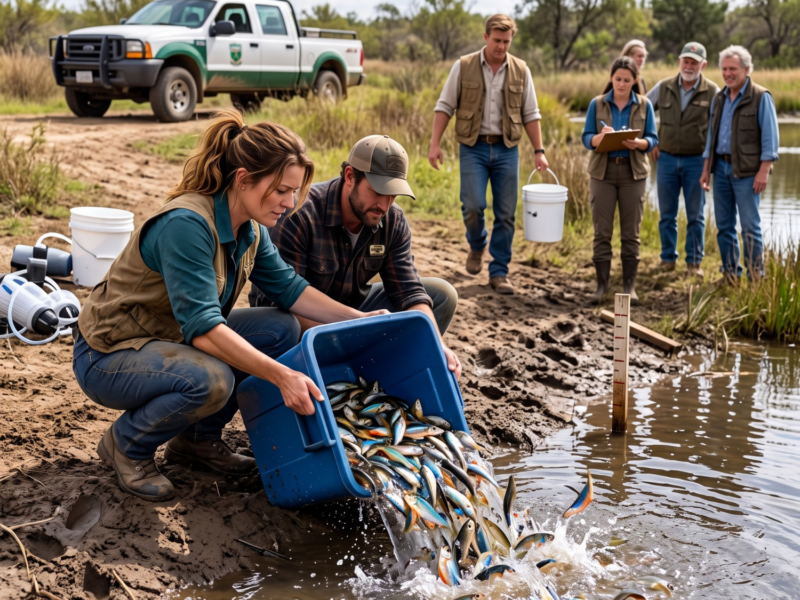
Single Mom Filled an Empty Pond With Minnows—Then the Worst Drought in 60 Years Arrived
THE BINGTON RESERVOIR
June arrived, and the rain simply stopped. It stopped the way a conversation stops when somebody walks into the room: abrupt and total.
At first, nobody worried, because two dry weeks in June is just a Tuesday in Kansas. But two weeks became three, and three became five, then six, and the National Weather Service office in Dodge City started using language in its outlooks that the older men in town recognized from their fathers. The pastures went from green to yellow in nine days, and from yellow to the dull brown of a paper sack by the second week of July. The farms that had laughed in April began doing heavy math at the kitchen table in June.
Grant Barington’s show pond, dug four years earlier and stocked with largemouth bass, dropped eleven feet and left a ring of dead cattails in cracked mud. The shallow wells went first—the forty- and fifty-foot ones on the older places—losing pressure in the afternoon, then losing it by noon, and eventually failing to come back at all. Hay that had been eighty dollars a ton in March was quoted at two hundred and thirty by the middle of July.
Silas Barington was not worried, and he had earned the right not to be. The Bington reservoir, dug in two stages during the late 1960s, held more surface water than everything else in the county combined. For thirty years, the Bington family had sold water out of it to their neighbors in dry stretches at a fair price with a handshake, and that generosity was the foundation of everything else they owned. A family that has saved you once owns a piece of your opinion forever.
So when Silas began buying land that summer, the town told itself a comfortable story about it. He bought the Lindström place in the first week of July at four hundred an acre—under half what it would have brought in a wet year.
He came to see Mara a second time on the eleventh of July, in the evening when the thermometer on her barn still read ninety-nine degrees. He offered to buy the entire seventy acres at twelve hundred an acre—more than double what she had paid for it in February. He said that a single woman with a child, no herd, no well worth the name, and no irrigation was running a race she had already lost, and that there was no shame in taking a win when it was offered.
Mara said no.
Silas put his hat back on, looked down at the basin where a brown oval of water sat surrounded by forty feet of baked clay, and told her in the same pleasant tone he used in church that when her pond turned to dust, the next offer would be considerably smaller.
Here is what was strange, and what the men at the cafe started mentioning to each other in late July without quite knowing why it bothered them: The pond at the Whitlock place was shrinking, but it was not dying. By the end of July, it had pulled back to perhaps a third of its April footprint—a dark oval maybe sixty feet across—and then it more or less stopped. It held a shape it had no business holding through six weeks without rain in a hundred-degree July.
The minnows were still there.
Mara was not watching it with hope, which is what people assumed; she was measuring it. She took the water temperature at four fixed points every morning and again every evening, writing the numbers down with the air temperature beside them. She noted wind direction, because wind drives evaporation harder than heat does, and she noted where in the basin the fish were holding—a column of data she had been filling since the second week of April.
By the last week of July, the drought stopped being a season and became a crisis with rules. The Bington operation announced it would be limiting outside water sales in order to protect its own herd—which was reasonable, legal, and devastating. Grant drove the county with his window down, telling anyone who would listen that the people who had prepared would come through fine, and that this was just the land sorting out who was serious.
Meanwhile, Mara was building. She bought two used fifteen-gallon poly tanks at a dairy sale and set them on a timber pad above the house. She rebuilt a quarter-mile of ancient buried line, pulled the transfer pump out of the barn, set it in a plywood box at the pond’s edge, and began moving small volumes of water—never more than a few hundred gallons at a time—out to the new grass on the upper slope on a schedule she timed with a kitchen clock.
Josie helped her glue fittings on the porch and asked why they were watering grass nobody could eat. Mara told her that the grass was not the crop; the ground underneath it was.









