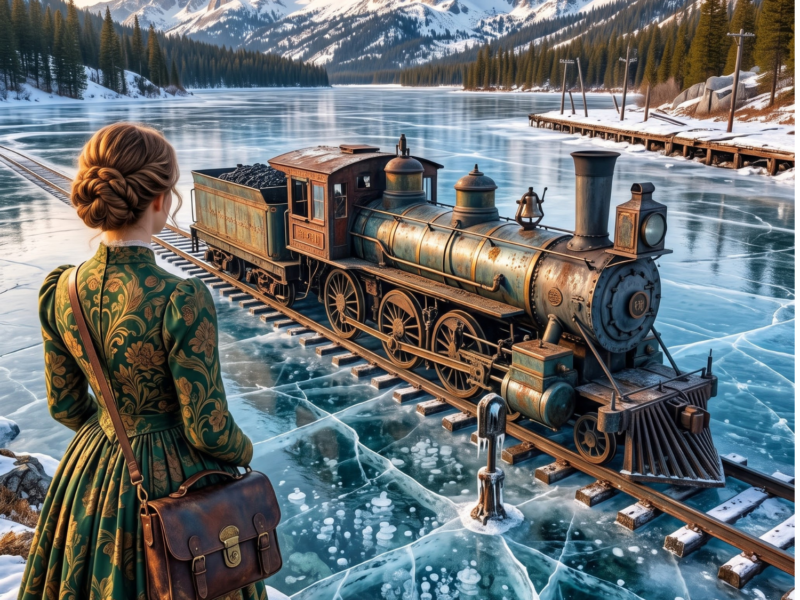
The Locomotive Lay Beneath 40 Feet of Clear Ice—She Was First to Reach What Was Locked in the Cab
The Locomotive Lay Beneath 40 Feet of Clear Ice—Sh…
The Locomotive Lay Beneath 40 Feet of Clear Ice—She Was First to Reach What Was Locked in the Cab
Larch Bend, March 1894
What would you do if the entire town told you that the only thing your father left you was a meaningless piece of brass no bigger than your little finger?
For six years, Jane Ward had known exactly what she had to do: survive. She was twenty-one now, a quiet woman with eyes the color of slate and hands hardened by flatland labor. But then, in the heart of a bitter winter, the mountain above her childhood home cracked open and showed the world that her piece of brass belonged to a locomotive buried under forty feet of clear ice, as smooth as glass.
The story of Jane Ward begins on a Tuesday, when she came down from the North Road on a borrowed, swaybacked mule.
She rode with a canvas bundle strapped behind her saddle and a heavy gray shawl pulled tight against the biting March wind. The valley below Cold Water Pass sat in a massive bowl of black pine trees and loose, jagged stone. The town of Larch Bend clung to the valley floor like something the freezing river had simply forgotten to carry away. Smoke rose from the stone chimneys in thin, gray ropes, and melting snow ran dirty in the deep ruts of the wagon road.
Jane rode with her chin tucked low. Her hands were raw inside her wool mittens, and she did not lift her eyes to the towering ridge until the mule stopped of its own accord at the freezing water trough beside the town livery.
It had been six years since she had ridden away from this place in the back of a freight wagon. Six years since the catastrophic winter her father did not come home from his run over the high pass.
He had been an engineer on the mountain train line, a quiet, methodical man named Thomas Ward, with permanent soot under his fingernails and a slow, careful way of watching the weather before he spoke. When the massive Engine Number Nine went off the west trestle in the blinding blizzard of ’88, the recovery crews had found the tender and the coal car completely smashed half a mile down the brutal slope. Pieces of the passenger coach were scattered wherever the violent wind had wanted them to be.
But the locomotive itself, and the man inside it, had vanished into the deep snow above the switchback. It had never been seen again.
The railroad company had paid nothing to the grieving families. They cited an “act of God,” washing their hands of the disaster. The town of Larch Bend had whispered about it—whispered that Thomas Ward had been drinking, whispered that he had taken the corner too fast, whispered that he was a coward who had jumped.
And Jane, who was fifteen then and had no mother to protect her, had been sent down to live with a bitter aunt in the flatlands. She left with a small tin cigar box that held her father’s cracked pocket watch, his union card, and a heavy brass cab key stamped with the number 9.
Then, two weeks ago, the impossible news had come to the flatlands by a rider on horseback.
The ancient glacier above Cold Water Pass had shifted during a freak, warm January thaw. Something dark, long, and clearly made by human hands had shown itself deep within the sheer wall of blue ice at the top of the great, round bowl in the mountain. Prospectors and miners with brass spyglasses had climbed the treacherous shoulder to look. They saw a riveted boiler. They saw a tall smokestack. They saw the number 9 in faded white paint, still perfectly readable under forty feet of clear, compacted ice.
The mountain had finally given back what it had taken. And instantly, the valley began arguing violently about who owned the iron corpse.
Jane slid off the mule. She did not answer the liveryman when he approached and asked who she was. She only nodded toward the towering ridge where the pass sat white, blue, and impossibly huge against the afternoon sky.
She paid for the mule’s feed with a silver coin and walked along the warped wooden sidewalk toward the boarding house where she had spent her childhood. She carried the brass key in a leather pouch tied at her throat. She could feel the cold metal resting heavily against her collarbone with every single breath she took.
Related Articles

They Mocked the Widow’s Dirt Cellar—Then the Freeze Left Every Cabin Cold but Hers Warm
They Mocked the Widow’s Dirt Cellar—Then the Freeze Left Every Cabin Cold but Hers Warm…

A Homeless Veteran and His German Shepherd Inherited a Ridge No One Wanted — 35 Feet In, They Found
Chapter 1 / 7 A Homeless Veteran and His German Shepherd Inherit… A Homeless Veteran…

Neighbors Laughed When He Built A Cabin Inside An Old Barn—Until It Kept His Home 35 Degrees Warmer
Chapter 1 / 8 Neighbors Laughed When He Built A Cabin Inside An… Neighbors Laughed…

His Sod House Had No Woodpile in January – Until the Trains Stopped and the Town Came Begging
Chapter 1 / 10 His Sod House Had No Woodpile in January – Until t……

She Built Her Cabin Over the Woodshed and Never Burned Wet Wood Again
Chapter 1 / 8 She Built Her Cabin Over the Woodshed and Never Bu… She…

The Duke Abandoned Her on Their Wedding Day—Years Later, He Discovered What He Had Lost
Chapter 1 / 7 The Duke Abandoned Her on Their Wedding Day—Years… The Duke Abandoned…

He Wedged a Tiny A Frame Into a Crevice Before Winter and His Family Slept at 75°F While Town Hit
Chapter 1 / 7 He Wedged a Tiny A Frame Into a Crevice Before Win……

He Was Too Old to Ride—So He Bought the Ruined Ranch and Found the Room Behind the Fireplac
Chapter 1 / 5 He Was Too Old to Ride—So He Bought the Ruined Ran……

Settlers Laughed at His Underground Heat Recovery Duct — Until It Kept His Cabin 71°F Warmer
Chapter 1 / 9 Settlers Laughed at His Underground Heat Recovery… Settlers Laughed at His…

A Navy SEAL Built a Home Inside a Mountain—Then His Dog Warned Him Before the Storm
Chapter 1 / 5 A Navy SEAL Built a Home Inside a Mountain—Then Hi… A…