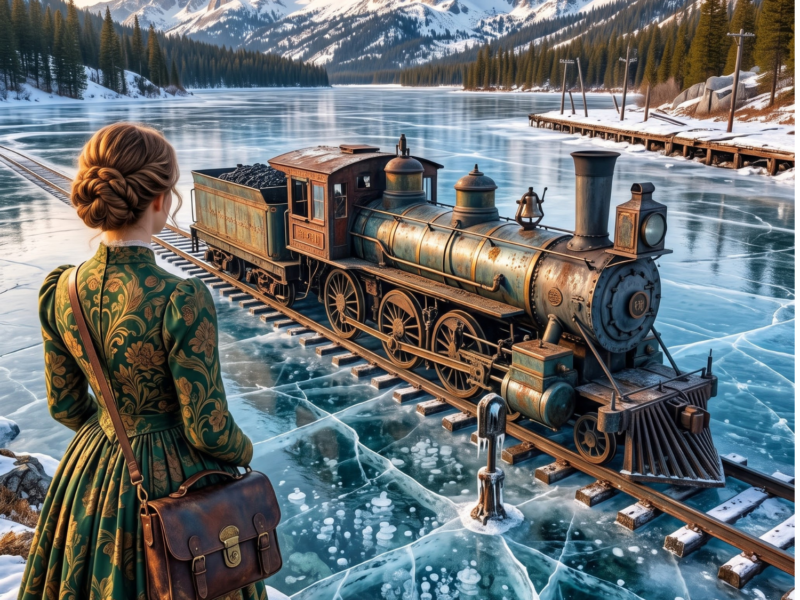
The Locomotive Lay Beneath 40 Feet of Clear Ice—She Was First to Reach What Was Locked in the Cab
The Mark in the Ice
The Shaft
When the first pale, gray light showed above the eastern ridge, Jane sat up instantly. She stirred the dying coals, put her last pieces of pine on them, and warmed her hands until her stiff fingers would bend enough to grip a tool.
The mule stood exactly where she had left it, with one hip cocked lazily, its breath making slow, rhythmic white banners in the brutal cold.
She rose, her joints popping, and walked to the mouth of the shaft the miners had cut.
The channel went down clean and perfectly straight for the first ten feet. Then, it bent slightly, following a natural, diagonal seam in the ice that the saw workers had clearly chosen because it was softer to cut through. Jane knelt at the treacherous edge and looked in. The blue of the ice grew darker, almost black, as it deepened. At the very bottom of the cut, she could just barely see the black, riveted corner of something square.
She could not yet tell what part of the train it was.
She lay flat on her belly on the freezing ice, shuffling forward until her head hung over the abyss. She put her ear to the shaft, the exact way a trackman puts an ear to a steel rail to hear a coming train. The glacier hummed—a low, steady, terrifying vibration. But under the hum, there was nothing. No voices. No movement.
She stayed there a long time, the cold seeping into her bones.
When she finally stood up, she walked slowly, once around the perimeter of the shaft. And that was when she saw it.
On the far side of the hole, embedded in the sheer wall of clear ice about waist-high above the surface, there was a mark. It was not a scratch from a rogue saw blade, and it was not the ordinary, chaotic flaw of freezing water.
A deliberate shape had been cut into the ice from the inside, or it had lain forcefully against the ice from the inside, until its outline had slowly, over years of pressure, pressed through to the outer surface.
It was a small, perfectly even square, no bigger than a man’s hand. And inside that square, there was a raised line of letters, reversed by the ice but perfectly legible.
Jane bent incredibly close, her breath fogging the ice. She wiped it away with her mitten.
The letters read: T.W.W.
She stood back, staggering as if she had been physically struck. She did not touch the mark. She looked at it for a long, agonizing time. Then she looked up at the white, indifferent shoulder of the pass, and then down at the deep ice, where the massive Number Nine lay pale and readable under forty feet of frozen winter.
A cold that had absolutely nothing to do with the mountain air went straight through her heart.
Thomas William Ward.
Her father’s initials. Pressed against the inside of the ice, as if he had deliberately left them there for her to find.
It made absolutely no sense. The railroad company had definitively stated six years ago that no body had been recovered from the wreck of the Number Nine, and that in a catastrophic fall that big, into a ravine that deep, no body would ever be found. The engineer had gone with the engine, they had said. The engine had gone into the snow, and the snow had closed over it forever.
Jane had lived six agonizing years with that finalized sentence. She had grown around that grief the way a young, supple tree grows around a rusted iron nail driven into its trunk.
And now, on the far side of the shaft the miners had cut, two letters stood perfectly in the ice, as clean and sharp as if a man had pressed a brass stamp against the freezing window of the cab and held it there, with his dying strength, while the mountain violently took him.
She did not act immediately. She had learned the hard way in the flatlands never to act on the first shock of a thing.
She walked back to the dying fire, set the tin cup on the coals, boiled more snow, and drank it slowly, forcing her heart rate to slow down. She watched the mark from thirty paces away while the sky turned from gray to the pale, blinding gold of a March morning at extreme altitude.
Howerin’s men would be coming up the track by noon. She had until noon to be simply a grieving woman with a mule, a rope, and a brass key. But in the afternoon, when they arrived with their dynamite, she would have to be something else entirely.
She did not yet know what that was. She only knew that the mark was meant for her, that it had been waiting in the dark for six years, and that she would not tell a single soul in Larch Bend what she had seen until she had put her own bare hand on it.
She went back to the shaft, knelt again, and looked deep down into the blue. This time, as the sun hit a better angle, at the very bottom of the cut where the saw workers had given up and stopped, she saw the unmistakable, curved corner of what she now understood was the locomotive cab’s iron roof.
It was significantly closer to the surface than Howerin had boasted in town. The miners had done far more grueling work than he had admitted. The way in was already half open.
By the time the sun fully cleared the eastern ridge, Jane had a plan for the day. And the plan was brutal, unrelenting work.
She untied the canvas bundle and laid out exactly what she had carried up from Larch Bend. A short-handled, forged steel ice axe her father had used on the winter line. A heavy cold chisel with a hickory grip worn perfectly to the shape of a man’s hand. A two-pound iron hammer. A massive coil of braided hemp rope. A folded canvas lifting sling. The tin of matches. And the heavy brass cab key on its leather cord.
She looked at each tool once, committing her strategy to memory, and then she began.
She started with the shaft. Howerin’s thick men had cut it wide enough for their own massive shoulders, which meant it was slightly too narrow for a man in a bulky oilskin to swing a tool, and too wide for the ice to hold its structural shape for long against the warming spring sun.
She worked the ice axe fiercely against the north edge, where the lazy saw workers had left a dangerous, hanging tongue of ice that would eventually crack the wrong way when weight came onto it. She brought the massive tongue down in three clean, explosive strokes, and kicked the heavy, shattering pieces clear of the hole.
Then she went to the mule. She led it closer, tied one end of the hemp rope securely to the heavy pack saddle, ran the free end over the smooth edge of the granite tooth for leverage, and coiled the rest beside the shaft. The mule stood for it patiently, its long, fuzzy ears swiveling at every terrifying sound the deep glacier made. She rubbed its soft nose once, told it quietly that it was a good, brave animal, and the mule blew a warm, reassuring breath against her frozen mitten.
She worked the cold chisel next.
She went around the mouth of the shaft, set the steel chisel against the ice, tapped it gently with the hammer, and listened to the resonance. The saw workers had cut with crosscut saws because saws are fast. But saws violently bruise the ice and leave weak, unstable seams a hand’s width deep into the walls. The chisel found those hidden seams and lifted them out in massive, flat blue plates that Jane stacked carefully on the snow to build a windbreak.
By mid-morning, sweating despite the freezing air, she had perfectly squared the throat of the shaft and cleared a solid, safe foothold a step down inside it. Her shoulders burned with lactic acid. Her breath came in short, painful gasps at that altitude.
She stopped only once to eat a tough strip of salted dried meat, drink melted snow, and lean her aching forehead against the mule’s warm, muscular shoulder. The mule did not move an inch.
While she worked, her hands remembered things her conscious mind had not yet articulated. The chisel, in her father’s grip-worn hickory handle, sat in her palm exactly as if her own hand had been shaped to hold it. The heavy axe swung true and bit deep, because Thomas Ward had swung it true a thousand times in front of her, and the wood remembered the motion.
When she set the brass key beside the heavy tools on the canvas, the key looked like the smallest, most insignificant and plainest thing there. And yet, it also looked like the sole reason for all the rest of the iron and steel.
She thought of the mark in the ice on the far side of the shaft. The two letters pressed through from the inside. She did not look at them yet. She kept her back to them and worked like a demon.
By noon, Howerin’s heavy sled came into sight at the very last switchback below, a crawling black dot against the vast expanse of white snow.
Jane was already six feet down inside the blue shaft, with the chisel in her hand, the rope tied securely against the granite, and the mule standing quiet and vigilant above her, watching the road.
Jane went down.









