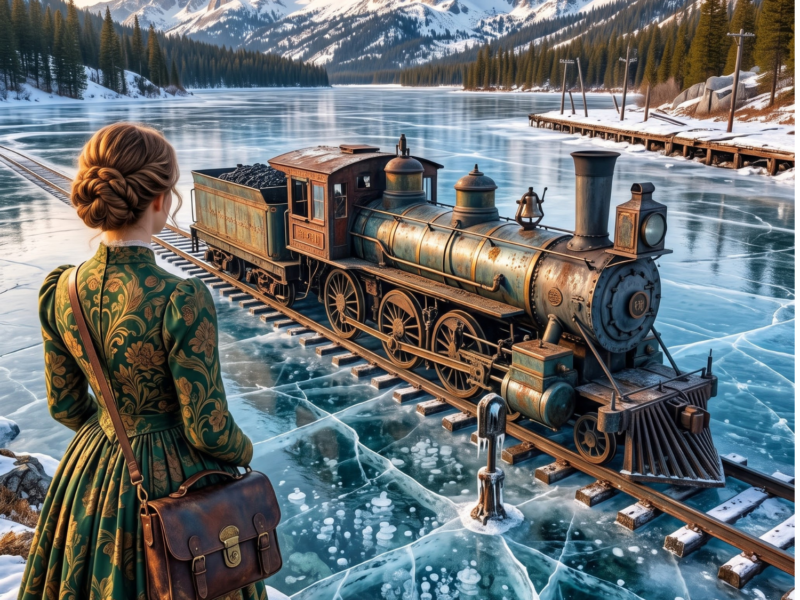
The Locomotive Lay Beneath 40 Feet of Clear Ice—She Was First to Reach What Was Locked in the Cab
The Avalanche
The Standoff
Howerin stood at the mouth of the shaft in his ridiculous beaver hat. Flanking him were his two massive workers, looking nervous, and the stark black wooden case of blasting powder rested open on the sled behind them.
He leaned over the hole, cupping his hands. He called down that Jane was illegally trespassing on a federally filed salvage claim. He called down that he, as a gentleman, would generously give her a count of ten to climb up the rope before they acted. He called down that the dynamite was already primed, capped, and fused.
Jane put the black ledger inside her heavy wool coat, buttoned it tightly to her chin, and started up the hemp rope hand over hand, her boots finding the cut holds, with the lantern swinging wildly at her hip.
She was halfway to the surface, twenty feet up the blue chimney, when the wind violently changed.
It did not shift; it exploded. It came off the jagged shoulder of the pass in one long, catastrophic shove—the kind of massive, atmospheric March gust that carries the last, violent death throes of winter in it. The sky above the mouth of the shaft went from pale gold to a bruised, iron gray in the space of a single breath.
Snow began forming in the air before it even began falling on the ground, a blinding whiteout.
Jane clung to the rope and climbed on, her muscles screaming.
Above her, Howerin was shouting frantically at his men to set the charge, light the fuse, and clear the treacherous ledge before the storm trapped them.
But one of the men, the younger of the two workers, was arguing back over the roar of the wind. He was screaming that the sky had turned deadly, that they needed to be down past the lower switchback before dark or they would all freeze, and that blowing the ice now in a whiteout was suicide. Howerin was screaming back, calling the boy a coward and threatening his wages.
The argument ended abruptly when the younger man slipped on the slick, polished ice near the lip of the hole.
Jane heard a terrified shout, the sickening scrape of an oilskin jacket sliding against wet ice, and then a heavy body came plunging into the mouth of the shaft above her.
He came down feet first, screaming, tangled hopelessly in his own heavy coat. He fell fifteen feet and stopped with a bone-jarring crack against the slight bend in the shaft, right where the lazy saw workers’ cut had turned.
He hung there, groaning in agony, with one arm wedged immovably in the narrow ice and the other arm swinging free, exactly ten feet above Jane’s head.
And the black powder case above him, kicked loose in the struggle, tipped precariously at the very lip of the shaft. It teetered over the abyss, defying gravity for a split second, and miraculously did not fall.
Jane didn’t hesitate. She climbed up to the trapped boy.
She braced her heavy boots fiercely against one blue wall of the shaft and pressed her back against the opposite wall, bridging the gap over the abyss. She pulled the chisel from her belt and worked it frantically, blindly behind his wedged shoulder, chipping away the ice until the glacier finally let him loose with a wet sucking sound.
She took his entire dead weight onto the hemp rope she had tied at her own waist, groaning under the strain, and lowered him the last terrifying foot onto the small, squared floor she had cut just above the locomotive cab.
In the dim light, she saw he was far younger than she had thought from watching him in town. He was no older than she was, with a terrified, bloodied lip and a wrist bent at a sickening, impossible angle.
She didn’t speak. She ripped her wool scarf from her neck, wrapped it tightly around the shattered wrist, and tied it off as a crude splint. She told him to breathe through his nose. She told him to look only at the flame in the lantern and absolutely not to look up at the black powder case swaying above them.
Above, the storm was reaching a crescendo. Howerin was screaming blindly into the shaft, demanding to know if the boy was dead, and the snow was coming down so hard it was filling the hole.
Jane understood the brutal physics of the situation perfectly. If Howerin threw a lit stick of powder down that shaft right now out of panic or malice, the explosion would fracture the glacier. The whole mountain bowl would come down in a massive avalanche, burying her father, the ledger, the boy at her knee, and herself forever.
She stood up in the narrow shaft, gripped the hemp rope in her bloody hands, and called up to the surface in a voice the screaming wind carried much further than she meant it to.
She screamed that Howerin’s own man was severely hurt at the bottom of the hole. She screamed that the storm had turned into a whiteout, and that if he lit a single fuse, he would deliberately murder three people at once, and the town would know it.
There was a long, agonizing silence from above, broken only by the howl of the wind.
Then came the heavy, scraping sound of the wooden powder case being dragged safely back from the deadly lip of the shaft. And then came Howerin’s voice. It sounded impossibly small, stripped of all its bombast and power, telling his other, terrified worker to grab the rope and hold fast.
Jane tied the groaning boy securely into the canvas lifting sling. She climbed up the rope above him, set her boots against the ice, and pulled with everything she had.
High above, at the surface, the mule tethered behind the granite tooth felt the tension. It took the massive weight, exactly as Jane had trained it to do that morning, stepping backward one careful, agonizing step at a time.
The boy rose slowly out of the blue ice, up into the blinding, falling snow, and directly into the waiting arms of the very man who, an hour before, had fully intended to blow the shaft closed over her head.
Howerin laid the weeping boy gently down in the snow beside the sled. He stripped off his own expensive, fur-lined oilskin coat and tucked it under the boy’s head. For a long, shaking moment, Howerin did not dare look at the open shaft.
When he finally did, Jane was already coming up over the lip. She pulled herself through the mouth of the ice with the black ledger buttoned tightly inside her coat and the lantern dark and swinging on its cord.
She stepped onto the snow, exhausted, freezing, and victorious. She stood directly in front of the massive man, the violent wind pulling her hair loose from its pins. She did not raise her voice over the storm.
She said, simply, “He is alive.”
Howerin, pale and shaking, nodded once.
“So was my father,” Jane said, her voice like cracking ice. “Until the rotten piling gave way.”
Howerin did not answer. He couldn’t.
Jane unbuttoned her coat with numb fingers, took the black ledger out, and held it firmly against her ribs. She did not offer it to him. She only let him see the battered corner of the leather cover, the square, patient, unmistakable writing on the visible page, the two signatures at the bottom, and the fatal date.
Howerin looked at the page for a long, terrible time. He saw his own signature, and he saw his own ruin. The heavy snow settled on the brim of his beaver hat and coated his broad shoulders. His other worker stood frozen at the mule’s head, his fists wrapped tight in the rope, and did not dare speak a word.
At last, Howerin looked away from the book. He looked at Jane’s slate-gray eyes.
“Bring your father down,” Howerin said.
He said it low, quiet, with absolutely none of his usual theatrical show behind it. It was a surrender.
Jane put the ledger back inside her coat.









