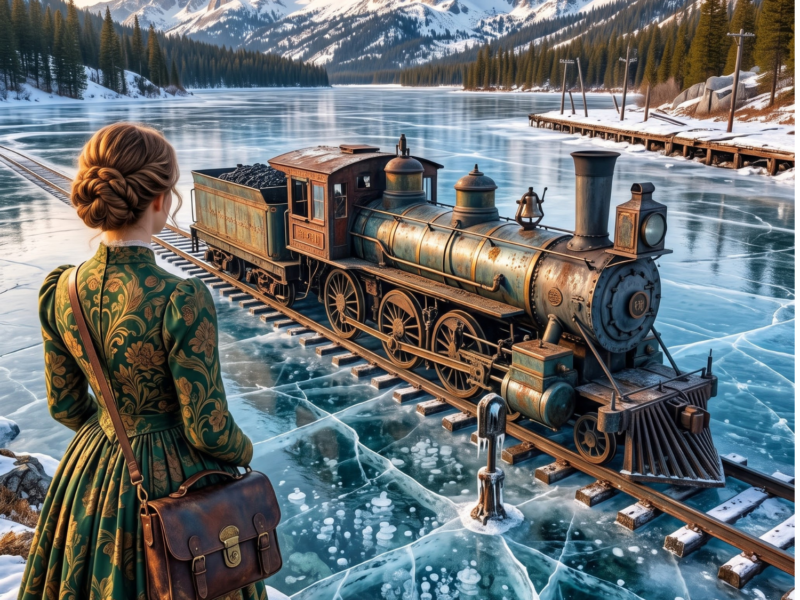
The Locomotive Lay Beneath 40 Feet of Clear Ice—She Was First to Reach What Was Locked in the Cab
The Engineer's Cab
The Deep Ice
She set her heavy boots firmly in the foothold she had cut, took the thick hemp rope in her mitten-clad hand, and let her full weight settle into the vertical shaft.
The brilliant blue ice closed over her head like water.
The screaming sound of the wind above her instantly thinned to a ghostly hush. In its place came the deep, terrifying, geologic ticking of the ice—the exact same sound she had heard in the night, only vastly nearer now, pressing in all around her ribs.
She lowered herself another foot, her boots finding the grooves the miners had left. The heavy chisel hung from her leather belt on a loop. The kerosene lantern she had lit at the mouth of the hole, she carried below her on a second, thinner cord. The flickering yellow flame in its tin sleeve threw a small, desperately warm circle against a sheer wall of cold, ancient blue that had no bottom she could see.
Six feet became eight. Eight became ten.
At twelve feet down, the shaft bent sharply as the saw workers’ cut had lazily followed the soft seam. Jane had to contort her body to slide past the elbow.
And at fourteen feet, in absolute, freezing darkness save for the lantern, her boot came down hard on solid iron.
She knelt in the small, cramped square the miners had cleared. She took off her mitten and brushed the last of the frozen ice shavings away with her bare hand. Under her palm, she saw the massive, indestructible roof of the locomotive cab.
She saw heavy steel rivets. She saw a graceful curve of black paint that had faded to a ghostly slate gray. And she saw the heavy iron knuckle of a door hinge.
She worked sideways along the seam with the chisel and hammer, tapping rhythmically, listening to the pitch of the ice, taking the frozen blue away in plates the size of hymnal pages. Slowly, agonizingly, the top half of the heavy iron door showed itself.
The door had a small, square, reinforced window. Inside the glass, there was nothing but absolute, impenetrable dark.
She hung the lantern from a protruding stub of the iron hinge and set her ear flat against the freezing iron door. Total silence. She set her palm flat against it, feeling the immense, crushing weight of the mountain pressing down on the steel box.
And then, because she had come six years and climbed forty feet into the ice for this exact moment, she took the leather pouch from her throat and drew out the brass key stamped with the number nine.
The keyhole in the iron cab door was completely frozen shut with a thick plug of white frost. She warmed it first with her hot breath, then held the lantern’s tin belly against it until it hissed, and finally chipped the last stubborn skin of ice from the tumblers with the needle point of the chisel.
She fit the brass key in. It slid in smoothly.
She turned it.
Something deep inside the massive iron lock, mechanisms older than she was, gave a small, dry, echoing click.
The heavy iron door moved a finger’s width toward her on its well-greased hinges, breaking the vacuum seal of the ice with a wet gasp.
Jane pulled it open slowly, the metal groaning in protest.
The cold inside the sealed cab was an entirely different kind of cold than the glacier outside. It was bone-dry, stagnant, and perfectly still, sealed up tight in a time capsule for six long winters.
She sent the lantern in ahead of her hand, the yellow light piercing the gloom.
The light found the polished brass of the throttle bar. It found the glass face of the steam gauge, fogged pale with ancient, frozen condensation.
Then, the light found a heavy wool coat sleeve. And a hand.
The hand rested exactly where a good, attentive engineer’s hand always rests: draped loosely, expertly over the air brake valve. The fingers were dark with frostbite, but the fingernails were still meticulously clean of everything but a fine rim of coal soot.
Above the sleeve was a broad shoulder. Above the shoulder, a thick beard brilliantly silvered with sparkling frost. And above the beard was a face she had not seen in six agonizing years.
Quiet as a man who had simply fallen asleep at a post he violently refused to abandon, Thomas Ward sat upright in his engineer’s seat. He looked exactly as if the mountain had only just closed the door behind him an hour ago.
Jane knelt in the freezing opening of the door. She did not weep. She had done all her weeping in the flatlands, where tears were cheap.
She looked at her father for a long, quiet time by the flickering lantern light, committing his peaceful, frozen face to her memory forever. And then, she looked down at what his body had been physically guarding.
Wedged tightly between his heavy boots on the steel floorboard of the cab was a battered, leather satchel she recognized immediately from the kitchen table of her childhood. Beside the satchel, wrapped carefully in his yellow oilskin coat to protect it from moisture, lay a heavy canvas railroad payroll sack, tied securely at the neck with copper wire.
And resting squarely on top of the payroll sack was a small, black, leather-bound ledger book.
Jane reached in and lifted the ledger with both trembling hands. The paper pages inside were stiff, almost brittle with the extreme cold, but the ink was perfectly preserved and easy to read.
In her father’s square, meticulous, careful handwriting were the official, logged entries for the final, fatal run of the Number Nine.
She read the dispatcher’s direct, written order to leave the station in the middle of a catastrophic storm, directly against Thomas Ward’s written, formal protest. She read the mileposts meticulously marked as safe and unsafe.
And then, she read the final, damning entry. It was a formal note stating that the massive wooden pilings of the West Trestle had been officially reported as structurally cracked in November, and had deliberately never been repaired by the company to save money.
Beneath that terrifying entry were two signatures. One she knew intimately: Thomas W. Ward.
The other signature she did not know, but she recognized the name instantly.
Bartholomew Howerin, Yard Boss.
It was initialed and dated exactly one day before the catastrophic wreck. Howerin had forced the train onto a broken bridge.
Jane closed the ledger, her hands shaking not from the cold, but from absolute, blinding rage. She sat back on her heels in the freezing cab of the Number Nine, with her murdered father beside her and the explosive truth resting in her lap.
And then, above her, faint but terrifyingly clear through forty feet of solid ice, she heard the sharp ring of an iron point striking the surface of the glacier.
A man’s voice she knew all too well was calling her name down the echoing shaft.
Howerin had arrived.









