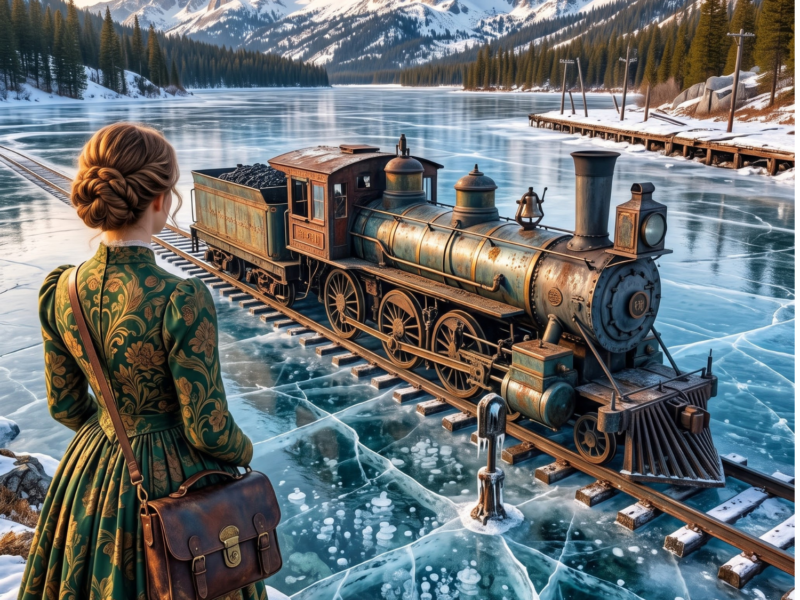
The Locomotive Lay Beneath 40 Feet of Clear Ice—She Was First to Reach What Was Locked in the Cab
The Ascent
The North Road
Word of her suicidal plan moved through Larch Bend long before the sun had cleared the eastern ridge. It moved the way malicious news always moves in small, bored places: from the baker’s back door to the blacksmith’s open shop, from the schoolhouse steps to the assayer’s office, growing a little more exaggerated and foolish at every mouth.
By the time Jane crossed the town square with her canvas bundle strapped over one shoulder and a heavy coil of hemp rope over the other, half the town had decided she was insane, and the other half were just waiting for her to die so they could say they knew it all along.
A woman at the dry goods window pulled her lace curtain shut half an inch as Jane passed. Two young boys by the water trough elbowed each other and grinned. An old, scarred wagon driver sitting on the porch of the feed store took his corncob pipe from between his teeth and slowly shook his head once, as if she had already fallen off the cliff.
She kept walking.
She had learned over six years down in the brutal flatlands how to walk directly through the sound of mockery without turning her head. It was not a trick so much as a calloused habit. It was the exact way a person learns to work up to their waist in freezing water and simply stops noticing the cold.
The pouch at her throat rested warm against her skin. The key inside it weighed almost nothing, yet it was the anchor holding her to the earth. She counted her steady steps to the livery and forced herself not to count the eyes watching her.
At the livery, the same man from the day before leaned in the doorway with his arms folded over his chest. He watched her meticulously tighten the mule’s saddle strap.
“Girl,” he said, his voice surprisingly gentle, not unkind. “The pass will have fresh snow up to your knees by the time you hit the second switchback.”
Jane nodded, testing the tension of the leather. “I know it.”
“There are hardened men who have been climbing that high country for twenty years,” the liveryman continued, stepping closer. “And they will get up there ahead of you. They have picks, blasting powder, and a proper base camp.”
“Let them,” Jane said flatly.
He worked his jaw for a moment, staring at her slate-gray eyes. Then, he reached into his pocket. He handed her a small tin of strike-anywhere matches wrapped carefully in waterproof oilcloth. He didn’t say a word. He just stepped back so she could lead the mule out into the frozen road.
Howerin was waiting for her at the head of the wagon track. A man like Howerin could not resist a public spectacle; he thrived on theatrical farewells.
He had two of his heavy workers with him, thick-necked men wearing yellow oilskins against the wind. Behind them sat a heavy wooden sled loaded with a massive two-man ice saw, a steel auger, and a stark black wooden case that Jane instantly understood was blasting powder.
Howerin tipped his beaver hat with showy, mocking politeness as she approached.
“Ward’s girl is going up!” he called out, his voice booming, loud enough for everyone on the wooden sidewalk to hear. “Going up with a piece of rope, a half-dead mule, and a brass button on a string! You watch your footing up there, little sister. The mountain has already eaten one Ward. It will not hesitate to spit the second one back down if it takes a mind to!”
Somewhere behind her, a woman gasped in shock at the cruelty. A man laughed, but the laugh was cut off sharply. Jane felt the small, clean, white-hot anger that had carried her up the North Road suddenly tighten into something quieter, harder, and infinitely more useful. She did not even look at Howerin. She led the mule right past his sled and out onto the deeply frozen ruts of the mountain trail.
At the very edge of town, where the wagon track bent sharply upward toward the treeline, Jane saw an old woman standing in the doorway of a low, sod-roofed cabin. Jane did not remember the cabin from her childhood, though the structure looked older than her childhood by half.
The woman was small and severely bent, with a heavy gray shawl pinned tightly at her throat. Her eyes were the pale, shocking color of river ice.
She lifted one frail hand as Jane came level with the heavy oak door.
Jane stopped. She did not know why she pulled back on the halter, but she did. The mule blew out a massive, warm breath into the freezing air.
“Girl,” the old woman said. Her voice was thin, reedy, and incredibly steady, like a piano wire pulled perfectly tight. “The mountain does not keep what was never hers. Go and ask her to give back what she borrowed.”
Jane opened her mouth to answer, to ask what the riddle meant, but found she had no words ready. The old woman simply lowered her hand, stepped backward into the absolute dark of the cabin, and pulled the door closed. The iron latch fell with a small, dry, terrifying sound.
Jane stood for a long moment in the road, the bizarre words folded into her mind. She didn’t understand them yet, understanding only that they had been meant specifically for her, and that they would keep until she needed them. She clicked her tongue at the mule and started up the brutal incline.
The road to the pass climbed slowly at first, winding through towering black pines that still carried the last of the winter’s heavy snow on the north side of every trunk. By mid-morning, the trees thinned out drastically, and the road narrowed to a treacherous track. By noon, the track itself was only a memory, buried under hard, wind-packed snow and treacherous ice.
Jane broke the trail on foot, kicking steps into the crust, and led the mule behind her by the rope halter.
The sky above was the pale, dry, unforgiving blue of high country in March. The wind coming down off the massive mountain bowl tasted sharply of raw stone and old, glacial ice. She stopped twice to breathe, her lungs burning in the thin altitude. She did not stop to eat; eating would make her sleepy, and sleep up here was death.
When she looked back over her shoulder, Larch Bend had become nothing but a handful of dark, insignificant specks at the bottom of a massive white bowl, and the smoke from its boastful chimneys had thinned to absolutely nothing.
She caught her first sight of the shape near the fourth hour of the climb.
The mountain bowl opened above her like a great, pale, terrifying room. In the far, sheer wall of it, where the ancient glacier bent around the jagged shoulder of the pass, a long, dark, unnatural line lay suspended deep in the blue ice.
Even at a mile’s distance, she could see the unmistakable round shape of an iron boiler and the straight, proud line of a smokestack. And faint, like breath fogging a windowpane, was a pale figure—a number she could not yet read, but knew in her bones.
Her chest tightened painfully once, and then let go. She kept walking.
By late afternoon, the sun casting long, purple shadows across the snow, she was close enough to see the shaft.
The miners with their spyglasses had done far more than just look from a distance. Someone with significant time, money, and heavy iron tools had already been here. They had cut a narrow, terrifyingly deep channel straight down through the clear ice from the surface of the glacier, aiming directly toward the buried cab of the locomotive.
It was a raw, bright blue chimney, no wider than a broad man’s shoulders. The massive chips of ice tossed out of it lay scattered on the pristine snow like broken green glass.
Howerin’s men, she suddenly understood, had not begun their salvage operation with blasting powder after all. They had begun with long ice saws, trying to reach the cab quietly. They had gone home for the night, leaving the shaft open.
Jane made a small, efficient camp in the lee shelter of a massive granite tooth, thirty paces from the lip of the shaft. She unloaded the exhausted mule, hobbled its legs securely, and rubbed its freezing neck for a long time before she let it be.
She built a small, intensely hot fire out of the dry pine she had carried up in her canvas bundle, because there was absolutely no combustible wood at this extreme height. She boiled snow in a tin cup and drank the water plain, the heat radiating into her freezing core.
The sun went down violently behind the western ridge. The light hitting the glacier above her turned first a brilliant pink, then a bruised lavender, and finally the deep, still, terrifying blue that mountain people call the “Hour of the Dead.”
In that eerie light, the massive shape of the locomotive suspended under forty feet of clear ice looked less like a violent train wreck and more like a mythical beast, peacefully asleep.
Jane lay down in her wool blanket with her back pressed to the granite and her face turned toward the ice. She did not sleep for a long time. She listened.
The glacier was alive. It made small, terrifying sounds all night. There were sharp ticks, sudden pops, and long, low, agonizing groans—the exact way an old wooden house speaks when the stove goes cold in the dead of winter, but magnified a thousand times by the mass of the mountain.
Once, somewhere deep inside the ice, she heard a single, soft, distinct knock. It sounded exactly as if a human hand had struck a piece of hollow iron. And then, there was nothing but the wind. She did not sleep, and she did not pretend to.









