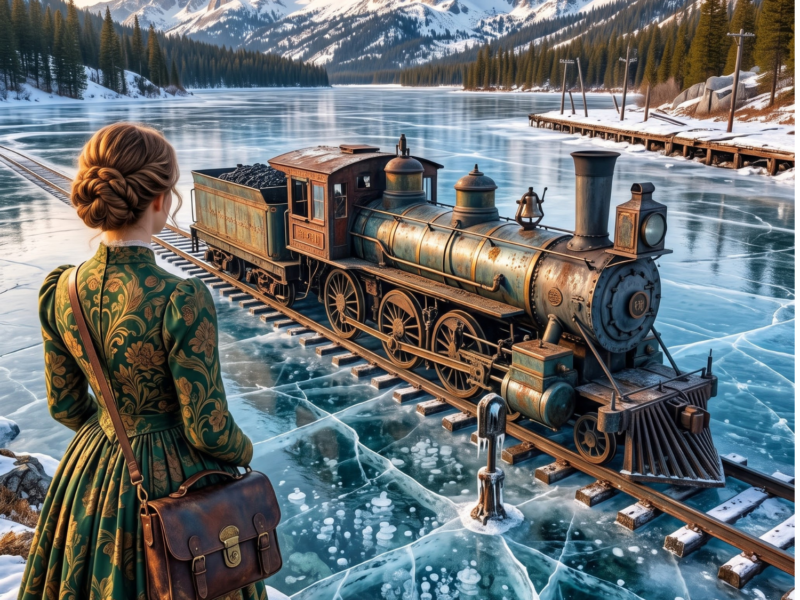
The Locomotive Lay Beneath 40 Feet of Clear Ice—She Was First to Reach What Was Locked in the Cab
The Descent
The Return to Larch Bend
They came off the brutal mountain agonizingly slowly.
The injured boy rode the wooden sled, wrapped tightly in Howerin’s heavy oilskin. The borrowed mule carried the heavy canvas bundle of tools Jane had brought up, along with the railroad payroll sack. And Howerin, the richest, loudest man in Larch Bend, walked silently at the head of the sled, pulling the rope with his own bare, freezing hands.
The violent storm unexpectedly eased just before they reached the second switchback, as chaotic March storms in the high country sometimes do. By the time they finally saw the warm, flickering yellow lamps of Larch Bend in the valley below, the sky above the pass had cleared completely to a hard, crystalline blue-black, pricked with millions of freezing stars.
Word of what had happened on the ice had somehow gone ahead of them, traveling the way word always does in a valley—on the wind, or carried by the sheer weight of consequence.
The wooden sidewalk of the main street was lined with people when the bizarre procession finally came into town.
There was absolutely no laughter. There were no whispers.
The town baker stood silently in his open doorway, his forearms dusted white with flour. The gruff liveryman stepped into the muddy street, took the mule’s halter gently from Jane’s bleeding hand, and led the exhausted animal away without asking a single question.
And the old woman from the low, sod-roofed cabin stood at the very edge of the quiet crowd. Her gray shawl was pinned tightly at her throat, and her pale, river-ice eyes were locked on Jane. She said nothing. She didn’t need to. She had already delivered her line that morning, and the mountain had indeed given back what it had borrowed.
By the next morning, the official county clerk had ridden into Larch Bend from the flatlands on a good, fast bay horse. He was a small, tidy, meticulous man in a black wool coat, with permanent ink stains on his cuffs.
He sat at the long wooden table in the boarding house, sipping black coffee, and read Thomas Ward’s ledger through from cover to cover. Twice. Without speaking a single word.
When he finally closed the leather cover, he placed his hand flat on it. He looked up at Jane, who sat across from him, and said quietly, “This is enough, Miss Ward.”
He stated the facts as they would unfold. He said the original engineering report on the west trestle piling would be immediately pulled from the November company archives. He said the railroad company executives would be answering federal questions they had successfully buried for six years. He said, with absolute legal finality, that Howerin’s salvage claim would not stand in any court, because maritime and rail law dictated that a man found at his post still held command of his vessel.
He said all of this in the calm, level voice of a man simply confirming a truth he had known deep down before he even opened the book.
Jane thanked him softly, poured him another cup of coffee, and maintained her composure. She did not weep in front of him.
Later that afternoon, Rufus Howerin came to the porch of the boarding house. He carried his expensive beaver hat in his hands. He did not step up onto the wooden boards; he seemed to feel he had lost the right to the elevation. He stood in the muddy slush of the spring thaw and looked up at Jane.
“I signed a paper I should have refused to sign,” Howerin said, his voice stripped of its pride. “They told me it would hold.”
Jane looked down at him from the doorway. “I know.”
Howerin nodded, accepting the judgment. “The boy with the broken wrist… he is asking after you. He wants to thank you properly.”
Jane softened slightly. “Tell him I will come by the infirmary.”
Howerin nodded again, turned, and walked slowly back across the muddy town square. And the townspeople sitting on the bench outside the post office watched him go, and not a single one of them laughed.
Something fundamental in the valley of Larch Bend that had been crooked, twisted, and ugly for six long years settled a little straighter on its foundation that day.
EPILOGUE: The Open Door
June 1894
They brought Thomas Ward down off the mountain a week later, when the weather finally broke and held.
Six strong men went up with a heavy sled, canvas tarps, and thick ropes. Jane went with them. Howerin went with them. No one spoke a single word on the grueling climb, listening only to the wind.
They laid the engineer to rest in the small, rocky churchyard at the edge of Larch Bend on a bright, cold Tuesday morning. He was buried in a plain, honest pine box. Inside the box with him, Jane placed his union card, his cracked silver pocket watch, and, folded gently into his frozen hands, the heavy brass key on its leather cord.
The local priest read a short, quiet service. The entire town came to stand in the snow.
When it was done, and the crowd had dispersed, Jane stood a long while at the fresh mound of earth. Her shawl was pulled tight against the chill, and the sun was already sinking low behind the jagged ridge.
That evening, she walked out to the edge of town, to the sod-roofed cabin by the wagon track. But the heavy oak door was wide open, swinging in the wind. The hearth fire was dead and cold, and no one was inside. And Jane understood, in the bone-deep way one understands such mystical things on the frontier, that the old woman with the pale eyes had said exactly what she had come to the valley to say, and had simply gone on to wherever she was needed next.
Jane closed the door for her, latching it tight, and walked back through the dark pines in the blue hour.
Weeks passed. The melting snow thickened in the muddy ruts, thinned again, and finally vanished. The pass opened for wagons, closed in a late flurry, and opened for good.
Jane took a permanent room at the boarding house where she had grown up. One morning, she went out front and expertly mended the broken wooden step herself, kneeling in the dirt wearing her father’s heavy wool coat, with his worn hammer in her steady hand.
Howerin’s younger worker came by the next week with his wrist in a neat wooden splint. He stood on the newly mended step, awkwardly took off his hat, and thanked her plainly for saving his life on the ice. Jane smiled, gave him hot coffee, and asked about his mother down in the valley. He stayed for an hour. He came back the next week. And the week after that.
The boarding house filled again by early summer with rough linemen, quiet surveyors, and a nervous railroad company man from the flatlands who took off his hat and lowered his eyes whenever Jane crossed the dining room.
On a golden, impossibly warm evening in late June, Jane stood at the edge of the churchyard. The low sun painted the ridge in fiery colors, and Cold Water Pass was nothing but a soft, harmless white line high above the green pines.
Howerin came walking up the dirt path. He held his hat in his hand and stopped a respectful pace behind her. He had aged ten years in three months.
He looked at the grave, and then at Jane. “You built a hard thing here, Jane,” he said quietly. “You made a hard truth.”
Jane looked at the mound of earth, and at the high pass beyond it. Then, she looked down at her own hands. They were her father’s hands now—calloused, steady, capable of heavy work, and absolutely clean.
She said quietly, without malice, “I did not build it, Mr. Howerin. I only opened the door.”
Howerin nodded once, deeply. He put his beaver hat back on his head and walked slowly down the path back to town. Jane stayed a while longer in the churchyard, watching the pass, bathed in the last, peaceful light of the day.









