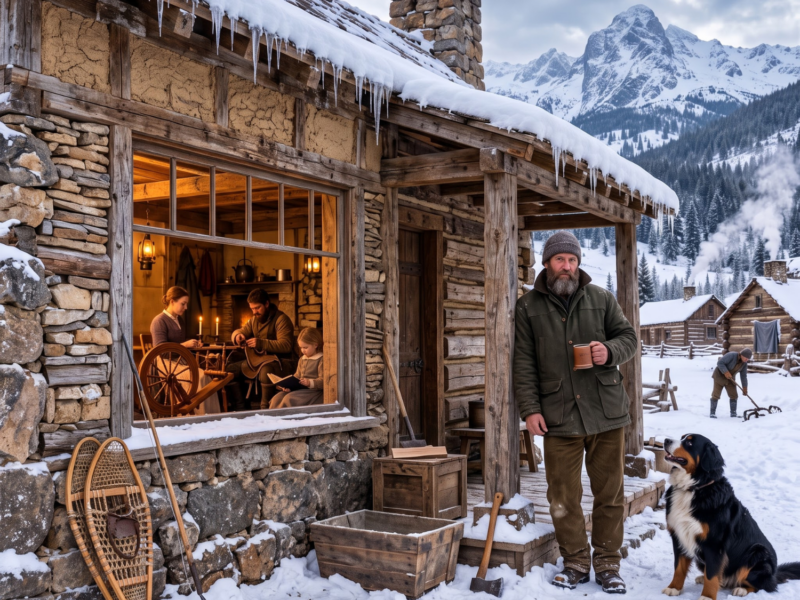
They Called Him Crazy for a Double Stone Wall Cabin — It Stayed 62°F Warmer Than His Neighbors
The Mason of the Carpathians
Elias Vane was a man who seemed to have been carved directly from the bedrock of the earth. He possessed a quiet, deliberate nature that stood in stark, unsettling contrast to the nervous, frantic energy of his new neighbors.
He was an immigrant from the deep, shadowed valleys of the Carpathian Mountains in Eastern Europe—a place where winter was not merely a season to be endured, but a reigning, absolute monarch that demanded absolute respect and meticulous, year-round preparation.
Elias did not speak often. When he did, his words were heavily accented, laconic, and strictly purposeful. He was a man of medium height, but his shoulders were immensely broad, and his hands were thick, heavily calloused, and scarred, with knuckles that looked like polished walnuts.
He possessed a highly specialized, old-world knowledge. It was an intimate understanding of stone, earth, and temperature that had been passed down through generations of masons and builders who had survived centuries of brutal alpine winters.
Where the other settlers looked at the Wyoming landscape and saw a desolate, terrifying wasteland, Elias looked at the rocky outcroppings, the deep soil, and the angle of the sun, and he saw a puzzle. A puzzle waiting to be solved through the application of ancient, immutable physical principles.
While the other newly arrived families immediately set about frantically felling trees and throwing up hasty timber frames in a desperate race against the coming autumn, Elias Vane did nothing of the sort.
Instead, he spent his entire first month living in a simple, freezing canvas tent.
He spent his days walking the perimeter of his homestead with a slow, measured gait. He spent hours simply observing the prevailing direction of the wind, watching how the dust moved. He noted exactly how the snowdrifts from the late spring squalls formed, and where they lingered longest behind the natural rises in the terrain. He dug deep holes into the earth just to feel the temperature of the subsoil with his bare hands. And he spent days inspecting the vast fields of glacial till, the scattered boulders of dense, gray granite, and the crumbling outcroppings of sedimentary limestone that littered the area.
The community of Blackwood Creek watched him with growing unease, which quickly turned into quiet mockery. They whispered at the general store that the foreigner was lazy. That he was touched in the head. That he would surely freeze to death when the November blizzards arrived, and they would have to dig his grave in the frozen mud.
Silas Thorne, the unofficial leader of Blackwood Creek, was particularly vocal in his disdain.
Silas was a man who prided himself on his pragmatic, no-nonsense approach to frontier life. He had built the largest timber cabin in the settlement—a sprawling, drafty, two-story monument to conventional thinking. He viewed Elias’s methodical, seemingly unproductive behavior as a personal affront to the hardworking, frantic ethos of the community. To Silas, sweat equaled survival. Sitting and watching the wind equaled death.
The mockery escalated from quiet whispers to open, loud derision when Elias finally began to build.
He did not hire a wagon to bring expensive timber down from the mountains. He did not buy nails at the mercantile.
Instead, he yoked his two massive, slow-moving oxen to a heavy, flat wooden sledge. And he began the grueling, backbreaking labor of hauling stone.









