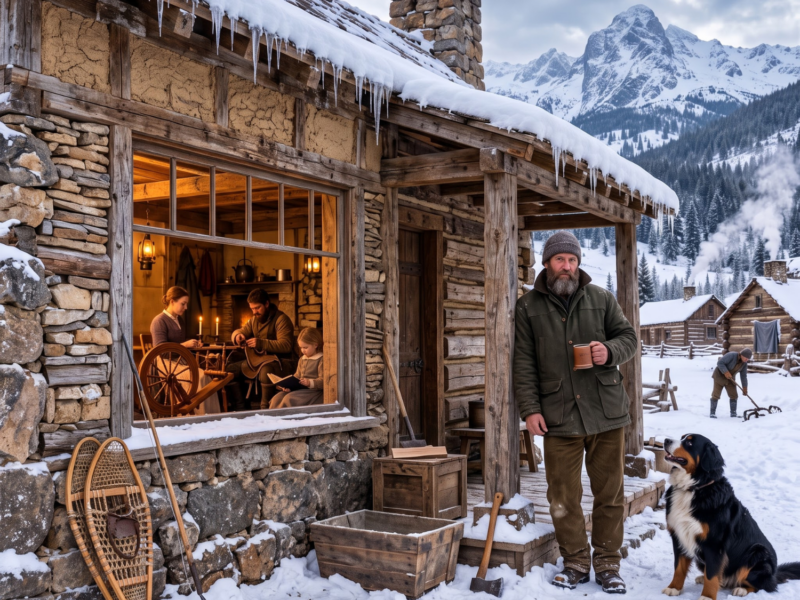
They Called Him Crazy for a Double Stone Wall Cabin — It Stayed 62°F Warmer Than His Neighbors
The Madman’s Wall
He gathered hundreds, then thousands of rocks.
He hauled the dense, heavy, gray granite that held the freezing cold of the morning deep into the afternoon. He hauled the lighter, porous, yellow limestone. He hauled smooth river rock and jagged fieldstone, piling them in massive, meticulously sorted mounds at the exact center of his claim.
He worked from the pale gray light of false dawn until the purple shadows of evening completely obscured his vision. The sheer, staggering volume of material he was gathering was far more than would be required for a simple, single-room stone hut.
When Silas Thorne rode out to Elias’s claim on a blisteringly hot afternoon in July, he sat atop his fine horse and looked down at the immigrant. Elias was covered in gray rock dust and sweat, carefully chiseling a flat face onto a massive block of granite with a heavy mallet.
Silas shook his head, a patronizing, arrogant smile playing across his lips as he prepared to deliver what he believed to be a dose of harsh, necessary frontier reality.
“You are wasting the summer, Mr. Vane,” Silas declared. His voice carried the loud, confident cadence of a man who has never once questioned his own assumptions. “A stone house in this country is a death trap. Stone holds the cold. It will draw the heat right out of your bones while you sleep. By January, that pile of rocks will be nothing but a frozen tomb, and you will be begging to sleep on the floor of my cabin near the stove.”
Silas pointed his riding crop at the distant treeline. “You need wood, man. You need timber to insulate against the wind. What you are building here is a monument to freezing.”
Elias stopped his chiseling. He slowly wiped the sweat from his brow with the back of his dusty forearm. He looked up at Silas with deep, dark, unreadable eyes.
He did not argue. He did not attempt to explain the complex thermodynamics of his plan to a man whose mind was already firmly closed and locked from the inside.
He simply looked at the massive pile of gathered stone, then back to Silas, and spoke in a quiet, rumbling voice that barely carried over the prairie wind.
“The stone remembers,” Elias said simply. “And the air holds the warm.”
Silas laughed aloud—a harsh, barking sound of genuine amusement that echoed across the empty plains. He turned his horse and rode away, eager to share the foreigner’s absolute foolishness with the rest of the men at the settlement. The stone remembers. It was the talk of the town for a week.
But Elias Vane was not building a simple stone house. Nor was he ignorant of the biting, lethal cold of the winter to come.
He was executing a masterclass in thermodynamics. He was applying a sophisticated, ancient understanding of heat transfer, thermal mass, and passive insulation that the conventional builders of his era completely, fatally misunderstood.
When he finally began to lay the foundation in late July, the true, baffling nature of his design became apparent to anyone who cared to look closely.
Elias did not dig a single foundation trench. He dug two parallel trenches, separated by a precise, continuous gap of exactly eight inches.
He began to raise not one wall, but two distinct, parallel walls of stone.









