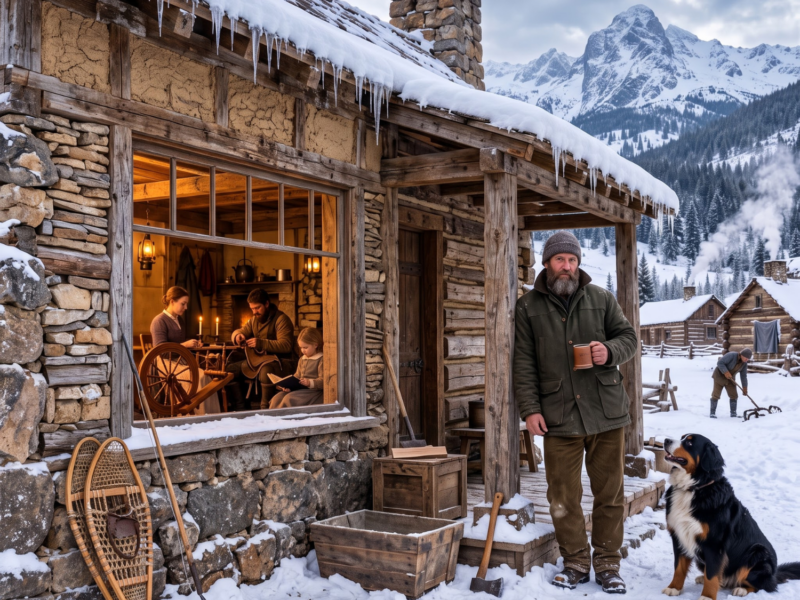
They Called Him Crazy for a Double Stone Wall Cabin — It Stayed 62°F Warmer Than His Neighbors
The Architecture of Survival
The rescue of Silas Thorne’s family was a brutal, terrifying endeavor. The wind was still fierce, the drifts deep. But they succeeded.
They brought Silas’s wife and two young children through the blinding tail end of the blizzard, dragging them wrapped in blankets through the deep drifts, and into the enveloping, miraculous warmth of the double-stone cabin.
For the next two weeks, as the region remained locked in a deep, paralyzing, sub-zero freeze, the Thorne family lived with Elias Vane.
They watched in quiet, humbled awe as Elias maintained the incredible, stable temperature of the cabin with nothing more than a few armfuls of twisted sagebrush and scrap wood, burned quickly in the morning and again in the evening.
They experienced firsthand the profound, physiological difference between the aggressive, localized, drying heat of an iron stove, and the gentle, pervasive, radiant warmth of thermal mass. They slept soundly, without shivering once, while the wind howled impotently against the outer granite shield.
When the thaw finally arrived in late March, turning the frozen plains into a sea of deep, clinging mud, the story of Elias Vane’s double-stone cabin spread through the settlement of Blackwood Creek like wildfire.
The community, which had spent the winter shivering in absolute misery, burning through their life savings to buy imported coal and battling constant, debilitating illness, looked at the immigrant with entirely new eyes.
He was no longer the foolish foreigner who wasted his summer hauling rocks. He was a master builder. He was a man who possessed a secret, ancient knowledge that had completely conquered the terrifying Wyoming winter.
And his most fervent, vocal, and powerful advocate was none other than Silas Thorne.
Silas, deeply humbled and forever changed by his near-death experience, became an absolute evangelist for Elias’s methods. He stood up at the spring town meeting, facing a gathering of gaunt, exhausted, coughing settlers, and publicly, loudly admitted his own foolishness.
He described the terrifying, creeping frost of his expensive timber cabin. He described the agonizing consumption of his fuel. And he described the profound, life-saving warmth of the dead airspace and the masonry heater. He used his substantial influence and standing in the community not to mock, but to educate.
“We have been building like fools,” Silas declared to the silent, rapt crowd. He pointed a thick finger toward Elias, who stood quietly in the back of the room, looking uncomfortable with the attention. “We brought the soft, wooden houses of the East to a land that requires armor.”
Silas struck the podium. “Mr. Vane did not just build a house. He built a machine for living. He used the earth. He used the stone. And he used the empty air itself to defeat the wind. We must learn from him, or the next great winter will bury us all.”
The transformation of Blackwood Creek over the next decade was slow, laborious, but undeniable.
The hastily built, single-wall timber cabins were gradually abandoned, torn down, or repurposed as drafty barns for livestock. In their place, the settlers began to gather stone.
They learned to lay the heavy granite outer walls. They learned to meticulously, precisely leave the continuous gap for the dead airspace. And they learned to build the inner walls of softer, heat-absorbing limestone.
Elias Vane, the once-mocked immigrant, became the most respected man in the territory. He did not charge exorbitant fees for his knowledge. He did not hold patents. He simply taught anyone willing to put in the labor the ancient, immutable laws of thermodynamics.
He taught them how to build the winding baffles of the masonry heaters. He taught them how to orient their small windows strictly to the southern sun to capture passive solar heat. And he taught them how to seal their heavy doors against the insidious drafts.
The settlement of Blackwood Creek ceased to be a place of perpetual siege. It became a fortress of quiet, enduring warmth. And the wind, though it still howled down from the Laramie Range, was no longer a killer. It was just noise outside the stone.









