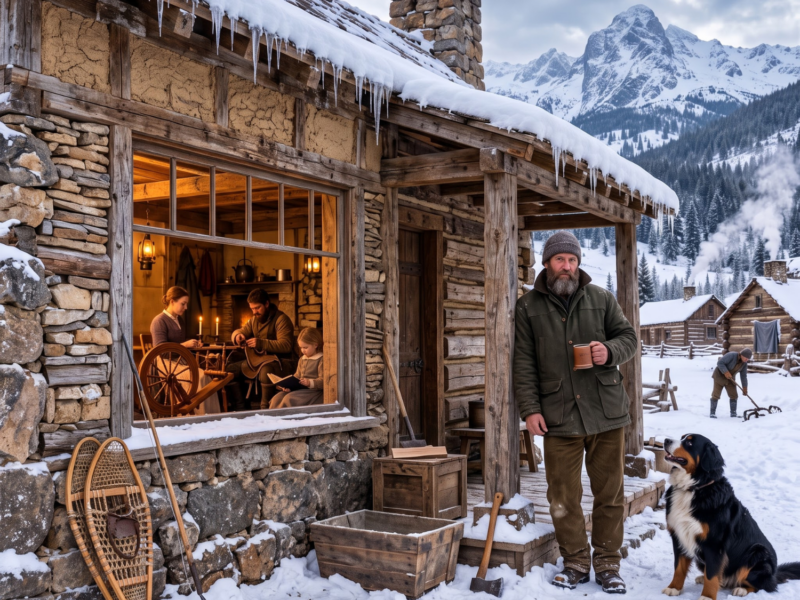
They Called Him Crazy for a Double Stone Wall Cabin — It Stayed 62°F Warmer Than His Neighbors
The Warm Stone
The stone cabin was barely visible, almost entirely buried under a massive, streamlined drift of snow that the wind had packed against the north wall.
But it was not the snow that caught Silas’s attention. It was the roof.
The thick, sod-covered roof was entirely clear of snow. It was completely melted off. And a thin, steady, almost imperceptible wisp of clear, shimmering heat was rising from the central masonry chimney.
There was no frantic, billowing cloud of black coal smoke. There was just the quiet, steady shimmer of incredibly efficient combustion.
Silas stumbled forward, his frozen boots crunching loudly on the packed snow. He threw his heavy, numb shoulder against the thick oak door. He expected it to be frozen shut, locked tight by ice against the deadly elements.
Instead, the heavy iron latch lifted smoothly, and the door swung inward with a solid, well-oiled silence.
The moment Silas crossed the threshold, he was struck by a physical sensation so profound, so entirely unexpected, that he actually staggered backward a step.
It was not the violent, aggressive, face-melting blast of heat that came from standing directly next to an overfired iron stove.
It was a gentle, enveloping, pervasive warmth that seemed to press against him from every direction at once.
He pulled the frozen scarf down from his face and gasped, taking in a deep breath of air that was comfortably warm, dry, and incredibly clean. He looked around the cabin in utter, speechless shock.
The interior was spartan, but immaculately clean. There was absolutely no frost on the inner limestone walls. In fact, the rough-hewn yellow stones seemed to glow with a soft, golden hue in the dim light of the window.
In the center of the room, the massive masonry heater stood silently. There was no roaring fire in the firebox, only a small, glowing bed of red coals. Yet, the massive stone structure was radiating a deep, powerful, heavy heat that reached effortlessly into the furthest corners of the room.
Elias Vane was sitting comfortably in a sturdy wooden rocking chair near the south-facing window, reading a small, leather-bound book in the pale sunlight.
He was not wearing a heavy coat. He was not wrapped in wool blankets. He was wearing a simple, thin cotton shirt, the sleeves rolled up to expose his thick forearms.
He looked up as the snow-covered, shivering figure of Silas Thorne stumbled into his home, leaving a trail of melting snow on the clean wooden floor.
Elias calmly closed his book, setting a piece of leather string to mark his place. He set it on a small side table and stood up. He did not look surprised. Nor did he look triumphant.
He simply walked over to a small iron kettle resting on a flat, warm ledge of the masonry heater, poured a steaming mug of dark tea, and held it out to the trembling man.
“You are cold, Mr. Thorne,” Elias said, his deep voice breaking the quiet, peaceful silence of the cabin. “Drink this. The stone will warm your bones soon enough.”
Silas took the mug with shaking, numb hands, the radiant heat from the heavy cup immediately sinking into his frozen, aching palms.
He could not stop staring at the walls. At the ceiling. At the man in the thin cotton shirt.
He looked at a small, simple glass thermometer hanging on a wooden post near the center of the room. The thin red line of mercury rested steadily, incredibly, at sixty-eight degrees Fahrenheit.
Silas knew, with the intimate, terrifying knowledge of a man who had just nearly died in it, that it was thirty below zero outside. The difference was a staggering, almost incomprehensible ninety-eight degrees.
Elias’s cabin was warmer, infinitely more comfortable, and infinitely safer than any timber structure in Blackwood Creek. And he was achieving this absolute miracle with a fraction of the fuel Silas was burning.
“How?” Silas finally managed to croak, his voice ragged from the cold and the sheer magnitude of his disbelief. “How is this possible? There is no fire. Your walls are stone. It should be a tomb. I told you it would be a tomb.”
He slumped heavily into a sturdy wooden chair. The deep, radiant heat of the room was already beginning to thaw his frozen extremities, sending painful, throbbing spikes of sensation through his fingers and toes.
He looked at Elias with wide, desperate eyes. The arrogance and mockery of the summer had been entirely stripped away. It was replaced by the raw, humbling awe of a man who realizes he has been fundamentally, dangerously wrong about the nature of the world.
Elias sat back down in his rocking chair, his movements slow and deliberate. He looked at the massive inner wall of his cabin, patting the warm limestone with a heavy, calloused hand.
“I told you, Mr. Thorne,” Elias said quietly. “The wood fights the wind, but the wind is stronger. The solid stone holds the cold, and the cold is deeper.”
He leaned forward, his dark eyes fixing on Silas. He adopted the patient, instructive tone of a master craftsman explaining a fundamental truth to an apprentice.
“But the air… the empty space between the stones. That is the shield.”
Elias patted the limestone again. “The outside wall, the granite. It takes the beating. It stops the wind. It gets as cold as the ice itself. But it does not touch this wall.”
He pointed to the window casing, showing the depth. “Between them is eight inches of nothing. Dead air. The cold cannot cross the dead air easily. It is a broken bridge.”
Elias then gestured to the massive, silent masonry heater in the center of the room.
“And this… this is not a stove to burn the air. This is a battery to catch the fire. The smoke does not run away out the chimney. It walks slowly through the stone inside. The fire burns fast, maybe two hours. But the stone…” He smiled, a small, quiet expression of profound satisfaction. “The stone drinks the heat. It holds it tight. And then, for the rest of the day, for the whole night, it breathes that heat back into the room.”
Elias sat back. “The inner wall is warm. The air gap keeps the cold away. The heat has nowhere to go but to us. It is simple, Mr. Thorne. We do not fight the winter. We use the heavy earth to hold the summer. And we wrap it in an invisible blanket.”
Silas sat in silence, drinking the hot tea, absorbing the profound, elegant simplicity of the engineering.
He realized that while he and his neighbors had been frantically burning mountains of coal to constantly replace the heat they were hemorrhaging through their drafty, uninsulated walls, Elias had built a closed system. A system that captured heat, stored it efficiently, and protected it behind an impenetrable thermal barrier.
Elias was not just “surviving” the blizzard. He was entirely immune to it. He was existing in a state of quiet, comfortable equilibrium, completely disconnected from the violent extremes of the environment outside.
Silas thought of his own family, huddled in terror around a glowing, dangerous iron box, watching the frost creep up the thin pine walls, and a deep, crushing wave of shame washed over him.
He had mocked this man. He had called him a fool, a madman, a cautionary tale. Yet here was the foreigner, sitting in a thin shirt, offering him warm tea in a house that entirely defeated the killing cold.
“My family,” Silas whispered, his voice trembling with a mixture of relief and lingering fear. “My coal is almost gone. The frost is inside the house. If the wind picks up again…”
He didn’t need to finish the sentence. Elias understood immediately.
The quiet, methodical immigrant stood up. He retrieved a heavy wool coat from a peg near the door and began pulling on his thick leather boots.
“We will go,” Elias said simply. His tone carried absolutely no judgment, no gloating, and no demand for an apology. It carried only the practical, necessary urgency of survival. “We will bring them here. The stone has enough warmth for everyone.”
Elias paused at the door, pulling on his gloves. “And when the spring comes, Mr. Thorne… perhaps we will talk about how to build a proper wall.”









