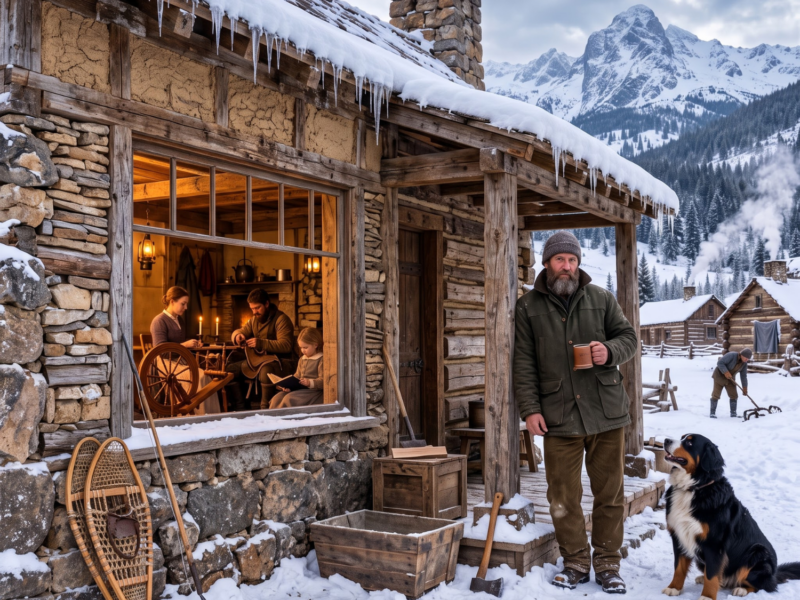
They Called Him Crazy for a Double Stone Wall Cabin — It Stayed 62°F Warmer Than His Neighbors
The Whiteout
The winter of 1884 began with a deceptive, terrifying mildness.
There was a series of cold but clear, sunny days that lulled the settlers of Blackwood Creek into a false, dangerous sense of security. They burned their expensive coal generously, keeping their drafty, single-wall timber cabins uncomfortably hot. They stripped off their heavy coats indoors, sweating, and boasted to each other at the general store about their preparedness.
But nature on the high plains is notoriously, maliciously fickle. And its wrath, when it finally arrives, is absolute.
In the second week of January, the barometric pressure plummeted with terrifying speed. The sky, usually a vast, pale, endless blue, turned a bruised, sickly shade of purple. A strange, heavy, oppressive silence fell over the land.
The livestock knew first. They grew incredibly restless, huddling tightly together against the leeward side of the fences, lowering their heads. The wild game vanished entirely into the deep draws and canyons.
The settlers finally looked to the northern horizon. They saw a solid, churning, impenetrable wall of white advancing toward them. It was a towering tidal wave of snow and wind that stretched from the earth to the heavens.
It was a great blizzard. A storm of such unprecedented ferocity that it would be burned into the generational memory of the region for a century.
When the storm hit, it did not merely arrive. It detonated.
The wind struck the settlement with the concussive force of a physical blow. It instantly tore poorly fastened shingles from roofs and sent loose buckets and tools tumbling away into the blinding white void, never to be seen again.
The temperature, which had been hovering near freezing, dropped forty degrees in less than two hours. It plunged rapidly into the deadly, bitter depths of thirty-five below zero.
The snow was not composed of gentle, drifting flakes. It was composed of microscopic, razor-sharp ice crystals that drove horizontally on sixty-mile-per-hour winds. The wind scoured the paint from wagons and found every microscopic crack and crevice in the settlers’ homes.
Inside his large, proud timber cabin, Silas Thorne suddenly found himself in a desperate, losing battle for survival.
The wind screamed through the dried, shrunken mud chinking of his log walls. It carried continuous streams of fine, powdery snow directly into his living room, piling up in small drifts on the floorboards.
The heavy iron stove in the center of the room was roaring. It glowed a terrifying, dangerous cherry red as Silas frantically shoveled in load after load of expensive coal.
But the heat was instantly stripped away by the aggressive, freezing drafts.
The physics of Silas’s failure were brutal, immediate, and undeniable. Because his walls lacked any thermal mass or insulation, the extreme cold outside conducted rapidly right through the thin pine logs. The interior surface of his walls dropped well below freezing.
The moisture from the air inside the cabin—from their own breath, and from the boiling pots of water on the stove—instantly condensed and froze upon contact with the wood. A thick, creeping layer of white frost began to grow on the inside of the cabin walls, advancing steadily, terrifyingly, toward the stove.
Silas, his wife, and their two children huddled within three feet of the glowing iron box. Their faces were burning from the intense, localized radiant heat, while their backs shivered violently in the subfreezing drafts tearing through the room. If they moved even five feet away from the stove, they could see their breath hanging in the air in thick white plumes.
They were trapped in a cruel, lethal paradox. They were simultaneously burning up and freezing to death. They were consuming their massive stockpile of fuel at an alarming, entirely unsustainable rate, just to maintain a small, desperate circle of survivability.
For three agonizing days and three terrifying nights, the blizzard raged without a single moment’s pause.
It was a whiteout of such absolute density that stepping outside the front door meant immediate disorientation and almost certain death. Silas Thorne watched in mounting horror as his massive pile of coal, which he had confidently believed would last until March, dwindled to a terrifyingly small heap. He had to keep the stove roaring at maximum capacity just to keep the frost from completely overtaking the room and freezing them in their beds.
On the morning of the fourth day, the wind finally began to lose its concussive force. It settled into a steady, mournful howl. The dense curtain of snow thinned just enough to reveal a pale, watery, heatless sun hanging low in the freezing sky.
The temperature, however, had not risen. It remained locked at a lethal thirty below zero.
Silas, exhausted to his bones, unwashed, and shivering violently despite the layers of wool wrapped around him, looked at his remaining fuel. He had enough coal for perhaps one more day. Two, if they let the room freeze to the edges.
After that, the iron stove would go cold. And the creeping frost on the walls would consume them all.
Desperation breeds a unique kind of clarity. Silas realized that he had to seek help, or his family would perish in their own home.
He bundled himself in every layer of clothing he possessed. He tied a thick woolen scarf tightly over his face, leaving only a narrow slit for his eyes. He grabbed a walking stick and forced his way out the front door, battling against a massive snowdrift that had piled halfway up his house.
The landscape was unrecognizable. It had been transformed into an alien, undulating ocean of blinding white drifts.
He decided to head toward the nearest claim, which belonged to the eccentric immigrant, Elias Vane. Silas did not expect to find Elias alive. He fully believed he would find the stone cabin transformed into the frozen tomb he had confidently predicted. He was going there, he admitted to himself, hoping only to scavenge whatever meager fuel the dead man had left behind.
The journey of half a mile took Silas over an hour. He waded through waist-deep snow, the bitter cold searing his lungs with every ragged breath, his extremities growing dangerously, terrifyingly numb.
When Silas finally crested a massive drift and laid eyes on Elias’s claim, he stopped in his tracks in sheer bewilderment.









